mercoledì 2 ottobre 2013

Giorgio Agamben: The Endless Crisis as an Instrument of Power. In conversation with Giorgio Agamben @ Verso website, 04 June 2013 (Original Interview by Dirk Schümer for FAZ)


A Latin empire against the German dominance? The Italian philosopher Giorgio Agamben explains his much-discussed thesis. Apparently, he had been misunderstood.

Professor Agamben, when you floated the idea in March of a ‘Latin imperium’ against Germanic domination in Europe, could you have imagined the powerful resonance this contention would have? In the meantime your essay has been translated into countless languages and passionately discussed across half the continent…

No, I didn’t expect this. But I believe in the power of words, when they are spoken at the right time.

Is the fracture in the European Union really between the economies and ways of life of the ‘Germanic’ north and the ‘Latin’ south?

I would like to make clear right away that my thesis has been exaggerated by journalists and therefore misrepresented. Its title, ‘The Latin empire should start a counter-attack’, was supplied by the editors of Libération and was taken up by the German media. It’s not something I ever said. How could I counterpose Latin culture to German, when any intelligent European knows that Italian culture of the Renaissance or the culture of classical Greece is today completely part of German culture, which reconceived it and appropriated it!

So, no dominant ‘Latin empire’? No uncultivated Germans?

In Europe, the identity of every culture always lies at the frontiers. A German such as Winckelmann or Hölderlin could be more Greek than the Greeks. And a Florentine like Dante could feel just as German as the Swabian emperor Frederick II. That is precisely what makes up Europe: a particularity that time and again oversteps national and cultural frontiers. The object of my criticism was not Germany, but rather the way in which the European Union has been constructed, that is, on an exclusively economic basis. So not only have our spiritual and cultural roots been ignored, but also our political and legal ones. If this was heard as a criticism of Germany, it is only because Germany, because of its dominant position and despite its exceptional philosophical tradition, appears unable at the present time to conceive of a Europe based on anything more than just the euro and economics.

In what way has the EU denied its political and legal roots?

When we speak of Europe today, we are faced with the gigantic repression of a painful and yet obvious truth: Europe’s so-called constitution is illegitimate. The text that was put through under this name was never voted by the peoples. Or when it was put to a vote, as in France and the Netherlands in 2005, it was frontally rejected. Legally speaking, therefore, what we have here is not a constitution, but on the contrary a treaty between governments: international law, not constitutional law. Just recently, the very respected German legal scholar Dieter Grimm recalled the fact that a European constitution lacks the fundamental, democratic element, since the European citizens were not allowed to decide on it. And now the whole project of ratification by the peoples has been silently put on ice.

That is indeed the famous ‘democratic deficit’ in the European system…

We shouldn’t lose sight of this. Journalists, particularly in Germany, have reproached me with understanding nothing of democracy, but they should consider first of all that the EU is a community based on treaties between states, and simply disguised with a democratic constitution. The idea of Europe as a constitution-giving power is a spectre that no one ventures to conjure up any more. But only with a valid constitution could European institutions regain their legitimacy.

Does this mean that you see the European Union as an illegal body?

Not illegal, but illegitimate. Legality is a question of the rules of exertion of power; legitimacy is the principle that underlies these rules. Legal treaties are certainly not just formalities, but they reflect a social reality. It is understandable therefore that an institution without a constitution cannot follow a genuine policy, but that each European state continues acting according to its egoistic interest – and today this evidently means above all economic interest. The lowest common denominator of unity is achieved when Europe appears as a vassal of the United States and takes part in wars that in no way lie in the common interest, to say nothing of the will of the people. A number of the founding states of the EU – such as Italy with its many American military bases – are more in the way of protectorates than sovereign states. In politics and militarily there is an Atlantic alliance, but certainly no Europe.

You’d therefore prefer a Latin imperium, whose way of life the ‘Germans’ would have to adapt to, to the EU…

No, it was perhaps rather provocatively that I took up Alexandre Kojève’s project of a ‘Latin imperium’. In the Middle Ages people at least knew that a unity of different political societies had to mean more than a purely political society. At that time, the uniting bond was sought in Christianity. Today I believe that this legitimation must be sought in Europe’s history and its cultural traditions. In contrast to Asians and Americans, for whom history means something completely different, Europeans always encounter their truth in a dialogue with their past. The past for us means not only a cultural inheritance and tradition, but a basic anthropological condition. If we were to ignore our own history, we could only penetrate into the past archeologically. The past for us would become a distinct life form. Europe has a special relationship to its cities, its artistic treasures, its landscapes. This is what Europe really consists of. And this is where the survival of Europe lies.

So Europe is first of all a life form, a historical life feeling?

Yes, that is why in my article I insisted that we have unconditionally to preserve our distinctive forms of life. When they bombed the German cities, the Allies also knew that they could destroy German identity. In the same way, speculators are destroying the Italian landscape today with concrete, motorways and expressways. This does not just mean robbing us of our property, but of our historical identity.

So should the EU emphasize differences rather than harmonization?

Perhaps there is nowhere else in the world, apart from Europe, where such a variety of cultures and life forms is perceptible – at least at valuable moments. Earlier on, as I see it, politics was expressed in the idea of the Roman empire, later the Roman-German empire. The whole however always left the particularities of the peoples intact. It is not easy to say what could emerge today in place of this. But quite certainly a political entity by the name of Europe can only proceed from this awareness of the past. It is precisely for this reason that the present crisis strikes me as so dangerous. We have to imagine unity first of all under an awareness of differences. But quite contrary to this, in the European states, schools and universities are being demolished and financially undermined, the very institutions that should perpetuate our culture and arouse living contact between past and present. This undermining goes together with a growing museumification of the past. We have the beginning of this in many cities that are transformed into historical zones, and in which the inhabitants are forced to feel themselves tourists in their own life world.

Is this creeping museumification the counterpart of a creeping impoverishment?

It is quite clear that we are not just faced with economic problems, but with the existence of Europe as a whole – starting with our relationship to the past. The only place in which the past can live is the present. And if the present no longer perceives its own past as something living, then universities and museums become problematic. It is quite evident that there are forces at work in Europe today that seek to manipulate our identity, by breaking the umbilical cord that still links us with our past. Differences are rather being levelled out. But Europe can only be our future if we make clear to ourselves that this means first of all our past. And this past is being increasingly liquidated.

Is the crisis that is present on all sides then the form of expression of a whole system of rule, directed at our everyday life?

The concept ‘crisis’ has indeed become a motto of modern politics, and for a long time it has been part of normality in any segment of social life. The very word expresses two semantic roots: the medical one, referring to the course of an illness, and the theological one of the Last Judgement. Both meanings, however, have undergone a transformation today, taking away their relation to time. ‘Crisis’ in ancient medicine meant a judgement, when the doctor noted at the decisive moment whether the sick person would survive or die. The present understanding of crisis, on the other hand, refers to an enduring state. So this uncertainty is extended into the future, indefinitely. It is exactly the same with the theological sense; the Last Judgement was inseparable from the end of time. Today, however, judgement is divorced from the idea of resolution and repeatedly postponed. So the prospect of a decision is ever less, and an endless process of decision never concludes.

Does this mean that the debt crisis, the crisis of state finance, of currency, of the EU, is never ending?

Today crisis has become an instrument of rule. It serves to legitimize political and economic decisions that in fact dispossess citizens and deprive them of any possibility of decision. In Italy this is very clear. Here a government was formed in the name of the crisis and Berlusconi brought back to power despite this being basically against the will of the electorate. This government is just as illegitimate as the so-called European constitution. The citizens of Europe must make clear to themselves that this unending crisis – just like a state of emergency – is incompatible with democracy.

What perspectives then remain for Europe?

We must start by restoring the original meaning of the word ‘crisis’, as a moment of judgement and choice. For Europe we cannot postpone this to the indefinite future. Many years ago a high official of the then embryonic Europe, the philosopher Alexandre Kojève, assumed that homo sapiens had come to the end of history and that there were now only two possibilities left. Either the ‘American way of life’, which Kojève saw as posthistoric vegetation. Or Japanese snobbery, simply going on celebrating the empty rituals of tradition now robbed of any historical meaning. I believe that Europe could however realize the alternative of a culture that remains at the same time human and vital, because it stands in dialogue with its own history and thereby acquires new life.

Europe, understood as culture and not only as economic space, could therefore provide an answer to the crisis?

For more than two hundred years, human energies have been focused on economics. Many things indicate that the moment has perhaps arrived for homo sapiens to organize human action afresh, beyond this single dimension. Old Europe can precisely make a decisive contribution to the future here.

Translated from German. Visit FAZ website, 24 May 2013, to read the original article.

Giorgio Agamben: La crisi perpetua come strumento di potere. Conversazione con Giorgio Agamben @ Il lavoro culturale website (Intervista originale a cura di Dirk Schümer per la FAZ)


La crisi perpetua come strumento di potere. Conversazione con Giorgio Agamben

Intervista uscita in tedesco a cura di Dirk Schümer il 24 maggio 2013 sul  Frankfurter Allgemeine Zeitung e poi pubblicata in inglese dalla casa editrice Verso il 4 giugno 2013. La traduzione è di Nicola Perugini.  
Professor Agamben, quando lo scorso marzo ha proposto l’idea di un “impero latino” contro il dominio tedesco in Europa, s’immaginava che questa idea avrebbe avuto una tale risonanza? Nel frattempo il suo saggio è stato tradotto in molte lingue e discusso appassionatamente in mezzo continente…
Giorgio Agamben: No, non me lo aspettavo. Ma credo nella forza delle parole, quando sono pronunciate al momento giusto.
La frattura dentro l’Unione Europea è davvero una frattura tra economie e modi di vita “germanico” del nord e “latino” del sud?
G.A.: Vorrei chiarire il fatto che la mia tesi è stata esagerata dai giornalisti e quindi fraintesa. Il titolo del mio articolo, “L’impero latino al contrattacco!”[1], è stato scelto dalla redazione di Libération ed è stato ripreso dai media tedeschi. Non ho mai utilizzato quella frase. Come potrei contrapporre la cultura latina a quella tedesca, quando qualsiasi europeo dotato d’intelligenza sa che la cultura italiana del Rinascimento o della Grecia classica sono oggi parte integrante della cultura tedesca, la quale le ha riformulate e se n’è appropriata!
Dunque non è una questione di “impero latino” dominante o di tedeschi ignoranti?
G.A.: L’identità di ogni cultura europea è un’identità di frontiera. Un tedesco come Winckelmann o Hölderlin potrebbe essere più greco dei greci. E un fiorentino come Dante potrebbe sentirsi tedesco quanto l’imperatore Federico II di Svevia. Questo è ciò che caratterizza l’Europa: una particolarità che non smette di oltrepassare le frontiere nazionali e culturali. L’oggetto della mia critica non era la Germania, ma il modo in cui l’Unione Europea è stata costruita, vale a dire su base esclusivamente economica. Dunque, in questo processo di costruzione sono state ignorate sia le nostre radici culturali e spirituali, sia quelle politiche e giuridiche. Se ciò è stato interpretato come una critica alla Germania, è perché la Germania, a causa della sua posizione dominante e nonostante la sua eccezionale tradizione filosofica, oggi sembra incapace di concepire un’Europa fondata su qualcosa di diverso dall’euro e dall’economia.
In che senso l’Unione Europea ha negato le sue radici politiche e giuridiche?
G.A.: Quando parliamo di Europa oggi, ci troviamo di fronte all’enorme repressione di una verità tanto dolorosa quanto ovvia: la cosiddetta costituzione europea è illegittima. Il testo varato con questo nome non è mai stato votato dai popoli europei. Quando è stato messo ai voti, ad esempio in Francia e Olanda nel 2005, è stato rifiutato con forza. Quindi, dal punto di vista legale, ciò che abbiamo non è una costituzione, bensì un trattato concordato tra governi: diritto internazionale, non diritto costituzionale. Recentemente un esperto tedesco di diritto molto rispettato come Dieter Grimm ci ha ricordato che la costituzione europea manca di un elemento democratico fondamentale, poiché ai cittadini europei non è stata concessa possibilità di esprimersi in merito. E ora l’intero progetto di ratifica popolare è stato congelato.
È proprio questo il famoso “deficit democratico” del sistema europeo…
G.A.: Non dovremmo perdere di vista questo elemento. I giornalisti, soprattutto in Germania, mi hanno accusato di non capire nulla di democrazia, ma farebbero bene a prendere in considerazione il fatto che l’Unione Europea è innanzitutto una comunità fondata su trattati tra stati camuffati con una costituzione democratica. L’idea di Europa come potere costituente è uno spettro che nessuno si azzarda più a evocare. Tuttavia è solo con una costituzione valida che le istituzioni europee potrebbero riacquisire legittimità.
Questo significa che lei vede nell’Unione Europea un’entità illegale?
G.A.: Non illegale ma illegittima. La legalità è una questione di regole con cui si esercita il potere; la legittimità è il principio che sta alla base di queste regole. I trattati legali non sono mere formalità poiché riflettono una realtà sociale. Per cui è chiaro che un’istituzione senza una costituzione non può seguire politiche sincere, e che ogni stato europeo continua ad agire secondo interessi egoistici – e oggi ciò significa chiaramente interessi economici. Il minimo comun denominatore di questa comunità si manifesta in maniera chiara quando l’Europa agisce come un vassallo degli Stati Uniti e prende parte a guerre che non sono fondate su alcun interesse comune, né sulla volontà dei popoli. Alcuni stati fondatori dell’Unione Europea –come l’Italia, con le sue molte basi americane– assomigliano più a dei protettorati che a degli stati sovrani. Nelle questioni politiche e militari c’è un Alleanza Atlantica, ma certamente non un’Europa.
Dunque lei all’Unione Europea preferirebbe un imperium latino, al cui stile di vita i “germanici” dovrebbero adattarsi…
G.A.: No, forse ho ripreso il progetto di “imperium latino” di Alexandre Kojève in maniera provocatoria. Nel Medio Evo quanto meno le persone sapevano che l’unione di società politiche diverse doveva significare qualcosa di più che una società esclusivamente politica. A quel tempo, il legame andava cercato nella cristianità. Oggi credo che questa legittimazione vada cercata nella storia dell’Europa e nelle sue tradizioni culturali. A differenza degli asiatici e degli americani, per cui la storia significa qualcosa di completamente diverso da come noi la intendiamo, gli europei incontrano sempre la verità nel dialogo con il proprio passato. Per noi il passato non significa solo un’eredità o una tradizione culturale, ma una condizione antropologica di fondo. Se ignorassimo la nostra storia potremmo solo penetrare nel nostro passato in maniera archeologica. Il passato diventerebbe per noi una forma di vita distinta. L’Europa ha una relazione speciale con le sue città, i suoi tesori artistici, i suoi paesaggi. In questo consiste l’Europa. E in questo risiede la sua sopravvivenza.
Quindi l’Europa è innanzitutto una forma di vita, una sensazione storica di vita?
G.A.: Sì, ed è per questo che nel mio articolo ho insistito sul fatto che dobbiamo preservare le nostre peculiari forme di vita. Quando gli Alleati hanno bombardato le città tedesche, sapevano che avrebbero potuto distruggere l’identità tedesca. Allo stesso modo, gli speculatori stanno distruggendo il paesaggio italiano con il cemento, le autostrade e le superstrade. Questo non significa solo derubarci di ciò che possediamo, ma anche della nostra identità storica.
Allora l’Unione Europea dovrebbe valorizzare le differenze al posto dell’armonizzazione?
G.A.: Forse non esiste un altro posto al mondo in cui è percepibile una tale varietà di culture e di forme di vita come in Europa. A mio avviso, in passato la politica si esprimeva nell’idea di impero romano, poi di impero romano-germanico. L’insieme ha sempre lasciato intatte le particolarità dei popoli. Non è facile prevedere cosa possa emergere oggi al posto di questo modello. Ma sicuramente un’entità politica che prenda il nome di Europa non può che muovere i suoi passi dalla consapevolezza del passato. È per questa ragione che la crisi attuale mi sembra così pericolosa. Dobbiamo immaginare l’unità nella piena consapevolezza delle differenze. Invece negli stati europei le scuole e le università – quelle stesse istituzioni che dovrebbero tramandare la nostra cultura e stimolare il contatto tra passato e presente – vengono demolite ed economicamente indebolite. Questo indebolimento va di pari passo con una crescente museificazione del passato. Un processo che sta prendendo piede in molte città, trasformate in zone storiche in cui gli abitanti sono costretti a sentirsi turisti negli spazi in cui vivono.
Questa museificazione strisciante va di pari passo con un impoverimento strisciante?
G.A.: È ormai chiaro che dobbiamo far fronte a problemi la cui natura non è solamente economica. La questione è l’esistenza dell’Europa nel suo insieme –a partire dalla nostra relazione con il passato. L’unico posto in cui il passato può vivere è il presente. E se il presente non percepisce più il proprio passato come un qualcosa di vivo, le università e i musei diventano problematici. È evidente che in Europa vi sono forze che cercano di manipolare la nostra identità tagliando il cordone ombelicale che ci lega al nostro passato. In questo modo le differenze vengono cancellate. Ma l’Europa può essere il nostro futuro se chiariamo a noi stessi che questo futuro significa prima di tutto il nostro passato. Un passato che si cerca sempre più di liquidare.
Dunque questa crisi è la forma di espressione di un sistema di governo che si applica alle nostre vite quotidiane?
G.A.: Il concetto di “crisi” è ormai divenuto il motto della politica moderna, e da tempo fa parte di tutte le sfere della vita sociale. La parola stessa esprime due radici semantiche: una medica, che si riferisce al percorso di una malattia, e una teologica, che si riferisce al Giudizio Universale. Tuttavia oggi entrambi i significati si sono trasformati, annullando la loro relazione con il tempo. “Crisi” nell’antica medicina significava giudizio, il momento decisivo in cui il dottore si rendeva conto se il paziente sarebbe sopravvissuto o no. Invece l’attuale interpretazione della nozione di crisi si riferisce a uno stato permanente. Dunque questa incertezza si estende al futuro, indefinitamente. La stessa cosa vale per il senso teologico di crisi: il Giudizio Universale non era separabile dalla fine del tempo. Invece oggi il giudizio viene separato dall’idea di fine e posticipato ripetutamente. Così la prospettiva di una decisione è senza fine, un interminabile processo decisionale che non si conclude mai.
Questo significa che la crisi del debito, la crisi della finanza statale, della moneta, dell’Unione Europea, sono crisi senza fine?
G.A.: Oggi la crisi è divenuta uno strumento di governo. Essa serve a legittimare decisioni politiche ed economiche che di fatto privano i cittadini di qualsiasi possibilità di decisione. Questo è estremamente chiaro in Italia, dove si è formato un governo nel nome della crisi e Berlusconi è tornato al potere contro la volontà degli elettori. Questo governo è illegittimo tanto quanto la cosiddetta costituzione europea. I cittadini europei devono rendersi conto che questa crisi senza fine –come qualsiasi stato di emergenza– è incompatibile con la democrazia.
Quali prospettive restano all’Europa?
G.A.: Dobbiamo iniziare con la riscoperta del significato originario della parola “crisi”, intesa come momento di giudizio e scelta. L’Europa non può continuare a posticipare a un futuro indefinito. Molti anni fa il filosofo Alexandre Kojève, un alto rappresentante di ciò che poi sarebbe stata l’Europa nel suo stadio embrionale, ipotizzava che l’homo sapiens era giunto alla fine della sua storia e che erano rimaste solo due possibilità. O l’“American way of life”, che Kojève vedeva come una sorta di vegetazione post-storica. O lo snobismo giapponese, una forma di celebrazione di rituali vuoti di una tradizione privata di qualsiasi significato storico. Penso che l’Europa possa rendersi conto dell’esistenza di un’alternativa, di una cultura che rimanga sia umana sia vitale, poiché in dialogo con la sua propria storia e quindi in grado di acquisire una nuova vita.
L’Europa, intesa come cultura e non solo come spazio economico, potrebbe dunque offrire una risposta alla crisi?
G.A.: Per oltre duecento anni le energie umane europee si sono focalizzate sull’economia. Molti elementi indicano che per l’homo sapiens è giunto il momento di riorganizzare l’azione umana al di là di questa dimensione esclusivamente economica. È qui che l’Europa può offrire il suo contributo al futuro.

Evgeny Morozov: To Save Everything, Click Here: The Folly of Technological Solutionism @ Public Affairs, March 2013


Evgeny Morozov:

To Save Everything, Click Here: The Folly of Technological Solutionism


In the very near future, “smart” technologies and “big data” will allow us to make large-scale and sophisticated interventions in politics, culture, and everyday life. Technology will allow us to solve problems in highly original ways and create new incentives to get more people to do the right thing. But how will such “solutionism” affect our society, once deeply political, moral, and irresolvable dilemmas are recast as uncontroversial and easily manageable matters of technological efficiency? What if some such problems are simply vices in disguise? What if some friction in communication is productive and some hypocrisy in politics necessary? The temptation of the digital age is to fix everything—from crime to corruption to pollution to obesity—by digitally quantifying, tracking, or gamifying behavior. But when we change the motivations for our moral, ethical, and civic behavior we may also change the very nature of that behavior. Technology, Evgeny Morozov proposes, can be a force for improvement—but only if we keep solutionism in check and learn to appreciate the imperfections of liberal democracy. Some of those imperfections are not accidental but by design.

Arguing that we badly need a new, post-Internet way to debate the moral consequences of digital technologies, To Save Everything, Click Here warns against a world of seamless efficiency, where everyone is forced to wear Silicon Valley’s digital straitjacket.

From Bookforum

No one writing about technology seems to read more or faster than Morozov. Now twenty-eight and just starting his graduate work at Harvard, Morozov already grasps wide swaths of several scholarly fields and weaves them together astutely. To Save Everything, Click Here is a heavy read, and it covers a vast array of material, from how we think about privacy (poorly) to the dangers of quantifying everything we can. It serves as a sharp corrective to the complacencies of our latter-day techno-prophets. —Siva Vaidhyanathan

Review

Richard Sennett, author of The Craftsman
“This hard-hitting book argues people have become enslaved to the machines they use to communicate.  It is incisive and beautifully written; whether you agree with Morozov or not, he will make you think hard."

Bruce Sterling, author of The Hacker Crackdown
"For the brilliant dissident Evgeny Morozov, computers are like broken beach-toys on the dark, historic tides of power politics.  His new book should be bound in sandpaper and used to abrade the works of other Internet pundits."

Nassim Nicholas Taleb, distinguished professor of risk engineering at NYU-Polytechnic and author of The Black Swan and Antifragile
"A clear voice of reason and critical thinking in the middle of today's neomania.”

David Rieff, author of A Bed For the Night: Humanitarianism in Crisis
“Evgeny Morozov calls himself a ‘digital heretic,’ and he is right to do so.  Against the reigning consensus—that there is a digital fix for every social and political problem, and that thanks to the technologies that we group together for convenience’s sake as the Internet, the brave new world of the future will be one of endless, limitless improvement in every realm of life—Morozov offers a sophisticated, eloquent, and definitive rebuttal.  Technological ‘solutionism,’ he argues, is the romantic utopia of our age, and, like Communism or the free market fantasies of Reagan and Thatcher before it, it is one more god doomed to fail. In our ahistorical, gadget obsessed, and self-regarding age, Morozov’s skeptical, modest humanism will doubtless engender fierce resistance.  But  then, that is the tribute that self-delusion has always paid to reason.  Voltairean in its  lucidity, To Save Everything, Click Here is not just a brilliant book, it is a necessary one.”

Toomas Hendrik Ilves, President of the Republic of Estonia
“When it comes to anything ‘internet’ related, Evgeny Morozov is the writer who brings us  back to earth. Lubricated by snake oil, too much of what we read about the internet and the possibilities offered by modern technology is hypertext hyperbole.  In this riotous  read, Morozov continues his quest to restore empirical rationality in our own thinking  about our techno-utopian pipe-dreams.  We have become gullible to what Morozov calls solutionism, the idea that whatever complex situation we face, we can solve it simply by  finding the right algorithm, and thanks to technology we can find a solution.  We have  seen this before, with Condorcet and other thinkers of the Enlightenment, but then, as  now, too much reliance on mathematics when we are dealing with problems of people and  society leads inevitably to failure.  Today, we who live, work, and dream in cyberspace need  Morozov to keep our feet firmly planted on Terra Firma.”

Kirkus Reviews
“Can technology solve social problems? To an extent, perhaps, writes [Morozov]. But for every Utopian application of a computer, dystopia awaits: Technology may afford hitherto disenfranchised or at least undercounted people an equal voice, but inside the world of clicks, likes and read-throughs lurk dragons…. Healthy skepticism…and a useful corrective for those who believe that we’ll somehow engineer ourselves out of our current mess.”

John Gray, author of Straw Dogs
“A devastating exposé of cyber-utopianism by the world's most far-seeing Internet guru”
 
Brian Eno
“Evgeny Morozov is the most challenging - and best-informed - critic of the Techno-Utopianism surrounding the Internet. 

Evgeny Morozov (@evgenymorozov) is the author of The Net Delusion: The Dark Side of Internet Freedom, a New York Times Notable Book of 2011 and winner of Harvard’s Kennedy School’s 2012 Goldsmith Book Prize. He is a contributing editor to The New Republic. His articles have appeared in the New York Times, the Financial Times, the Economist, the Wall Street Journal, the London Review of Books, and many other publications. His monthly column comes out in Slate, Frankfurter Allgemeine Zeitung (Germany), El Pais (Spain), Corriere della Sera (Italy), and several other newspapers. He was born in Belarus.

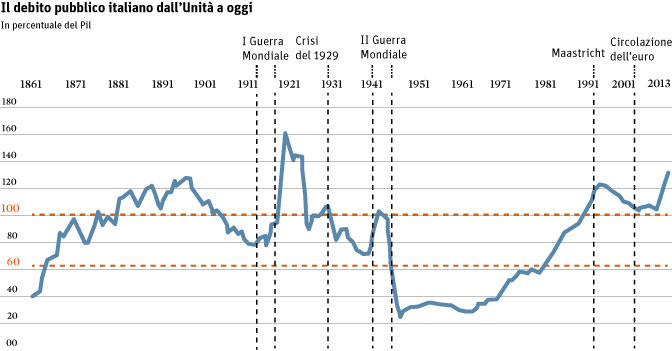
Il debito pubblico italiano dall'Unità a oggi @ Il Sole 24 ore - Enrico Marro/Debito pubblico mai così alto dal 1925. Dalle guerre coloniali al boom, ecco l'altalena del nostro "passivo"


Ecco l'andamento del debito pubblico italiano dal 1861 a oggi, con le serie storiche ricostruite grazie a uno studio della Banca d'Italia (Il debito pubblico italiano dall'Unità a oggi. Una ricostruzione della serie storica). Sono chiaramente visibili tre "picchi": quello dell'ultimo ventennio dell'Ottocento, quello ripidissimo del primo dopoguerra e l'impressionante salita iniziata negli anni Settanta e diventata particolarmente "ripida" negli anni Ottanta del secolo scorso. 

Debito pubblico mai così alto dal 1925. Dalle guerre coloniali al boom, ecco l'altalena del nostro "passivo" di Enrico Marro - Il Sole 24 Ore - leggi su http://24o.it/f3B2e Read more

martedì 1 ottobre 2013

The Wretched of the Screen Hito Steyerl @ E-flux journal - September 2012


The Wretched of the Screen Hito Steyerl 
@ E-flux journal - September 2012
Read more


In Hito Steyerl’s writing we begin to see how, even if the hopes and desires for coherent collective political projects have been displaced onto images and screens, it is precisely here that we must look frankly at the technology that seals them in. The Wretched of the Screen collects a number of Steyerl’s landmark essays from recent years in which she has steadily developed her very own politics of the image.
Twisting the politics of representation around the representation of politics, these essays uncover a rich trove of information in the formal shifts and aberrant distortions of accelerated capitalism, of the art system as a vast mine of labor extraction and passionate commitment, of occupation and internship, of structural and literal violence, enchantment and fun, of hysterical, uncontrollable flight through the wreckage of postcolonial and modernist discourses and their unanticipated openings.
With Introduction by Franco “Bifo” Berardi
Edited by Julieta Aranda, Brian Kuan Wood, Anton Vidokle

Contents
Preface
Introduction
In Free Fall: A Thought Experiment on Vertical Perspective
In Defense of the Poor Image
A Thing Like You and Me
Is a Museum a Factory?
The Articulation of Protest
Politics of Art: Contemporary Art and the Transition to Post-Democracy
Art as Occupation: Claims for an Autonomy of Life
Freedom from Everything: Freelancers and Mercenaries
Missing People: Entanglement, Superposition, and Exhumation as Sites of Indeterminacy
The Spam of the Earth: Withdrawal from Representation
Cut! Reproduction and Recombination


Nicolas Duvoux: The Empirical Sociology of Critique. An Interview with Luc Boltanski @ Books and Ideas, 14 February 2012


Read more @ Books and Ideas

Sociologist Luc Boltanski situates his most recent publications and their main concepts within his broader intellectual trajectory, examining critical sociology and the sociology of critique, and what they can tell us about today’s social situation.


Books and Ideas: Luc Boltanski, you are a sociologist, a professor at the EHESS, [1] and you are well known for having directed and participated in numerous projects over several decades. This interview gives us an opportunity to reflect on two works that you recently published. First, Rendre la réalité inacceptable (Making Reality Unacceptable) is a short book in which you look back at the creation of Actes de la recherche en sciences sociales. The book was published on the occasion of the republication of an article that you co-wrote with Pierre Bourdieu, entitled “The Production of the Dominant Ideology.” The other book, On Critique, considers a series of tools and concepts for rethinking the connection between two clearly identifiable periods of your career. The first stage was that of critical sociology, in which you participated on Pierre Bourdieu’s team as one of his most industrious researchers. The next period was that of a sociology of critique, marked by the founding of the GSPM, [2] in which you reinvented a number of tools for understanding the place of critique in contemporary society. A first and very simple question is: what were you trying to do in these two books? Are you returning to critical sociology, or are you taking stock of your intellectual itinerary, which has gone through several stages? How do you interpret this gesture of republishing and returning to different epochs of your career?

The Critique of Critique

Luc Boltanski: There are several answers to your question. The first is to borrow a phrase from Albert Hirschman that I like very much (I like him, his work, and the phrase): “a tendency towards self-subversion.” I think that I have a pronounced tendency towards critique—towards critique in general, the critique of my friends, and self-critique or self-subversion. And I hate dogmatism. I think that nothing is as opposed to science and intellectual activity as dogmatism. The turn that we made in the mid-eighties, by creating a small group, which included people who had worked with Bourdieu, was an anti-dogmatic turn, not a political one. We were not trying to critique critique, though our actions were often interpreted that way. I think this is part of the reason for the hostility that our work elicited. Some took us to task, saying: “Ah, they’re abandoning critique, they are against critique, they’re turncoats, they’ve become free marketeers, and so on.” Others, to the contrary, said: “That’s great! They have shown that critique is finite, that we had arrived at a post-critical era, etc.” Those are almost exactly the words that were used. But both reactions were completely off the mark. Our problem was sociology. It was to fight against what was becoming, after the creativity of the seventies, a kind of dogmatism, a kind of intellectual routine. We wanted to reopen a number of theoretical problems in sociology that had, in my mind, yet to be resolved. It is important to shed light on problems, even when one does not manage to resolve them.
The status of the two books you mention is somewhat different. The first,Rendre la réalité inacceptable, is a book I wrote for young people—students, but also young people who are not students. I will perhaps return to this point. I wanted to convey to them what it means to work freely, to invent, to be ironic—I am a strong believer in irony—particularly in the years following May 68. I also wanted, at the same time, to republish “The Production of the Dominant Ideology.” First, I had a lot of fun being involved in the writing of that long article. I created a “Dictionary of Received Ideas” for the time, which was a rather enjoyable task. But it also struck me as useful to republish the article, both for historical reasons and to shed light on the political era in which we presently find ourselves. The texts that it analyzes—those of Giscard, Poniatowski, or of contemporary economists—lie at the frontier of two outlooks: between, on the one hand, what at the time was called “technocracy,” which was still deeply statist, still deeply tied to the idea of economic planning, rationality, and industrialization; and, on the other—I’m using big words to simplify things—neoliberal forms of governance. It is very illuminating to return to the middle of the seventies if one wants to undertake the archaeology of the Sarkozian political universe, which has considerably expanded neoliberal policies while dressing them up, at times, in so-called “republican” rhetoric. And, at a personal level, I wanted to clarify, perhaps because I’m getting older and I don’t want to bring a bunch of old, vain quarrels before Saint Peter, my relationship with Bourdieu, which was a very close one—asymmetrical, of course, because I was his student, but also a true friendship—one that, I think, went both ways.
On Critique is a little different. It is a theoretical book. It is the first time that I have written a theoretical book that is not tied to investigative work. It is, in a sense, the theory that underlies The New Era of Capitalism. I sought to build a framework that integrated elements connected to critical sociology and elements relating to the sociology of critique. You could say, if you like, that it is Popperian. Last weekend I was rereading some texts by Popper for a book that I’m currently writing. I am far from being Popperian at all levels, but I am in complete agreement with the idea that scientific work consists of establishing models that start from a particular point of view, even though one is fully aware that this point of view is local. The important thing is not to try to expand this local point of view by applying it to everything, which is one of the primary causes of dogmatism. But one can try to build broader frameworks, in which the previously established model remains valid, on the condition that the scope of its validity is specified. In a nutshell, what worried us most about Bourdieusian sociology as it had developed was the outlandish asymmetry between, on the one hand, the great, clairvoyant researcher and, on the other, actors who were steeped in illusion. The researcher was seen as enlightening the actor. Rancière made the same critique.

Combining Structuralism and Phenomenology

Books and Ideas: Yes, he does so in The Philosopher and His Poor, which you mention. There is this asymmetry and then—to leap directly into the debate between critical sociology and the sociology of critique—there is another issue that you discuss in On Critique. Basically, when one has a theory of domination that encompasses everything, one no longer sees domination in any particular place. When domination is everywhere, it is nowhere. Could you reflect on this gesture of discerning the spaces from which domination is practically exercised? The turn to a sociology of critique has been interpreted as an abandonment of the problematic of domination, whereas it seems, from reading On Critique, that something else is at stake.
Luc Boltanski: I think that it is closely tied to another problem that lies at the very heart of sociology and that deeply preoccupied Bourdieu—which he tried to resolve without, in my view, really succeeding. It is a problem that, moreover, has yet to find a genuinely satisfying solution. It goes more or less like this. You can approach social reality from two perspectives. You can take the point of view of someone newly arrived in this world, to whom you will describe this reality. This requires a panoramic point of view, a historical narrative, reference to large entities and collectivities, which may or may not have juridical definitions: states, social classes, organizations, etc. Some will speak of references to structures. A perspective of this kind will tend to shed light on the stability of social reality, on the perpetuation of its asymmetries (to use Bourdieu’s language), on reproduction, and on the great difficulties actors encounter in altering their social destiny or—more difficult still—in transforming structures. But you can also adopt another perspective, which is called the sociology of the actor, that consists of adopting the point of view of someone who acts in the world, who is immersed in situations. No one acts within structures, we all act in determinant situations. And there, you no longer find yourself confronted with actors who, as it were, passively endure reality, but with creative individuals, who calculate, have intuitions, deceive, are sincere, have competencies, and act in ways that modify their immediate reality. No one, in my mind, has found a really convincing solution to combining these two approaches. Yet they are both necessary in making sense of social reality.
One could try to formulate this problem in terms of the relationship between structuralism and phenomenology. I tried to articulate these two approaches inLa condition fœtale, starting with the question of breeding and abortion. I am not sure that it was particularly satisfying. Bourdieu tried to combine these two approaches. Before discovering the social sciences, he wanted to devote himself to phenomenology. For him, this articulation depends on the theory of the habitus, towards which I have a number of theoretical reservations. It is a theory that is derived, in large part, from cultural anthropology, as it was developed by anthropologists like Ruth Benedict, Ralf Linton, and Margaret Mead. I recently reread Patterns of Culture by Ruth Benedict, and it is quite strange to see, from a contemporary perspective, how she uses categories drawn from Nietzsche or Spengler. Her main idea is that one can identify cultures that have specific traits—personalities, if you will—and that these personalities will reappear in the psychological dispositions—i.e., in the personalities—of the individuals who are immersed in these cultures. It is a rather bizarre construction, one that becomes circular, so that if you know an actor’s cultural location, as defined by sociology and statistics, you know her dispositions and you know, in advance, how this actor will react in any given situation. It is against this position that we took a stand. But we also wanted to avoid a different model, established in opposition to the cultural model, which, without the help of phenomenology but drawing on neoclassical economics, acknowledges only individuals. According to the Popperian model, known today as methodological individualism, only individuals exist. Each individual has her own motives and makes her own choices, and it is from the aggregation of these various motives (which occurs in ways that are not explained) that historical causality is derived, be it a micro-history of situations or economic or political macro-history. In this model, which sees only individuals, it is forbidden to confer intentionality onto entities that are not individual beings. On the face of it, this seems reasonable. Social groups—political groups or social classes, for instance—cannot be the subjects of action verbs. But, in my view, one problem with this model is that it cannot account for the fact that it is not only sociologists who refer to macro-sociological entities. Everyone does. Actors cannot construct social reality without inventing institutions and collective entities, which they know, at a certain level, are fictions, but which they nonetheless require to make sense of what is happening—that is, history.
Our way of approaching the question of action has taken a hyper-empirical turn. We took our inspiration from currents in Anglo-Saxon pragmatism. In our work with Bourdieu, these currents were far from unknown. We had, for example, read Austin, and many authors tied to analytic philosophy. We were very familiar with interactionism and Goffman’s work. It was, incidentally, Bourdieu who first had Goffman translated and introduced him in France. But compared to what occurred in Bourdieu’s group, we radicalized this approach. Our intention was to develop an empirical sociology of critique. To this end, we chose disputes as our principal object of study, as it is through disputes that actors display their critical capacities. We wanted to do fieldwork on disputes that was as precise as possible, approaching them from a position of uncertainty. In other words, we considered—and in this we were very influenced by what Bruno Latour and the anthropology of sciences were doing at the time—all the arguments made in the course of a dispute, in a symmetrical way. For the new anthropology of science, one must not, for example, study the Pasteurian crisis by assuming that Pasteur was right and his adversaries were wrong, but to proceed as if one was faced with two competing theories that had to be treated equally in terms of description, rather than assuming, retrospectively, the position of the theory that won. We adopted the same approach when considering disputes in our fieldwork. We considered major controversies or minor disputes occurring in offices or companies, closely examining the critical capacities of the actors, with the goal of reconstructing a critical theory, somewhat like Dewey, on the basis of the critical experiences of the actors themselves.

The Making and Unmaking of Social Classes

Books and Ideas: We’ll return to the question of uncertainty, which lies at the heart of On Critique, as your thinking on institutions is connected to the notion of uncertainty. First, in order to understand what is at stake in the historical trajectory marked by the different stages of your thought, there is one social structure which you mention that plays a distinct role in both books: social class. In essence, a major part of your thinking about historical change in recent decades has consisted of saying: we are witnessing a decline, a quasi-disappearance, of entities that, thirty years ago, were considered almost natural. This has political consequences, both in terms of how ideology is formed and in terms of how sociology itself is formed. You say in On Critique that the turn to a sociology of critique and the return—I am not sure if “return” is the best word—the search for a rearticulation, is entirely connected to the presence or absence of social classes in our social world. Are we simply left with the assessment that social classes have nearly disappeared as structuring entities that are worked into the state apparatus, or do you see a revival of forms that actors might latch onto to escape their confining individualism?
Luc Boltanski: I would just like to point out one thing: the logic of scholarly research is not the same as the logic of politics. In the mid-eighties, it was less that we thought that social classes were no longer relevant than that we concluded they were no longer interesting fields of research. When authors have dealt with an issue thoroughly—you find the same thing with novels—you have to move onto another topic. To take a completely different example, after Bataille, it was no longer very interesting to write erotic literature, as he went as far as one could go. You have to move onto other topics. Well, it’s the same for research. I felt, particularly after the publication of Bourdieu’s Distinction, that an analysis of social classes relying on the concept of habitus was not a terrain on which my generation would make new discoveries, on which it might innovate. I remember that the English translator of The Making of a Class [3] told me that he found it difficult to translate “habitus.” I told him: no problem, pal, there’s no “habitus” in The Making of a Class. It was important to adopt different approaches, to interest oneself in other things. The Making of a Class is indeed a book on the formation of social classes, but which approaches them through their political genesis. I should add that this turn occurred at the historical moment when the socialists had come to power, after Mitterrand’s election. Basically, we thought, very naively, that certain things could now be taken for granted politically and that, by the same token, we were freed from the tiresome task of having to repeat incessantly that capitalists exist, that inequalities exist, that domination exists, etc. For the left, it was a rather optimistic period, even if, after the fact, one might think that we were mistaken.
To return to social classes, it is, as you know, an extremely complicated concept, because on the one hand it is a critical concept, oriented to the normative horizon of the disappearance of classes. Considered from this perspective, the description of exploited or dominated social classes is primarily negative. On the other hand, it is a positive concept that seeks to arm you for struggle, because if you describe people only in a negative way, you can’t arm them for struggle. This was a common practice of the Communist Party. You must show how poor, miserable, and oppressed the proletariat is. But you must also show that it is courageous and resistant and that it has its own values which underpin its dignity. Also, something happened in France in particular that did not occur in Great Britain to the same extent, nor in the United States.
After the Popular Front, in 1936, and after the establishment of the welfare state, in the postwar years, a political system was set up that tried to integrate social classes into the representation of the political order, to make them official, and to give them a role in the construction of the political collectivity. Until then, in France, the collectivity had been conceived in what we might call Rousseauist terms, that is, as composed of “pure” citizens, defined with no reference to their proprieties or interests, as “men without qualities,” if you like. This occurred somewhat along the lines of corporatism, while preserving the critical aspect of social classes, as well as, in part, their antagonistic character. By the same token, references to social classes became complex. It was simultaneously a critical notion and a concept used to describe the institutions of the welfare state. Social classes were also integrated into actors’ mental categories. In the early eighties, Laurent Thévenot and I wrote a study (that appeared in English) entitled “Finding One’s Way in Social Space.” [4] Our approach was through exercises that were almost games, carried out in groups. We showed how the socio-professional categories of the INSEE, [5] which were invented in 1936 following the establishment of the welfare state, had equivalents in the actors’ own cognitive categories. They were tools for defining one’s own identity and for identifying others. If you look at films from the seventies, like those of Claude Sautet, you see that in a way they are “Bourdieu Light”: you have specific milieus, people who have a specific personality because they belong to these milieus or to a social class, etc.
What happened in sociology in the eighties was that people said: these things have been established, we’re going to think about something else. It’s not that they’re wrong, but we’re going to go a step further, to understand how people construct these categories, how they have other ones, particularly by considering the phenomena of disadjustment that was starting to destroy the coherence of social classes as they had been established institutionally through the relationship between market and work, the system of classification, the world of schools, INSEE classifications by way of collective bargaining agreements, etc.
But, that said, the profound changes shaping the social world have been neglected. There has been another phenomenon, tied to changes in capitalism and in politics: the dismantling both of the critical force implicit in the notion of social class and of its institutional character as a tool for grasping the political world. To put things in slightly complicated terms, what I studied in The Making of a Class, without realizing it, was the establishment in the fifties of a very rigid boundary between, on the one hand, the labor movement and the world of labor, and, on the other hand, everything else. This is when the boundary hardened. Everyone else became known as cadres—managers—a word that lumped together workers who had become self-educated foremen and great industrialists trained at elite schools who had become corporate employees and which managed to make a reality out of this assemblage composed of people who belonged to the same entity but were incapable of describing this entity, in which no one had the same habitus. And this was, at the time, politically and economically necessary. Later, I would say, in the eighties and even more after 1989, following the collapse of communism and the threat that socialist countries posed during the Cold War, this boundary disintegrated. During my lifetime, I have witnessed the rise of the category of “manager,” as well as its fall. This category no longer seems at all necessary. “Worker” has been replaced by “operator.” Today, there are operators and “executives” or “project managers.” As I see it, one of the major trends now underway is the implementation of a divide that is not instituted and that is a divide separating “executives”—in a nutshell, the rich, society’s upper crust—from everyone else. The reason is that one no longer has to contain the working class, which has lost, which is no longer seen as a threat, and which has, in a sense, unraveled.
Books and Ideas: There is no longer a critical force that might be integrated into a discourse.
Luc Boltanski: No. Perhaps one will come back. But you could say that, in the thirties, everyone believed in social class: social Catholics, corporatists, those who would become fascists, socialists, communists, etc. Except for liberals, everyone believed that something like social classes existed and that it was necessary to consider them and integrate them into the state. And everyone believed very strongly in the state. This was the problematic that dominated the period extending from the thirties to as late as 1970. The period that immediately followed May 68 was really the apogee of the welfare state—before Giscard, who after all was a great politician (I have a lot of admiration for Giscard, even if I naturally disagree with most of his policies), endeavored to displace the social question and to entertain the possibility of a weakening of the unions, followed by a halt to, even a dismantling of, the welfare state.
Books and Ideas: Notably by promoting—you show that this is the flip-side of the decline of class—the collectivization of questions of gender and the societal questions that took their place.
Luc Boltanski: Absolutely. And he was right to do so against the moralizing opposition of the Gaullists. With regards to social class, we have thus arrived, in sociology, at a rather bizarre situation, which, in some respects, creates a convergence between the substantialist position of Bourdieu and that of someone like Rosanvallon, when he tried to explain that classes don’t or no longer exist. When I was writing The Making of a Class, Bourdieu, who nonetheless, I think, had considerable respect for this work, would tell me that, when you get down to it, managers don’t exist, at least not as a class, since, because of its heterogeneity, the category included actors endowed with different habiti. Then, several years later, Ronsavallon referring to our research on social categories—my work, as well as that of Desrosières and Thévenot, for example—wrote that these works showed that social classes don’t exist, that they were, in a sense, artifacts. This was a misunderstanding of our work. We were trying to define what you might call an ontology of collective beings. We wanted to investigate the modalities of existence of these “inexistent beings” (as logicians call them) that are collective entities. They do not exist as individual, substantive beings do, but they exist devilishly—if I might say so—albeit in other modalities of existence. Substantialism, which, in the seventies, was often invoked to defend the existence of classes, was later used to argue for their non-existence. So a new “taken-for-grantedness” was established in the eighties and nineties. Its basic insight was the idea that we no longer live in a class society. We live in a society with a broad middle class and a little fraction of the excluded who, out of charity, must be helped, and a little fraction on the top, composed of the rich, the too rich, who should be more mindful of the public good, of “living together,” etc.—in short, more moral, and whom we must try to make moral. This was the beginning of this moral society to which we still belong. I called our group the “Political and Moral Sociology Group” as an homage to Hirschman, but, personally, I don’t like moralism.
First published in www.laviedesidees.fr. Translated from French by Michaël C. Behrent with the support of the Institut Français.
by Nicolas Duvoux & translated by Michael C. Behrent , 14 Febru

COSTAS LAPAVITSAS: FINANCIALIZATION IN CRISIS @ Haymarket, May 2013


FINANCIALIZATION IN CRISIS

edited by COSTAS LAPAVITSAS
-----------------------------------
In this important and timely volume, a number of well-known political economists draw on the insights of Marxist and other heterodox economists to argue that the turmoil of 2007 to 2009 represents a crisis of financialized capitalism that can only be understood through tracing out the structural changes in the modern global economy. Carefully examining domestic and international aspects of the financialization of capitalism over the past thirty years, the contributors persuasively demonstrate that the ongoing economic crisis commenced in the sphere of finance, spread to production, and then became a world recession.

-----------------------------------
Costas Lapavitsas is Professor of Economics at the School of Oriental and African Studies. He has published extensively on the political economy of money and finance. His publications include Social Foundations of Markets, Money and Credit. 

-----------------------------------
With Contributions From:
Carlos Morera Camacho • Paulo L. Dos Santos • Gary Dymski • Nuray Ergüneş • Makoto Itoh • Costas Lapavitsas • Juan Pablo Painceira • Demophanos Papadatos • José Antonio Rojas Nieto