mercoledì 25 settembre 2013

The poststructural anarchist. Todd May interviewed by Richard Marshall @ 3am Magazine - July 12th, 2013


The poststructural anarchist
Todd May interviewed by Richard Marshall @ 3:AM Magazine

Todd May is the poststructuralist anarchist who thinks anarchism is more than just a critique of the state, that there is more than one struggle, that Foucault, Deleuze and Lyotard are important, that postructuralism is elusive, that anarchism is bottom-up and liberalism is top-down, that ‘how might one live?’ is the down and dirty question, that Foucault’s thought will remain standing when the dust is settled, that what it means to be human is a matter of practices, that Ranciere gets him emotionally, that friendship offers a different model from neo-liberalism and that his conception is about resistance not cohesion. High Five!

3:AM: What made you become a philosopher? Were you always aware of a kind of crisis?

Todd May: Many philosophers I talk with seem to get their start in philosophy from a teacher, often a college professor, that turns them on to the subject. For me, it was different. I went to a high school in New York City during the late 1960s and early 1970s, where ideas and crisis were in the air. It was the kind of place where Melville, Faulkner, and Dostoyevsky, along with the Vietnam War, were regular staples of conversation. So early on I became interested in both ideas and political resistance. In college I studied psychology, but was never far from philosophy: I read Being and Time with a philosophy grad student. Another friend of mine, also a grad student in philosophy, gave me Merleau-Ponty’s Phenomenology of Perception as a graduation present. In the few years I took off between college and grad school, I read most of Merleau-Ponty’s work. Eventually I decided I wanted to go to grad school in clinical psychology, but wanted a phenomenologically oriented one, and so chose Duquesne University. But, as it happens, at the end of my first year there I was introduced to the work of Foucault and Deleuze, who raised unsettling questions for me about the entire project of psychotherapy. I pressed these questions in my classes at Duquesne, admittedly with the passion of which a person committed to ideas is capable, and at the end of my second year was informed that my funding was going to be cut off. So I spent a few more years reading and thinking about what is often called “poststructuralism,” and finally applied to Penn State, where I had the chance to study these thinkers more rigorously. A friend of mine who is a radical lawyer once asked me why I wanted to study philosophy if I was so interested in politics. My response, to which he offered me a mocking stare, was that I felt somehow that in order to understand and solve political problems I needed to be able to grasp their ontological underpinnings.

3:AM: You’ve written about and are associated with ‘poststructuralist anarchism.’ I think you see it as coming out of an awareness that political philosophy was in crisis following the fall of the Soviet Union which kind of made it official that Marxism was dead. Can you say something about how you understand this crisis give that for many – and yourself – the Soviet block was hardly a viable model for political change?

TM: For most traditional anarchists like Peter Kropotkin and Emma Goldman, the Soviet Union was a crisis almost from the beginning. They saw it as hierarchical in character, and in that way a continuation of the kinds of domination characteristic of capitalist society. In fact, earlier on, in his dispute with Marx, Mikhail Bakunin predicted that a Marxist takeover of the state would simply reproduce the hierarchical structure of social and political relations. AsThe Who said, “Here comes the new boss, same as the old boss.” This is where anarchism becomes associated with a critique of the state. My own reading of anarchism is, however, that it is much more than a critique of the state. It is a critique of domination in all its forms–political, economic, gender, racial, etc. So while the anarchists were certainly right about theSoviet Union, we should read their work as a more general critique of domination. Granted, this general critique is at times in the background of their work, but it is nevertheless recognizable. In this way, they differ importantly from Marx. For Marx, there is an Archimedean point of social change since there is a central point of domination: the extraction of surplus value from the workers. Therefore, there is really only a single struggle: the struggle for the ownership of means of production.
By contrast, for the anarchists there is no single struggle. As the British anarchist Colin Ward once said, there are always a series of struggles along a variety of fronts. This is where the poststructuralists, and especially Foucault, intersect with anarchism. Foucault traces historically different ways in which people become dominated. He does not reduce them to a single site or single type, but seeks to understand them in their specificity. The disciplinary power he writes about in Discipline and Punish is different from the role of sexuality he describes in the first volume of his history of sexuality, which in turn is different from the neoliberal governmentality he addresses in his lectures  The Birth of Biopolitics.  So while the nineteenth and early twentieth century anarchists were able to resist the reductionism of a Marxist program, later thinkers like Foucault, Deleuze, and Lyotard offer perspectives for theorizing the irreducibility of political relations and political struggle. That allows them to, among other things, take on board the feminist and anti-racist understandings that developed over the course of the twentieth century.
Where does that leave us in thinking about our politics? Broadly with a bottom-up view of political struggle and change. Rather than seeking the Archimedean point of struggle, we must analyze the different and intersecting facets of domination in their particularity, and struggle against them. This does not preclude top-down theorizing altogether, but it offers a framework for political reflection and action that has been neglected in much of political philosophy.

3:AM: So poststructuralist anarchism is to be understood as being framed by French poststructuralist and in particular the works of Foucault, Deleuze and Lyotard. Before coming to this trio and how they seem to offer a viable political philosophy and an alternative to Marxism can you tell us what you understand by ‘post structuralism’ and by ‘anarchism’ in this context?

TM: Poststructuralism is an elusive term. It is a bit chronological, like post-impressionism, and a bit conceptual. As chronological, it refers to the theories that arose in the wake of the heyday of structuralism. We might think of recent French philosophical history in terms of three successive movements, at least up until around the mid-1980s. There is the existentialism of the forties and fifties, which is rejected by the structuralism of the late 1950s and 1960s. And then, later in the 1960s, poststructuralism arises in part as a response to structuralism but not as dismissive of it as structuralism is of existentialism. This chronological view is a bit oversimplified. For instance, the structuralist Lacan was writing well before the 1950s, and Deleuze’s influential book on Nietzsche was published in 1962. But if we think of the prominence of the movements, this chronology offers a rough idea. Conceptually, structuralism rejects the primacy of the subject in existentialism, seeing the subject as constituted more than constituting. But for the structuralists, what constitutes the subject is more or less monolithic. For Lacan, it is the unconscious, for Levi-Strauss the structures of kinship, and for Althusser, at least in the last instance, it is the economy. Poststructuralism rejects these monolithic accounts of the structuring of the subject. For Foucault, the subject is a product of the intersection of particular practices of knowledge and power. For Deleuze, whatever actuality the subject presents carries within it a virtual field of difference that can make it very much other than it is now. Lyotard, in his turn, takes up themes in both Foucault and Deleuze during different points in his career, but in his major work The Differend offers a view of the subject as both constituted and constituting through a variety of different discursive practices. I haven’t mentioned Derrida here, who is often thought of as the central poststructuralist. However, even though he does not figure in my poststructuralist anarchism, he can also be seen as a figure who sees the subject as partially constituted by something that lies outside of it and that cannot be brought into conceptual presence, like Deleuze. Although his view of what it is that does the constituting is diverges from Deleuze’s.
As for anarchism, it is the historical movement that, theoretically at least, is rooted in the work of William Godwin and Pierre-Joseph Proudhon, articulated most clearly in the work of Bakunin, Kropotkin, Goldman, and others. It is often, as I said, associated with an anti-statist position, but in my view is better defined as a commitment to two positions: a critique of domination in all its forms and an embrace of bottom-up organizing and resistance. Viewing things this way leaves aside another strain of anarchist thought–the individualist anarchism associated with Benjamin Tucker and Max Stirner, and whose modern proponents are libertarians like Robert Nozick. However, the term anarchism is commonly thought to apply to the former more than the latter.

3:AM: Lyotard writes about the postmodern’ rather than the poststructioralist condition. Is this a distinction that matters?

TM: I have never liked the term postmodernism. If poststructuralism is a difficult term to define, then trying to capture postmodernism is like trying to stabilize mercury with your thumb. My understanding is that it was coined around 1979 by Christopher Jencks in regard to architecture. In the arts, it is often seen as a view that there is nothing new to be done, so art must recycle old themes and styles, often although not always in an ironic style. And one can see this in certain artists, like David Salle and Julian Schnabel. People claim this label for David Foster Wallace as well, but if the ironic recycling of old themes and styles is characteristic of literature, then why isn’t Joyce a postmodernist? Moreover, I don’t see any domination of what is called postmodern literature in the 1980s similar to what happened in painting or perhaps in architecture at that time. In philosophy, outside of Lyotard’s work, it is practically nonexistent. For Lyotard, postmodernism was largely what he called the rejection of grand narratives, single overarching stories that explain, say, who we are and how we got here. As a definition of postmodernism, it has resonances with my definition of poststructuralism. However, even here there are complications. For Foucault, for instance, what might be called micropolitics is a way of analyzing our historical situation, whereas for Lyotard it sometimes seems like an alternative political position to be embraced. That is, while for Foucault the move to micropolitics is analytical, for Lyotard it sometimes comes off as normative.

3:AM: What are the advantages of this approach to say Rawlsian ‘difference principle’ approaches to political theory, or Nozick’s or, say, the Critical Theorists of Adorno, Lukacs, and Habermas?

TM: The anarchist angle of approach is quite different from that of liberal theory on the one hand and Critical Theory on the other. At a first go, we might say that if anarchism is a bottom-up approach, liberalism is top-down. That is to say, liberalism starts with a set of principles (different principles for different theorists) that focus on the state, where anarchism starts with the people in the polity and asks what kind of social relations ought to obtain between and among them. This distinction isn’t entirely clean, however. It seems to me that both Rawls and anarchists share some important moral principles about how people should be treated–or if sharing is too strong, then at least there is some important overlap. Rawls, like most liberals, then tries to conceive a state that can meet the demands of those principles. Anarchists are leery of the focus on the state. They are concerned that the state, being an important site of power relationships, is not the proper focus for enacting those principles. So they turn to the people themselves, asking how people can organize themselves into a just polity.
For my own part, I think that liberalism, especially in the hands of people like Rawls and Sen, is often correct at the level of moral principle but often naive about power. This naivete happens at two levels. First, they fail to recognize many of the power games that occur at the level of the state and that preclude meeting the moral principles that they set out. In fact, if you look at many movements for justice, it is often at the level of the people that they begin: the state often does not create justice but responds to demands for justice from its people. Second, they do not recognize what seems to me a central insight of Foucault’s work: that power often works not by restriction but by production. That is, power helps produce who we are. So, for instance, one of the reasons people conform to and even endorse unjust social arrangements is that they have been inculcated into practices of normality that make these social arrangements seem natural. (That is a one-sentence and entirely superficial summary of Discipline and Punish.) This is not to say that there’s a conspiracy involved. Rather, it is to say that power often operates at the level of our daily practices, making us who we are. If this is right, then political resistance also has to focus on those practices, that is, it has to be bottom-up.
That said, unlike many anarchists, I do not oppose the state in principle. I think it is less effective in creating change than liberal theory would allow, but there does seem to me an important place for thinking about the justice of the state. So while there are advantages to the anarchist–or poststructuralist anarchist–approach to political thought, I do not believe that it is a substitute for liberalism.
As far as Critical Theory goes (and let’s keep in mind that the recent work of Habermas is probably more liberal that Critical Theoretical), it has much insight to offer. However, that insight is embedded in a largely Marxist perspective that shares the difficulties of being a single explainer theory of the kind poststructuralism rejects. So the advantage of anarchism to Critical Theory lies in its ability to take on board the insights the latter offers while not reducing political thought to the Marxist framework.


Dr. May took his Ph.D. from Penn State University in 1989, and has been at Clemson (after a brief stint at Indiana University of Pennsylvania) since 1991. He specializes in Continental philosophy, especially recent French philosophy. He has authored ten philosophical books, focusing on the philosophical work of Michel Foucault, Gilles Deleuze and Jacques Rancière. His book The Political Philosophy of Poststructuralist Anarchism has been influential in recent progressive political thought, and his work on Rancière is among the first in English. May’s writings also seek to bridge the gap between "Anglo-American" and "Continental" styles of philosophy that developed in the early twentieth century. His teaching interests are varied; he has found himself teaching classes as diverse as Anarchism, The Thought of Merleau-Ponty, Resistance and Alterity in Contemporary Culture, Secular Ethics in a Materialist Age, and Postmodernism and Art. 

Elettra Stimilli è la vincitrice del Premio Feronia 2013 nella sezione saggistica con "Il debito del vivente. Ascesi e capitalismo" (Quodlibet)


Elettra Stimilli è la vincitrice del Premio Feronia 2013 nella sezione saggistica con Il debito del vivente. Ascesi e capitalismo

Motivazione del premio 
di Aldo Mastropasqua

È assai raro che un saggio complesso e di non facile lettura come quello pubblicato da Elettra Stimilli, dal titolo in apparenza enigmatico: debito del vivente. Ascesi e capitalismo, riesca a suscitare un dibattito e un'attenzione non usuali oggi per la saggistica e soprattutto per quella filosofica. È anche per questo che un premio controcorrente come il nostro ha senza esitazioni deciso di premiarlo per la sezione Saggistica.
ll libro di Elettra Stimilli non ha una portata esclusivamente accademica - come perlopiù accade oggi per la saggistica - ma direi senz'altro che si colloca anche su un versante di ricerca militante, dal momento che si interroga e ci interroga sui rapporti attuali tra capitalismo e religione, centrali oggi in un'epoca in cui all'egemonia globale del mercato si contrappone una fortissima tensione internazionale legata a movimenti religiosi in ascesa e in espansione su scala planetaria. ll rapporto tra l'impetuoso sviluppo del capitalismo soprattutto nordoccidentale e il cristianesimo era stato - nei primi anni del Novecento - indagato con acume dall'importante studio di Max Weber L'etica protestante e lo spirito del capitalismo appunto a partire da questo saggio, che legava il capitalismo nella sua forma più moderna alla convinzione protestante - soprattutto calvinista - che la salvezza per l'uomo non si raggiungeva attraverso le opere ma attraverso la fede e che solo il conseguimento del successo economico fosse il segno di essere predestinati da Dio a essere salvati che si è sviluppato per tutto il secolo scorso e ancora fino ai nostri giorni una intensa discussione sui rapporti tra economia capitalistica e cristianesimo. Elettra Stimilli ripercorre problematicamente - nel suo saggio - questo lungo dibattito e focalizzando la sua attenzione sul concetto weberiano di «ascesi intramondana)) - vale a dire di una modalità di vita, quella del capitalista, votata tutta al conseguimento del profitto e al suo reinvestimento produttivo, senza alcun cedimento al consumo e al lusso - e su quello di «secolarizzazione» - cioè su un meccanismo completamente sganciato nella modernità da un orizzonte religioso, ne rovescia gli assunti anche sulla scorta di uno straordinario e assai attuale frammento giovanile di Walter Benjamin, il capitalismo come religione. Tale frammento rappresenta per Elettra Stimilli il primo passo verso la riflessione benjaminiana più matura che prenderà corpo negli anni trenta del Novecento nel grande lavoro incompiuto sui Passaggi di Parigi che avrà nel suo nucleo il tema marxiano del carattere di feticcio della merce nella forma di una moderna fantasmagoria. Nella metamorfosi attuale del capitalismo sotto la duplice spinta del mercato globale e della incessante speculazione finanziaria su scala planetaria, le considerazioni di Benjamin sul capitalismo come nuova religione sembrano per Stimilli correggere e insieme rovesciare gli assunti weberiani sul carattere razionale del processo economico del capitalismo proteso al perseguimento dell'utile e del progresso. 


L’«ascesi intramondana» si dedica da un lato alla continua ricerca del profitto attraverso la rendita finanziaria piuttosto che per mezzo della produzione e dall'altro al consumo Sempre più rapido di nuove merci: «l'ossessionata ricerca di fini utili è divenuta, piuttosto, un unico moto continuo che non ha più scopi né fine. Non conta soddisfare i bisogni, né tentare di dilazionarne il soddisfacimento, in vista di un maggiore profitto, ma alimentare una forma estrema di godimento e di consumo, che non si contenti d'altro che di sé. Una consumazione improduttiva come senso ultimo della produzione introduce sul mercato oggetti che, anziché soddisfare i desideri, hanno il potere di fomentare compulsivamente la domanda». Ma se l'analisi di Benjamin rimane quanto mai attuale, il contesto storico-economico in cui fu elaborata - quello dei drammatici anni trenta del secolo scorso - appare profondamente cambiato. Oggi la fantasmagoria della merce si manifesta nei passages immateriali del web o in quelli dei grandi centri commerciali: «Le condizioni in cui Benjamin ha sviluppato la sua analisi, oggi, non sono più le stesse. La rete informatica è divenuta la dimora virtuale e privilegiata dell'esposizione universale delle merci. L’analisi benjaminiana, - continua Elettra Stimilli- pur mantenendo alcuni caratteri di opacità, non ha tuttavia perso in efficacia anche per un'analisi del presente. I passages come luoghi fisici dell’autorappresentazione feticistica, sopravvivono nella forma di nuovi centri commerciali. L’azione volta all'acquisto o alla vendita, al fine di soddisfare una richiesta mirata, ha ormai perso ogni priorità. Esponenzialmente aumentato, è il potere delle merci di alimentare la domanda in maniera compulsiva; e definitivamente emersa è la forma di un desiderio fine a se stesso e artificialmente prodotto dall'anonima ripetizione di un godimento sempre uguale. come i passages parigini del XX secolo, anche questi nuovi centri del commercio universale sono luoghi infernali». Ma se il capitalismo, seguendo le indicazioni benjaminiane, nella modernità si sostituisce a Dio diventando al suo posto oggetto di culto, il popolo dei suoi fedeli, nati nella colpa e pertanto suoi debitori (e fondamentale - come è stato più volte di recente richiamato nella polemica contro la politica di austerity imposta dalla Germania ai paesi pigs" - è la coincidenza semantico-concettuale nella lingua tedesca di colpa-peccato e debito nel vocabolo tedesco "Shuld", da cui "schuldenmachen" = indebitarsi) risulta essere in balìa non del potere divino ma di quello del capitale finanziario. All'uomo "essere-in-debito" perenne nei confronti del suo Creatore si sostituisce oggi l'uomo consumatore compulsivo perennemente indebitato verso il potere economico, meccanismo che si riproduce su scala mondiale con l'indebitamento irreversibile di interi stati (e pensiamo ad esempio a quelli africani) nei confronti sia delle multinazionali che del Fondo Monetario lnternazionale.

ll cambiamento radicale delle metodiche di comportamento e degli stili di vita a cui assistiamo almeno a partire dagli anni sessanta del secolo scorso sono funzionali al capitale finanziario, a questa teologia economica secolarizzata ed è assai difficile che nuovi movimenti pauperistici, anche se appoggiati da nuovi orientamenti evangelici della chiesa cattolica che invocano un ritorno all'ascesi francescana o da pratiche di solidarietà sociale legate alla sharia islamica, possano riuscire a invertire questo complesso meccanismo che si manifesta ormai su scala globale.
È un problema oggi nodale che Elettra Stimilli individua con grande lucidità: «La tesi di Benjamin, secondo cui il capitalismo è la religione del nostro tempo, appare, così, in qualche modo realizzata. Pensare al capitalismo come all'ultima forma di religione può forse aiutare a comprendere anche il dirompente ritorno del religioso, a cui si è assistito negli ultimi anni. Nuove istanze religiose sono emerse, sia all'esterno che all'interno del mondo cosiddetto "moderno", coinvolgendo direttamente gli assetti politici internazionali e attirando prepotentemente l'attenzione dell'opinione pubblica. Ma una risposta convincente al problema del rinnovato dominio dell'ambito religioso sul piano pubblico della politica non è stata veramente data. Che tale ritorno sia connesso al perpetuarsi di una guerra, che invece di essere originata da un conflitto tra civiltà, sia, in realtà, piuttosto alimentata da un vero e proprio scontro planetario, sembra solo una conferma della profetica intuizione di Benjamin. Una prospettiva che voglia confrontarsi in maniera radicale con tale questione non può lasciare nell'ombra quanto il paradigma della secolarizzazione, di fatto, si sia rivelato sempre più inadeguato per una lettura del presente e come sia apparso del tutto riduttivo nei confronti di un fenomeno prepotentemente emergente come quello religioso.
L’affermarsi di nuove istanze religiose sul piano globale forse non è allora altro che una risposta all'imperante religione del nostro tempo che ancora si chiama "capitalismo".


Jonathan Crary: Le tecniche dell'osservatore Visione e modernità bel XIX secolo - Einaudi, Ita, 2013


Jonathan Crary
Le tecniche dell'osservatore
Visione e modernità bel XIX secolo

Uscito per la prima volta nel 1990, tradotto in dieci lingue e divenuto negli anni un testo di riferimento, il libro di Jonathan Crary analizza la «genea-logia » dell'osservatore moderno riconducendoci ai primi decenni dell'Ottocento, un'epoca rivoluzionaria per la visione e per i diversi apparati scientifici ad essa collegati. Si tratta di un periodo, precedente all'avvento della fotografia, nel quale, attraverso i nuovi «dispositivi dell'osservare» - come il fenachistoscopio e lo stereoscopio, indissolubilmente legati ai coevi interessi della fisiologia ottica -, si afferma il progressivo abbandono della discontinuità interno/esterno presupposta dall'esperienza visiva della camera oscura.
Fra teoria della percezione, storia dell'arte e filosofia estetica, passando per capisaldi come Goethe e Schopenhauer, pittori come Vermeer e Turner, Crary evidenzia infatti come l'opacità corporea della visione subentri alla trasparenza dell'occhio cartesiano e come il soggetto osservatore divenga il luogo della produzione delle immagini dando vita a nuove sperimentazioni artistiche. Ma se da una parte questi mutamenti rappresentano una «liberazione della visione», l'autore ci svela anche l'altra faccia della medaglia, il processo di normalizzazione a cui tale visione e le sue rispettive pratiche sono sottoposte. Crary ci invita allora a rileggere alcuni fenomeni di rottura sia nella storia dell'arte che in quella piú generale della visione, facendo del suo approccio interdisciplinare una guida metodologica allo studio della modernità.
Indice
Introduzione di Luca Acquarelli. - I. La modernità e la questione dell'osservatore. II. La camera oscura e il suo soggetto. III. La visione soggettiva e la separazione dei sensi. IV. Le tecniche dell'osservatore. V. Astrazione visionaria. - Bibliografia. - Indice dei nomi.

Jonathan Crary insegna Modern Art and Theory alla Columbia University ed è tra i fondatori delle edizioni Zone Books. Tra i suoi libri: Incorporations (MIT Press, 1992); Suspensions of Perception (MIT Press, 2001), vincitore del Lionel Trilling Book Award e 24/7: Terminal Capitalism and the Ends of Sleep (Verso, 2013). Nel 2013 è uscito per Einaudi Le tecniche dell'osservatore. Visione e modernità nel XIX secolo (PBE), pubblicato per la prima volta nel 1990.

martedì 24 settembre 2013

Megan Heuer: Who sleeps ? On Jonathan Crary's 24/7 @ Rhizome mag, 17th September 2013


Megan Heuer: Who sleeps ? 
On Jonathan Crary's 24/7 @ Rhizome mag, 17th September 2013
Labor Day is supposed to be a day that honors those of us who work for a living with an extra day of rest. I'm writing this on Labor Day, at home on my own laptop, avoiding a long list of other tasks I need to attend to in order to keep my work, and my life, manageable. That work happens all the time and increasingly also at the worker's own expense isn't news, but it helps bring into sharp, urgent focus the arguments in Jonathan Crary's terse, polemical new book, 24/7: Late Capitalism and the Ends of Sleep.
Instead of focusing on labor, Crary takes sleep as a lens through which to consider economic and social transformations wrought by late 20th and early 21st century techno-global capitalism. Offering a genealogical account of the reformatting of time from the beginning of the Industrial Revolution to the present, 24/7 is relentlessly negative: sleep is the last unleveraged form of human activity and it is violently threatened by a world in which the divisions between night and day, between rest and work, are disappearing due to mutations in the experience of time produced by unceasing digital networks, new metrics for productivity, and ever-expanding forms of control and surveillance.
Opening with chilling descriptions of contemporary military-industrial research on how soldiers might function without sleep and torture techniques based on sleep deprivation, the book quickly establishes sleep as an activity that is constitutive of human life at a basic level.[i] That sleep is threatened not just in extreme situations but in the realm of everyday existence has to do with what Crary describes as "a generalized inscription of human life into duration without breaks, defined by a principle of continuous functioning. It is a time that no longer passes, beyond clock time." As he elaborates the specific textures (or lack thereof) of this new temporality, signaled with the shorthand 24/7, Crary ties the disruption of sleep to an emerging and intensifying set of demands around our productivity as workers. More than simply an elaboration of Marxist theories of modernity that hinge on new concepts of space and time (think of the work of Fredric Jameson, Ernst Mandel, E.P. Thompson, among others), 24/7 seeks to specify how an increasingly homogenous construction of time reorients human activities and experience, and is thus transforming us from the inside out.
In part, this new uninflected temporality is tied to the constant illumination of screens through which we are connected, regardless of what we are actually doing, to mechanisms of surveillance and algorithms that continually serve us more of what we have revealed that we "like." For anyone familiar with Crary's work on vision and attention in modern culture, this argument comes as no surprise. But 24/7 has a broader scope, arguing that visual experience and its function within digital culture are far overshadowed by other kinds of sensations and activities. Key concepts here are self-management—the way that we willingly, even eagerly participate in producing profits for multinational corporations and in state surveillance via products like Facebook and Gmail—and a continual cycle of consumption as production—in which our productivity as workers relies on our consumption of commodities from smartphones to streaming movies to (mostly useless) information itself.
The smartphone in particular exemplifies Crary's understanding of the economic and social reorganization that has taken place over the past three decades, often referred to as neoliberalism. It represents two seemingly opposed tendencies: on the one hand, there is the standardization of experience and mass synchronization, and on the other, "the parcellization and fragmentation of shared zones of experience into fabricated microworlds of affects and symbols." This apparent contradiction is key for understanding the particular impossibility of the current state of technological experience: we might all be doing the same thing (looking at our own individual screens, typing and swiping), but the effect is increasing separation and irreversible damage to any kind of collective experience.
It is worth attending to how carefully Crary demarcates this contemporary regime of experience. Nearly twenty-five years ago, in his first book Techniques of the Observer, he argued that with industrial reorganization and scientific studies of perception in the middle of the 19th century, the camera obscura, which had functioned as a model for human vision for centuries, was surpassed by a new regime of vision based on the perceptual apparatus of the human body itself. Now he eschews such epistemic breaks based in scientific and technological discourse, positing instead that we need to focus on paradigms of experience and perception.
[I]t must be emphasized that we are not… simply passing from one dominant arrangement of machinic and discursive systems to another. That books and essays written on ‘new media’ only five years ago are already outdated is particularly telling, and anything written with the same goal today will become dated in far less time. At present, the particular operation and effects of specific new machines or networks are less important than how the rhythms, speeds, and formats of accelerated and intensified consumption are reshaping experience and perception."
There is a challenge here (of no small relevance to Rhizome itself) to theories of "new media" that focus on technical or aesthetic mutations rather than addressing the modes of attention and cognition demanded by digital devices and formats in general. By turning exclusively to a theory of the user and leaving behind a certain materialist inquiry, Crary never explicitly considers those affected by contemporary technology who aren’t its intended consumers, such as victims of drone strikes, soldiers fighting to control the supply of coltan, or workers in smartphone sweatshops, implying simply that indifference and lack of attention to these positions is yet another effect of the dull sameness of 24/7 time. Still, Crary’s provocation is certainly a useful reminder of the fact that perceptual paradigms extend well beyond any specific technology.
In particular, this argument is useful in articulating the possibilities of resistance for those embedded in the 24/7 experiential regime. As in his other work as art historian, Crary develops such arguments through a rigorous mix of Marxist analysis, Foucauldian histories of power and institutions, and a commitment to a Situationist tactics and aesthetics. A kernel of 24/7 appears in Suspensions of Perception: Attention, Spectacle, and Modern Culture (1999), where he argues that in the late 19th century,
…spectacular culture is not founded on the necessity of making a subject see, but rather on strategies in which individuals are isolated, separated, and inhabit timeas disempowered. Likewise, counter-forms of attention are neither exclusively nor essentially visual but rather constituted as other temporalities and cognitive states, such as those in trance or reverie.  
Now, more than a decade later, Crary laments the disappearance of many of these "counter-strategies" found in seemingly non-attentive states (i.e. dreams and sleep) with the intensification of spectacular culture wrought by digital technologies, such as the personal computer and the Internet.
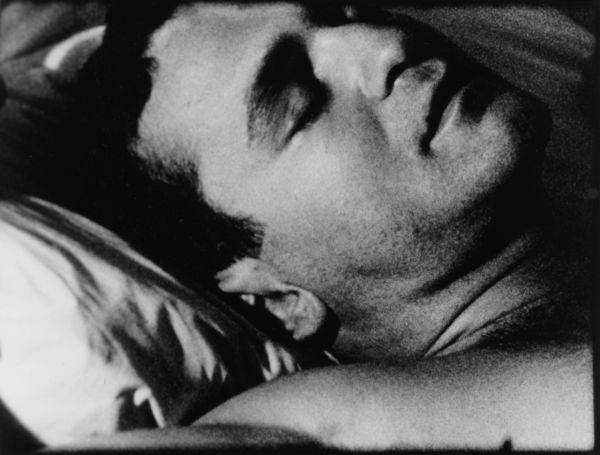
Picblog: Andy Warhol's Sleep (1963)


Matthew Fuller: Night Terrors - Matthew Fuller on Jonathan Crary's 24/7 @ Mute Mag, 10 July 2013


Matthew Fuller: Night Terrors - 
Matthew Fuller on Jonathan Crary's 24/7 @ Mute Mag, 10 July 2013 
There are many self-help manuals that promise to cure sleep problems through hypnosis, positive thinking, careful routine or a deliberately casual vacancy. There even exist collections of stories claimed to be so soothing and peaceful that they render the reader’s over-busy brain incapable of anything except the sleep they need. Jonathan Crary’s new book 24/7 is unlikely to be denying shelf-space to either of these kinds of publication, and not only due to its brevity. Crary is an esteemed historian and theorist of technologies of visual culture and here he opens with a catalogue of episodes in which sleep has been turned against itself into commodity or systematically denied as a form of torture, becoming a tumbrel upon which bodies are constantly turned and jolted in the night. 24/7 is about the always on, always invasive imperatives of contemporary life in the overdeveloped world. It is about the denial of sleep and sleep as a potential resource for a politically attuned everyday.
Sleep as a biopolitical phenomenon has recently been taken up by a range of writers such as Alexei Penzin, (Rex Exsomnis), Simon Williams (The Politics of Sleep), and Matthew Wolf-Meyer (The Slumbering Masses) amongst others in the last couple of years. Another set of authors have been working on insomnia for rather longer. The general thrust of the arguments is around how sleep becomes a social, medical and physiological problem, rather than something inert and ostensibly natural that happens to occur to most humans with a relative degree of regularity, constituting a third of their lives. Drugs, technically advanced mattresses, a panoply of apps, and a whole battery of new scientific processes, of the kind ably mapped by Kenton Kroker’s exhaustive history of sleep scienceThe Sleep of Others, are deployed in order to both roll back the hold of sleep on the human components of work systems and to make new products available to ensure that sleep can be had that is of a superior quality to that which is mundanely available.
Sleep is a blockage, a paradoxically animal impediment to time that would be better spent on work, communication, consumption and marketing. As recently mapped by historians such as Ekirch and Koslofsky, early modernity saw the beginning of a disenchantment of the night through the use of lighting, fireworks and, for certain classes in Europe, the ostentatious occupation of darkness as if it were day. There is a glittery thrill in bucking the solar cycle and inhabiting the dazzling spaces of illuminated night. Crary shows us how this tendency has become massified and rather tending to loose its appealing shine in an overstocked zone of endless neon, halogen and LCD light. The latter is what especially concerns him. On the other side of all those screens are information systems that never stop churning, alerting and eliciting, logging data and corralling attention. Sleep, for Crary, is a means of asserting both a reminder of vulnerable physicality and a requirement for social forms that protect it. As such it is both intransigent and rather frail, but what he establishes is that the specific inflection given to sleep as a social form is telling of the nature of its politics. Here the book nimbly assays numerous examples of the configuration of sleep from philosophy and literature, and it is the particular quality of sleep in its ability to pick out those that slumber and those that watch, and those that are rendered unable to shut their eyes, that gives the book a real acuity in re-reading authors such as Kafka or Arendt for their figurations of the sleeper and the solicitude that they require.
Crary wants us to attend to the ‘relentless capture and control of time and experience’ by systems of media and control, pungently warning against a media theoretical emphasis on the relatively superficial analysis of momentary media forms. From one angle Crary works something of the repeated plaint of the humanist that nothing is ever really new and that everything has been seen before – what we see happening to sleep can be read out from the trajectory of modernisation. But at the same time, he notes, present conditions of being ‘always on’ even when in sleep mode burn up reserves of consciousness that might have otherwise been drawn into reflection and contemplation, the time of individuation and thought. But also that of a deeper time that also implies the imagination of a future beyond the imperatives of the next few items on the task-list. In a sense, Crary talks little about sleep itself, but rather about the degradation of waking life implied by the technical and economic supercession of unproductive time. The loss of sleep is mere collateral damage in pursuit of the perfect flow distended into products, services and platforms that in turn serve up malleable and well-mapped subjects to the itchy minions of opinion and control.
Pharmaceutical and psychiatric techniques, such as those outlined in the ever-expanding and fabulatory Diagnostic and Statistical Manual of Mental Disorders, intervene to release unhappy persons into the state of blandness required to function in such a context. A recent Samsung phone was advertised as your ‘lifetime companion’. Billboards show a user leaping through its interface, as if through a portal, into a bright and lush void where smiling is mandatory and all relationships can be managed through the same interface. Everyday life just got better, brighter, and easier to navigate, backed up and monitored on restless servers.
Crary suggests a genealogy for such a situation that runs through the invention of the necessarily always-on factory systems of Arkwright through to the stabilisation of time established by the telegraph and rail, to television – something he figures as the comforter necessary after the twin triumphs of modernity in Auschwitz and Hiroshima. Nested deep within WW2 however was the code-breaking centre of Bletchley Park and the systematisation of computing machines. The incorporation of all symbolic domains into computational frameworks subtends the integration of their users, something parodied by Christopher Strachey and Alan Turing in their Love Letter Generator program written in Manchester in 1952. Both capitalism and computing present highly abstract, intensely mutable systems that are capable of movements of both great decentralisation and concentration and that provide a more or less adequate – the texture of which adequacy is immensely significant – means of interpolating other social forms to their characteristics. Crary follows their integration into previously distinct areas of existence, such as everyday life, and finds that the coercive facilitation being offered is rendering almost everything fully interoperable with them.
There is a sense in which a certain kind of critical theory is left simply watching and describing the immensity and effectiveness of contemporary forms of power. Others let something ineffable stand in for what is devoured in order to show the extent of the stakes: that something seemingly impossible to absorb is possibly subsumable suggests that things are getting harsh. Dreams indeed are figured as something on which such attempts are made. That films about mind control, where dreams are to download, and wild security-state fantasies about the revelatory capacities of brain scanners populate anticipations of the future in ever more abundant quantities suggest some of today’s tropic anxieties. Philip K. Dick’s Do Androids Dream of Electric Sheep? and Chris Marker La Jetée provide points of reference here. Cinema and pre-cinematic technologies are means of achieving a related state to dream, one that is replicable and fungible. But, Crary suggests, there is something beyond such a condition, a form of subjective state that is irreplicable and fugitive, the hypnagogic state between wakefulness and dream, the capacity for unbidden free association and reflection, that arises before sleep. The mind wanders, loosening its moorings in front of screens, by drifting off. Sleep, for Crary, is a part of the everyday that has yet to be fully integrated, where we are vulnerable but also capable of moving into other forms of time. As such, sleep is a resource not only for physiological renewal, but one that provides, the book proposes, an exemplary space for rethinking the basis of the relationship of politics, the imagination and the processes of living.

Matthew Fuller <m.fuller@gold.ac.uk> is co-author of Evil Media (MIT) and author of Elephant and Castle (Autonomedia). Read more

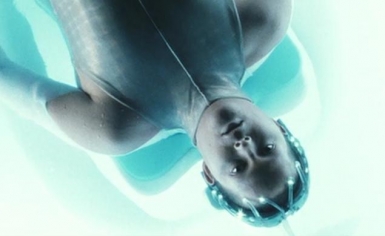
picblog: Spielberg's Minority Report

Michael Hardt: Sleep no more - Michael Hardt on Jonathan Crary's 24/7 @ Artforum.com - September 2013


Michael Hardt: Sleep no more - 
Michael Hardt on Jonathan Crary's 24/7 @ Artforum.com - September 2013
JONATHAN CRARY’S dark, brilliant book 24/7: Late Capitalism and the Ends of Sleep analyzes the nonstop demands of the contemporary global capitalist system and laments the damage we suffer from being caught up in the fascination and relentless rhythms of its technological production and consumption. This brief volume’s central claim is not that we are always awake—although Crary notes the growing prevalence of insomnia and use of neuropharmaceutical sleep suppressants and alertness aids—but rather that the division between wakefulness and sleep is being eroded, along with a series of other vital boundaries, such as those between day and night, public and private, activity and rest, work and leisure. Crary makes “24/7” a concise and powerful shorthand for this emerging social condition, which he characterizes as “a generalized inscription of human life into duration without breaks, defined by a principle of continuous functioning.” The constant availability of e-mail, online entertainment, and Internet shopping sites, the incessant call for attention from ubiquitous video screens, and myriad other potential occupations and distractions exert a persistent pull and eat away at the bases of noncapitalist life and rest. Sleep no more! Capital hath murdered sleep—or, perhaps better, sleep has been worn away by a minute clicking of little wheels.
Crary’s principal subject of investigation is the transformation of temporality that began with the advent of the Industrial Revolution and has vastly accelerated during the so-called Information Age. More specifically, he is concerned with how the coming sleeplessness will alter our sense and experience of time (and the distressing degree to which it already has). Reading this book, I was frequently reminded of historian E. P. Thompson’s analysis of industrial capital’s creation, in eighteenth-century England, of a new temporality defined by clocks, homogeneous temporal units, and universal synchrony. The older senses of time aligned with nature’s rhythms, such as the tides, or the duration of common tasks such as milking a cow, were gradually subordinated to workers’ experience of the precise measure of hours, minutes, and seconds—a machinic temporal sensibility. This new inner sense of time, which for Thompson is intimately tied to the creation of the working day and the strong demarcation between work time and nonwork time, spread from the factory over the course of decades and centuries to all other economic sectors and across society as a whole.
The temporal transformations of 24/7 capital, in Crary’s account, do not return us to precapitalist natural and task-based temporalities, nor do they destroy the uniform, homogeneous clock time that Thompson anatomized. In fact, Crary argues, modern machine time has perhaps only come to be fully realized and generalized in today’s nonstop rhythms. The crucial shift, for him, is instead defined by the ways in which contemporary media and other technologies have overcome those basic demarcations of the day that previously defined our experience and sense of time. Indeed, the blurring of the boundaries between work time and nonwork time is destroying the very notion of the working day and concomitantly altering our sense of time—a phenomenon felt more intensely in particular sectors of employment and regions of the world than in others. Some of the workers most affected have come to recognize that the ability to work online from any place at any time, which can at first appear a newfound freedom, ends up being a mechanism of temporal enslavement.
Crary focuses primarily, however, on more basic existential divisions than the working day. “24/7,” he writes, “steadily undermines distinctions between day and night, between light and dark, and between action and repose. It is a zone of insensibility, of amnesia, of what defeats the possibility of experience.” Instead of investing us with a new temporality, which progressively aligns all social activity and even our inner sense of time with the rhythms of the industrial machine, as Thompson conceived the changes in an earlier period, Crary theorizes 24/7 as a strategy of power that strips us of time, leaving us living in a kind of destitute nontime, “a disabled and derelict diachrony” that seems to preclude even the possibility of change.
Crary sees 24/7 as the fulfillment of a tendency inherent in capitalist modernity from the outset, and he articulates this point through a wonderful reading of British painter Joseph Wright’s landscapeArkwright’s Cotton Mills by Night, ca. 1782. He also demonstrates, however, that 24/7 is an unlivable condition (at least for humans), given that the time of reproduction, for physical and mental recuperation, is being reduced beyond sustainable levels. “Time for human rest and regeneration,” Crary writes, “is now simply too expensive to be structurally possible within contemporary capitalism.” This trend passes beyond the tipping point when expansion of the working day makes humans less, not more, productive, and it also threatens a more fundamental threshold: Beyond a minimum limit of reproduction time, capitalist production itself cannot be maintained—at least insofar as we assume it to be based on human productivity. Crary’s analysis thus identifies a contradiction by which capital’s fundamental tendency to erode the time of reproduction undermines its own sustainability. Some authors would develop this contradiction into a narrative about capital’s imminent or eventual collapse, but Crary instead leaves it as a background condition that adds to the gravity of our contemporary predicament. He is much more concerned with the demise of the human than with that of capital.
The driving force in Crary’s analysis is the increasing technological domination of our world, and he positions this polemic against “technophilic intellectuals and writers” who believe that new technologies will somehow necessarily or automatically bring justice and equality. In many respects, this is a familiar script about the dehumanizing effects of machines (no less familiar, of course, than the continual trumpeting of each new technology as the bearer of mankind’s salvation). Karl Marx, along with many nineteenth-century reformers, lamented that the lifelong vocation of the artisan was destroyed by the factory, wherein the worker, rather than employ his tools, himself became an instrument wielded by the industrial apparatus. Crary recognizes a similar inversion of subject and object in the contemporary developments of new media and digital technologies. “Everything once loosely considered to be ‘personal,’” he observes, “is now reconfigured so as to facilitate the fabricating of oneself into a jumble of identities that exist only as effects of temporary technological arrangements.” The increasing animation and vitality of the technological apparatuses in which we are enmeshed corresponds to a draining of subjective potential from our existence, leaving us degraded, reified beings.
One danger of such a lament is that it might lead to nostalgia. As the relentless rhythms of information technologies overtake our world, we can easily, understandably, find ourselves yearning for technologies and temporalities of the past. I remember fondly the experience of receiving a letter in the mail and taking the time to read and respond to it, for instance, and the sensations of the dark peacefulness of the night when all shops were closed and all machines turned off. Crary admirably casts aside all misty-eyed nostalgia for an idyllic past. As he sees it, we are all inside the 24/7 world, and there is no turning back. However, no sooner is the danger of succumbing to nostalgia warded off than arises another: that our lament of humanity’s degradation in the face of unremitting technological advancement leads merely to a profound pessimism according to which humanity is trapped in a closed technological dystopia with no way out.
Some critiques of technological innovation steer clear of the dual perils of nostalgia and hopelessness by recognizing that the new, in addition to intensifying the means of control and domination, also contains the seeds for previously unknown potentials for liberation. That is a core element of Marx’s own critique of capitalist technologies, for instance. Does 24/7 capitalism create its own gravediggers—that is, antagonistic subjects who arise “inside” and directly as a consequence of capital’s own development? Is there a way not only to sabotage, to jam the gears of, the nonstop machine but also to transform its tools into weapons for liberation? This is the path I would pursue to address our current predicament.
Crary’s primary mode of resistance does not draw from the arsenal created by the development of 24/7 capitalism but instead focuses on one irreducible human need that is intrinsically incompatible with capital’s regime: sleep. Indeed, some of the most beautiful passages in the book (weaving together insightful readings of Tarkovsky, Kafka, Chris Marker, and Philip K. Dick) are paeans to slumber. Sleep has long been a primary expression of the refusal of work, and its powers of resistance become even greater today, especially insofar as capitalist production and consumption rely increasingly on attention. Against the destructiveness of a global system that never sleeps, Crary writes, “sleep can stand for the durability of the social.” In the sleeping exodus from capitalist control, moreover, Crary senses the potential for community. In sleep we are vulnerable and rely on the care of others in a way that suggests to him the possibility of a form of being together: “In the depersonalization of slumber, the sleeper inhabits a world in common, a shared enactment of withdrawal from the calamitous nullity and waste of 24/7 praxis.” In the time of sleep, when we can dream a better future, Crary locates the potential to resist the pressures of contemporary capital and rescue our humanity from its destruction.

Michael Hardt, a professor in the program in literature at Duke University, is coauthor, with Antonio Negri, of Empire (2000), Multitude (2004), Commonwealth (2009), and Declaration (2012). Read more

lunedì 23 settembre 2013

Jonathan Crary - 24/7: Late Capitalism and the Ends of Sleep - Verso Books, July 2013


Jonathan Crary - 24/7: Late Capitalism and the Ends of Sleep - Verso Books, July 2013
Capitalism’s colonization of every hour in the day
24/7: Late Capitalism and the Ends of Sleep explores some of the ruinous consequences of the expanding non-stop processes of twenty-first-century capitalism. The marketplace now operates through every hour of the clock, pushing us into constant activity and eroding forms of community and political expression, damaging the fabric of everyday life.
Jonathan Crary examines how this interminable non-time blurs any separation between an intensified, ubiquitous consumerism and emerging strategies of control and surveillance. He describes the ongoing management of individual attentiveness and the impairment of perception within the compulsory routines of contemporary technological culture. At the same time, he shows that human sleep, as a restorative withdrawal that is intrinsically incompatible with 24/7 capitalism, points to other more formidable and collective refusals of world-destroying patterns of growth and accumulation.

Jonathan Crary is Meyer Schapiro Professor of Modern Art and Theory at Columbia University and is a founding editor of Zone Books. His books includeTechniques of the Observer, Suspensions of Perception, and Incorporations(coeditor).