We live in an information society in which data has become a commodity; we offer Data Mining from a Post-Marxist Perspective (We're sorry about the visual noise but we're in our Metal Box In Dub era).
Visualizzazione post con etichetta Lapo Berti. Mostra tutti i post
sabato 6 aprile 2019
mercoledì 6 dicembre 2017
Andrea Fumagalli @ Effimera :: In ricordo di Lapo Berti (1940 -2017)
E' con un dolore enorme che postiamo questo bel ricordo di Lapo Berti, amico, complice e compagno di Obsolete Capitalism e Rizosfera. Scomparso il 2 dicembre scorso, a Roma.
Lapo Berti fa parte dei tanti militanti che hanno dedicato la propria vita alla ricerca della verità (nel senso di “parresia”) – una compagine oramai rara ai giorni nostri, così presi della performatività dell’apparire. Ha partecipato ai principali avvenimenti della rottura culturale degli anni Sessanta fino gli anni Novanta. Nato nel 1940, a Milano, è vissuto a Firenze, poi di nuovo a Milano e infine a Roma. A Firenze, insieme a Claudio Greppi, si era legato al circolo “Giovanni Francovich”. Visse appieno l’intera esperienza, fondamentale per l’operaismo italiano, della rivista “Classe operaia”. Pur legato più a Mario Tronti che a Toni Negri, non ebbe il minimo dubbio nel momento della scelta (per la verità dubbi ne aveva molti, per carattere: ma sapeva scegliere). Partecipò all’intero ciclo di “Potere operaio”, dalla costruzione (quella veneto-emiliana, per intenderci) fino alla conclusione (convegno di Rosolina). Lapo ha insegnato all’università senza neppure essere laureato. Ha un antenato illustre, Claudio Napoleoni. Gli riuscivano cose apparentemente impossibili. Nella struttura di Potere Operaio ebbe anche un ruolo dirigente, non di semplice adesione ideologica. Con Ferruccio Gambino divideva la responsabilità del settore internazionale; in Germania l’operaismo è penetrato nell’elaborazione del pensiero antagonista anche grazie al suo intervento appassionato. Dopo la parabola di Potere Operaio, è stato uno degli animatori della rivista Primo Maggio, partecipando al gruppo di studio sulla Moneta, con Christian Marazzi, Roberto Convenevole, Franco Gori e Sergio Bologna e più avanti Riccardo Bellofiore. Ha prodotto teoria sull’idea che la creazione di moneta – come moneta credito – fosse in ultima analisi, nonostante il monopolio di emissione della Banca Centrale, un fattore endogeno alla dinamica dell’economia capitalistica. Ha partecipato al seminario sulla Moneta animato nei tardi anni Settanta da Augusto Graziani con Marcello Messori, Roberto Convenevole, Riccardo Farina, Lilia Constabile, contribuendo allo sviluppo della Teoria del circuito monetario (insieme a quella della règulation francese, le uniche capaci di concepire una teoria economica in grado di essere un antidoto all’egemonia monetarista dell’epoca). È stato uno studioso dei classici, in primo luogo Marx, e poi Schumpeter. Del primo ha divulgato l’idea che la moneta non è altro che un rapporto sociale, ovvero strumento del dominio del capitale sul lavoro. Del secondoci ha tramandato (oltre alla traduzione di Teoria dello sviluppo economico – Sansoni Editore, 1971, nuova ed. 2013, a cura di Rizzoli), la seminale, ma parziale, traduzione dell’opera schumpeteriana più misconosciuta – Das Wesen des Geldes (L’essenza del denaro), importante per comprendere il ruolo di discriminazione che è insito nel potere del denaro. Concetti che oggi, nell’era del capitalismo cognitivo finanziarizzato, sono più che mai attuali. Ha inoltre curato l’edizione di Teoria della moneta e dei mezzi di circolazione di Ludwig von Mises, de L’equilibrio monetario di Gunnar Myrdal e ha tradotto la Teoria economica del credito di L. Albert Hahn, tutti testi che contribuirono non poco negli anni Ottanta alla discussione sulle teorie monetarie eterodosse. Negli anni Novanta si è interessato alle trasformazioni del processo di valorizzazione nella fase del capitalismo post-fordista. È stato membro della redazione di Altreragioni, primo ambito di rivitalizzazione del pensiero economico operaista di fronte alle nuove forme di organizzazione del lavoro e della globalizzazione, un passaggio cruciale per cogliere lo sviluppo dell’Italian thought di oggi. Non a caso è in quell’ambito che vengono sviluppate le prime analisi critiche da parte del pensiero dell’Autonomist marxism sul processo di costruzione dell’Unione Monetaria Europea, riflessioni che vedono la luce, oltre che sul n. 2 di Altreragioni, nel volume collettaneo L’Antieuropa delle monete (Manifestolibri, Roma, 1992). Da metà degli anni Novanta sino alla pensione ha lavorato all’Antitrust, prima con un contratto biennale e poi in modo stabile, dopo una buona parte dell’esistenza passata in condizione precarie (si direbbe oggi), anche come scelta di coniugare spirito di militanza ed etica di vita. Pur in un ambiente non facile (istituzionalizzato), ha continuato a denunciare le storture del mercato come luogo di concentrazione del potere economico, in controtendenza con l’idea neo-liberale del mercato come luogo di pari opportunità. In questo periodo, non a caso ha pubblicato Il mercato oltre le ideologie (Università Bocconi, 2006) e Le stagioni dell’antitrust. Dalla tutela della concorrenza alla tutela del consumatore (con Andrea Pezzoli) (Università Bocconi, 2010).
Read more @ Manifesto
Read more @ Effimera
mercoledì 5 aprile 2017
mercoledì 22 marzo 2017
domenica 18 dicembre 2016
giovedì 24 novembre 2016
venerdì 1 aprile 2016
lunedì 1 febbraio 2016
venerdì 13 marzo 2015
Lapo Berti: Il grande freddo Considerazioni sulla qualità della vita in tempi di turbolenza @ Lab21 website
Lapo Berti: Il grande freddo
Considerazioni sulla qualità della vita in tempi di turbolenza
Una crisi di civiltà?
Il termine forse più usato e abusato negli anni o decenni passati è quasi certamente “crisi”. Lo si è declinato in un’infinità di modi. Si è parlato di crisi politica, di crisi economica, di crisi finanziaria, di crisi ambientale, di crisi sociale, di crisi morale, di crisi religiosa; di crisi di nervi, verrebbe da aggiungere. Di un’ulteriore e possibile declinazione non si è parlato o si è parlato molto poco, quasi incidentalmente, o, addirittura non si è voluto parlare: di crisi di civiltà. Eppure, è forse questa la prospettiva che ci consentirebbe di considerare e di comprendere più in profondità le tante crisi che ci angosciano e, più in generale, le dinamiche sociali, economiche, politiche lungo le quali sta scivolando la nostra civiltà. Il grande antropologo Ernesto De Martino vi avrebbe forse trovato la materia per delineare un’ennesima “apocalisse culturale”.
Forse, come l’ambiente fisico in cui viviamo, anche l’ambiente sociale è soggetto all’alternanza di ere calde o temperate in cui la vita fiorisce e si espande e di ere glaciali in cui la vita si ritira e combatte duramente per conservarsi. La sensazione cui vorrei offrire il supporto di qualche riflessione più accurata è che ci stiamo avviando verso una sorta di glaciazione sociale, perché stanno venendo meno alcune delle spinte vitali, espansive, che hanno sospinto la precedente fioritura.Parlando di quella che ha definito la “grande stagnazione” del proprio paese, un economista americano, Tyler Cowen, ha sostenuto che la società americana, negli ultimi tre secoli, si è mangiata tutti i “low-hanging fruits”, i frutti a portata di mano, che quella terra e la sua storia fortunata gli avevano offerto. Forse è una considerazione che vale non solo per gli americani, ma per noi tutti e descrive bene la natura dello sviluppo economico che ha fatto apparentemente prosperare le nostre società (occidentali).
Sono finiti i “frutti a portata di mano”
Abbiamo a lungo sfruttato i frutti di una terra generosa, che ci ha offerto cibo e materie prime per alimentare un grandioso sviluppo delle nostre capacità economiche e della nostra ricchezza individuale e collettiva. Dalle viscere della terra abbiamo scavato una quantità pressoché incommensurabile di energia, che ha moltiplicato le nostre capacità e possibilità. L’offerta era così abbondante che appariva illimitata, suscitando l’illusione, incarnata dalla cultura del progresso, che il modello di crescita della ricchezza che avevamo individuato, sotto il nome di capitalismo, potesse rappresentare il destino eterno dell’umanità.
Ma non ci siamo limitati ad arraffare in maniera sconsiderata i frutti a portata di mano. Abbiamo anche posto le basi per cambiamenti di sistema irreversibili, suscettibili di intaccare, se non distruggere, le fondamenta materiali su cui poggia la nostra civiltà e quelle ancora più fragili su cui abbiamo eretto la convivenza sociale.
Questo è il rischio spaventoso cui lo sviluppo della nostra civiltà sta esponendo la società
degli uomini. È il rischio faustiano cui l’imponente sviluppo della scienza e delle forze produttive
innescato dalla rivoluzione industriale sta esponendo il nostro ambiente fisico e di conseguenza
anche quello umano. Siamo ormai entrati nell’antropocene, come l’hanno definito alcuni studiosi,
un’era nuova e sconvolgente che proietta la nostra sopravvivenza in un quadro futuro che sovverte
l’ordine fisico che ha finora accompagnato e sostenuto il cammino della civiltà umana. Per la prima
volta nella storia del nostro pianeta, l’azione dell’uomo, che pure ha sempre inciso, trasformandolo,
sull’ambiente naturale, senza peraltro turbarne gli equilibri sistemici, è oggi in grado di mutare gli
assetti dell’ecosistema terra, addirittura di governare e trasformare i processi naturali. Fino a oggi
era l’uomo, in linea di massima, ad adeguarsi alle dinamiche naturali, tentando di piegarle ai propri
fini, oggi è la natura che deve provare ad adeguarsi alle dinamiche messe in moto dall’uomo. È un
rovesciamento radicale del rapporto uomo-natura, che stenta a trovare un modo altrettanto
radicale di cambiare i nostri comportamenti e i modi in cui pensiamo e progettiamo l’evoluzione
dell’ambiente terrestre.
La dissipazione del capitale sociale
Il capitalismo non è solo un grande divoratore di risorse ambientali; è anche un grande, spietato, divoratore di risorse sociali e umane.
Abbiamo attinto, senza nemmeno rendercene conto, all’immenso patrimonio sociale e culturale accumulato nel corso di millenni dalla nostra civiltà. Quello che alcuni sociologi ed economisti, con felice intuito, hanno chiamato “capitale sociale”, ovvero quell’insieme complesso e variegato di soluzioni oggettivate in istituzioni o trasfuse nelle abitudini, nei modi di sentire e di comportarsi delle persone, che hanno costituito la solida intelaiatura della nostra civiltà, garantendo la coesione sociale e la convivenza pacifica tra i membri di una società composta di estranei. Il capitale sociale rappresentava il patrimonio delle esperienze ereditate da millenni di sforzi e di ricerche per rendere migliore la vita dell’umanità. Esso ha costituito il fondamento di conoscenze, di capacità, di relazioni sociali, su cui è stato possibile costruire il grande progetto illuministico di un progresso continuo e illimitato delle capacità umane. Il capitale sociale è l’elemento costitutivo della qualità della vita.
Quel patrimonio è stato dilapidato. Più esattamente, è stato sacrificato sull’altare di quel moloch della modernità che è la crescita economica. Abbiamo affidato il nostro destino a un meccanismo potente quanto devastante che va sotto il nome di capitalismo. Esso ha rimesso in gioco, potenziandoli e in certa misura sublimandoli, gli impulsi primordiali che facevano sì che ogni uomo fosse un lupo per l’altro uomo: homo homini lupus, come segnalava Hobbes. L’egoismo, l’affermazione di se stessi, la conquista del potere sopra gli altri, la facoltà di disporre di tutto ciò che è a portata di mano per soddisfare i propri bisogni e le proprie voglie: questo groviglio di pulsioni che definiscono biologicamente la natura dell’uomo è stato trasposto, e solo in parte sublimato, nel grande gioco dell’economia. La società ha ricevuto in cambio la crescita economica, la soddisfazione di una quantità crescente di bisogni, l’apertura, spesso illusoria, di nuove prospettive di vita e di esperienza, ma ha dovuto impegnare quello che di più prezioso era riuscita a mettere insieme in millenni di esperienze traumatiche, di sofferenze, di lotte, di guerre: la convivenza pacifica fra individui che non si conoscono. L’individualismo esasperato che il capitalismo inevitabilmente promuove, perché nel grande gioco dell’economia gli uomini vincono solo in quanto individui, ha poco a poco corroso il tessuto sociale, esaltato l’estraneità che era stata appena domata, santificato l’egoismo contro la compassione.
La dissipazione del capitale sociale
Il capitalismo non è solo un grande divoratore di risorse ambientali; è anche un grande, spietato, divoratore di risorse sociali e umane.
Abbiamo attinto, senza nemmeno rendercene conto, all’immenso patrimonio sociale e culturale accumulato nel corso di millenni dalla nostra civiltà. Quello che alcuni sociologi ed economisti, con felice intuito, hanno chiamato “capitale sociale”, ovvero quell’insieme complesso e variegato di soluzioni oggettivate in istituzioni o trasfuse nelle abitudini, nei modi di sentire e di comportarsi delle persone, che hanno costituito la solida intelaiatura della nostra civiltà, garantendo la coesione sociale e la convivenza pacifica tra i membri di una società composta di estranei. Il capitale sociale rappresentava il patrimonio delle esperienze ereditate da millenni di sforzi e di ricerche per rendere migliore la vita dell’umanità. Esso ha costituito il fondamento di conoscenze, di capacità, di relazioni sociali, su cui è stato possibile costruire il grande progetto illuministico di un progresso continuo e illimitato delle capacità umane. Il capitale sociale è l’elemento costitutivo della qualità della vita.
Quel patrimonio è stato dilapidato. Più esattamente, è stato sacrificato sull’altare di quel moloch della modernità che è la crescita economica. Abbiamo affidato il nostro destino a un meccanismo potente quanto devastante che va sotto il nome di capitalismo. Esso ha rimesso in gioco, potenziandoli e in certa misura sublimandoli, gli impulsi primordiali che facevano sì che ogni uomo fosse un lupo per l’altro uomo: homo homini lupus, come segnalava Hobbes. L’egoismo, l’affermazione di se stessi, la conquista del potere sopra gli altri, la facoltà di disporre di tutto ciò che è a portata di mano per soddisfare i propri bisogni e le proprie voglie: questo groviglio di pulsioni che definiscono biologicamente la natura dell’uomo è stato trasposto, e solo in parte sublimato, nel grande gioco dell’economia. La società ha ricevuto in cambio la crescita economica, la soddisfazione di una quantità crescente di bisogni, l’apertura, spesso illusoria, di nuove prospettive di vita e di esperienza, ma ha dovuto impegnare quello che di più prezioso era riuscita a mettere insieme in millenni di esperienze traumatiche, di sofferenze, di lotte, di guerre: la convivenza pacifica fra individui che non si conoscono. L’individualismo esasperato che il capitalismo inevitabilmente promuove, perché nel grande gioco dell’economia gli uomini vincono solo in quanto individui, ha poco a poco corroso il tessuto sociale, esaltato l’estraneità che era stata appena domata, santificato l’egoismo contro la compassione.
I risultati di questa devastazione del patrimonio più intimamente connesso con l’idea di
civiltà, del capitale sociale, sono ormai solidamente installati all’interno degli ambienti urbani e si
stanno diffondendo esponenzialmente. Poche generazioni saranno sufficienti a distruggere i
risultati del faticoso quanto grandioso percorso di convivenza che ha impegnato centinaia di
generazioni di uomini.
Il degrado dell’ambiente fisico e sociale delle nostre metropoli ne è l’esempio più vivo e drammatico. Da quando, non molti anni fa, si cominciò a notare l’emergere di un sempre più diffuso “livore metropolitano” (Dahrendorf), sintomo di una disgregazione già avanzata, del tessuto sociale, il processo di disfacimento ha ormai raggiunti livelli probabilmente irreversibili. Tutte le gradazioni dell’estraneità sono state sperimentate. Dall’indifferenza all’aggressività, dall’individualismo esasperato allo spregio dei beni comuni. Lo spazio pubblico, sia nella sua accezione virtuale che in quella concreta, si è ristretto fino a scomparire, trasformato sempre più spesso nel luogo di nessuno, una sorta di enorme discarica del malessere metropolitano. Tutto questo in un ambiente economico dominato e plasmato dalla crescita drammatica e, in apparenza, inarrestabile, delle disuguaglianze di reddito e di ricchezza. Il mondo sembra appartenere a quelli che hanno di più, mentre quelli che hanno di meno sembrano scivolare sempre più in basso.
Certo, sarebbe un errore non vedere e non apprezzare quei nuclei di persone attive che, pur in minoranza, si sforzano tenacemente di tenere in mano il filo della coesione sociale. Ma sarebbe altrettanto un errore non vedere la fragilità e la precarietà di questi tentativi, sempre sul punto di essere spazzati via dal vento dell’indifferenza.
La società degli estranei
L'umanità ha impiegato migliaia di anni per riuscire a far convivere in pace milioni di sconosciuti. C’è voluto un tempo infinito perché, dopo la fine dell’ultima era glaciale, più di 10.000 anni fa, quel cugino stretto degli scimpanzé e dei bonobo da cui discendiamo si risolvesse ad abbandonare il suo atteggiamento violento, aggressivo, diffidente nei confronti degli altri e decidesse di dar vita a insediamenti stabili dove allevare animali e coltivare piante. L’uomo, Homo sapiens sapiens è così diventato “l’unico animale che si è impegnato in una complessa divisione di compiti fra membri della stessa specie non collegati geneticamente... La natura non conosce altri esempi di una simile, complessa, mutua dipendenza fra estranei” (Seabright 2004). Per arrivarci, gli uomini hanno dovuto modificare i loro comportamenti primordiali innati, hanno dovuto inventare un linguaggio di segni, a partire dal sorriso, per significare la deposizione dell'aggressività e la disposizione a cooperare. Hanno creato istituzioni sempre più complesse per articolare e tutelare le relazioni fra di loro, per contenere la violenza, per condividere fini. Quella fiducia che, malgrado l'attuale degrado, caratterizza ancora l'ambiente sociale in cui viviamo rendendo possibili quelle innumerevoli interazioni fra estranei che riempiono la nostra vita di tutti i giorni non è un dato primario, "naturale", bensì il frutto consolidato di un'infinità di atti di scambio e di cooperazione.
Il degrado dell’ambiente fisico e sociale delle nostre metropoli ne è l’esempio più vivo e drammatico. Da quando, non molti anni fa, si cominciò a notare l’emergere di un sempre più diffuso “livore metropolitano” (Dahrendorf), sintomo di una disgregazione già avanzata, del tessuto sociale, il processo di disfacimento ha ormai raggiunti livelli probabilmente irreversibili. Tutte le gradazioni dell’estraneità sono state sperimentate. Dall’indifferenza all’aggressività, dall’individualismo esasperato allo spregio dei beni comuni. Lo spazio pubblico, sia nella sua accezione virtuale che in quella concreta, si è ristretto fino a scomparire, trasformato sempre più spesso nel luogo di nessuno, una sorta di enorme discarica del malessere metropolitano. Tutto questo in un ambiente economico dominato e plasmato dalla crescita drammatica e, in apparenza, inarrestabile, delle disuguaglianze di reddito e di ricchezza. Il mondo sembra appartenere a quelli che hanno di più, mentre quelli che hanno di meno sembrano scivolare sempre più in basso.
Certo, sarebbe un errore non vedere e non apprezzare quei nuclei di persone attive che, pur in minoranza, si sforzano tenacemente di tenere in mano il filo della coesione sociale. Ma sarebbe altrettanto un errore non vedere la fragilità e la precarietà di questi tentativi, sempre sul punto di essere spazzati via dal vento dell’indifferenza.
La società degli estranei
L'umanità ha impiegato migliaia di anni per riuscire a far convivere in pace milioni di sconosciuti. C’è voluto un tempo infinito perché, dopo la fine dell’ultima era glaciale, più di 10.000 anni fa, quel cugino stretto degli scimpanzé e dei bonobo da cui discendiamo si risolvesse ad abbandonare il suo atteggiamento violento, aggressivo, diffidente nei confronti degli altri e decidesse di dar vita a insediamenti stabili dove allevare animali e coltivare piante. L’uomo, Homo sapiens sapiens è così diventato “l’unico animale che si è impegnato in una complessa divisione di compiti fra membri della stessa specie non collegati geneticamente... La natura non conosce altri esempi di una simile, complessa, mutua dipendenza fra estranei” (Seabright 2004). Per arrivarci, gli uomini hanno dovuto modificare i loro comportamenti primordiali innati, hanno dovuto inventare un linguaggio di segni, a partire dal sorriso, per significare la deposizione dell'aggressività e la disposizione a cooperare. Hanno creato istituzioni sempre più complesse per articolare e tutelare le relazioni fra di loro, per contenere la violenza, per condividere fini. Quella fiducia che, malgrado l'attuale degrado, caratterizza ancora l'ambiente sociale in cui viviamo rendendo possibili quelle innumerevoli interazioni fra estranei che riempiono la nostra vita di tutti i giorni non è un dato primario, "naturale", bensì il frutto consolidato di un'infinità di atti di scambio e di cooperazione.
La globalizzazione sta portando alle estreme conseguenze, alla sua massima estensione,
questo lungo processo di costruzione di un’unica umanità planetaria. Era inevitabile che questo
processo avanzasse in mezzo a timori, incomprensioni, reazioni difensive, di ripulsa. Era ed è
inevitabile che esso richieda l’elaborazione di strumenti culturali aggiuntivi, di nuove forme
istituzionali per renderlo accettabile e condiviso. Ma lo scenario che oggi ci troviamo di fronte è
diverso e più preoccupante. È come se, in prossimità del raggiungimento di questo approdo
supremo della nostra civiltà, le tensioni che questa trasformazione provoca fossero sul punto di far
saltare l’intero processo, precipitando l’umanità in una sorta di caos sociale primordiale. Il ritorno
prepotente della violenza, del terrore, della sopraffazione, della guerra, come strumenti di
regolazione dei rapporti fra estranei e, per converso, il rinserramento nelle identità ataviche a tutela
di interessi materiali che atavici non sono, bensì frutti avvelenati della modernità, la resurrezione
prepotente del nemico che è “legittimo” annientare: sono tutti sintomi inquietanti di un regresso
della nostra civiltà, capace di metterne a rischio la sopravvivenza. L’esaltazione della
disuguaglianza e l’ossessione per il diverso non ne sono che una delle conseguenze più insidiose
e distruttive.
Un nuovo paradigma?
I frutti non sono più a portata di mano, non basta sollevare il braccio e afferrarli per poterne godere. I frutti che rimangono sono ormai in alto e forse non sono accessibili a tutti. Occorre attrezzarsi per coglierli e farli fruire all’intera umanità. Occorre un nuovo paradigma tecnologico, che consenta di condividere i progressi, e un nuovo patto sociale che includa l’ambiente in cui viviamo e contrasti la crescente polarizzazione della società. La difficoltà crescente nel cogliere i frutti dello sviluppo ha fatto emergere con forza la nozione di limite, che è connaturata alla condizione umana. Una nozione che la sapienza antica ha riconosciuto per tempo, facendone il fulcro di una concezione realistica quanto pessimistica dell’esistenza umana, ma che una superba quanto vana ideologia del progresso ha tentato di cancellare nelle nostre mentii senza riuscire a cancellarla nella materialità del mondo fisico. Il senso del limite deve tornare a ispirare i nostri comportamenti, a dettare le regole della convivenza. L’economia è l’ambito principale in cui va affermato.
Un nuovo paradigma?
I frutti non sono più a portata di mano, non basta sollevare il braccio e afferrarli per poterne godere. I frutti che rimangono sono ormai in alto e forse non sono accessibili a tutti. Occorre attrezzarsi per coglierli e farli fruire all’intera umanità. Occorre un nuovo paradigma tecnologico, che consenta di condividere i progressi, e un nuovo patto sociale che includa l’ambiente in cui viviamo e contrasti la crescente polarizzazione della società. La difficoltà crescente nel cogliere i frutti dello sviluppo ha fatto emergere con forza la nozione di limite, che è connaturata alla condizione umana. Una nozione che la sapienza antica ha riconosciuto per tempo, facendone il fulcro di una concezione realistica quanto pessimistica dell’esistenza umana, ma che una superba quanto vana ideologia del progresso ha tentato di cancellare nelle nostre mentii senza riuscire a cancellarla nella materialità del mondo fisico. Il senso del limite deve tornare a ispirare i nostri comportamenti, a dettare le regole della convivenza. L’economia è l’ambito principale in cui va affermato.
I nostri costrutti mentali cambiano molto lentamente, e ancora più lentamente cambiano i
nostri comportamenti, perché prima che i mutamenti che si verificano nell’ambiente provochino
reazioni stabili e durature occorre che vengano sperimentati ripetutamente e che ne venga
pienamente percepita la portata. Questo avviene, per lo più, sotto l’influenza di eventi traumatici
che ci toccano direttamente. Questo vale sia per l’ambiente fisico che per l’ambiente sociale. È
richiesto un senso di responsabilità più maturo ed evoluto, che contempli non solo il
riconoscimento e il rispetto dell’altro, ma di tutto ciò che ci circonda sulla nostra terra. Compito
immane, per istituzioni che ancora non ci sono, in un mondo in cui la civiltà sembra aver perso la
bussola. Siamo cresciuti nell’illusione di essere diventati i padroni del mondo, di poter disegnare a
nostro piacimento il mondo fisico e quello sociale. Non è così. Possiamo solo provarci,
interagendo, ma senza la certezza di quello che sarà il risultato delle nostre azioni, che sarà
sempre anche il risultato di circostanze che non conosciamo e non controlliamo.
Possiamo, e dobbiamo, partire dalla cura e dal rispetto del nostro territorio e della nostra comunità, dalla consapevolezza ritrovata dei limiti non valicabili, dalla riscoperta dei sentimenti e dei comportamenti che ci fanno essere animali sociali, dobbiamo tornare a fidarci degli estranei; ma la strada è lunga e incerta e il tempo breve.
Read more @ Lib21
Possiamo, e dobbiamo, partire dalla cura e dal rispetto del nostro territorio e della nostra comunità, dalla consapevolezza ritrovata dei limiti non valicabili, dalla riscoperta dei sentimenti e dei comportamenti che ci fanno essere animali sociali, dobbiamo tornare a fidarci degli estranei; ma la strada è lunga e incerta e il tempo breve.
Read more @ Lib21
sabato 7 marzo 2015
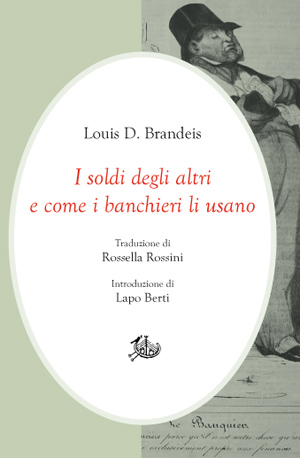
Lapo Berti: I soldi degli altri e come i banchieri li usano @ Lib21 (Introduzione al libro di Louis d. Brandeis "I soldi degli altri e come i banchieri li usano")
In questo paese il grande monopolio è il monopolio del denaro… Una grande nazione industriale è controllata dal suo sistema creditizio. Il nostro sistema creditizio è concentrato in mani private. La crescita della nazione, dunque, e tutte le nostre attività sono nelle mani di un manipolo di persone che congelano, tengono a freno e distruggono l’autentica libertà economica. Questo è il problema più grande di tutti; e gli uomini di stato lo devono affrontare con convinta determinazione per giovare al lontano futuro e alle vere libertà degli uomini”. In occasione della pubblicazione dell’edizione italiana di questo splendido pamphlet, riproponiamo una presentazione di quattro anni fa.
Il potere del denaro
“In questo paese il grande monopolio è il monopolio del denaro. Finché esso esiste, la nostra antica diversità e libertà e la capacità individuale di svilupparsi sono impraticabili. Una grande nazione industriale è controllata dal suo sistema creditizio. Il nostro sistema creditizio è concentrato in mani private. La crescita della nazione, dunque, e tutte le nostre attività sono nelle mani di un manipolo di persone che, anche se le loro azioni sono oneste e rivolte al pubblico interesse, sono necessariamente concentrate nelle grandi intraprese in cui il loro denaro è impegnato e che, necessariamente, qualunque sia la ragione dei loro limiti, congelano, tengano a freno e distruggono l’autentica libertà economica. Questo è il problema più grande di tutti; e gli uomini di stato lo devono affrontare con convinta determinazione per giovare al lontano futuro e alle vere libertà degli uomini”.
Sono le parole, pronunciate esattamente un secolo fa dal presidente americano Woodrow Wilson, con cui Louis D. Brandeis apre il suo vivace e puntiglioso pamphlet su I soldi degli altri e come i banchieri li usano, pubblicato nel 19141.
Quando pubblica quest’aureo libretto, Brandeis è già un avvocato affermato e ampiamente noto per il suo impegno civile, che gli meriterà vari soprannomi come l’”avvocato della gente” o il “Robin Hood della legge”, ma è anche oggetto di un’altrettanto ampia ostilità da parte del mondo conservatore. Un suo acerrimo avversario, il giudice William O. Douglas, scrisse di lui: “E’ stato un crociato militante per la giustizia sociale, chiunque fosse il suo avversario. E’ stato pericoloso non solo per la sua intelligenza brillante, per il suo genio matematico, per il suo coraggio. E’ stato pericoloso perché era incorruttibile”. Di quanti di questi uomini “pericolosi” avremmo oggi bisogno!
La concentrazione del potere
Quella che Brandeis prende di mira nella sua lucida polemica è l”oligarchia finanziaria”, ovvero il Money Trust che concentra nelle sue mani un potere economico enorme e condiziona l’intera vita del paese. Esso è il frutto della concentrazione, degli intrecci societari, degli accordi più o meno occulti fra coloro che controllano le imprese maggiori. Il più insidioso degli strumenti, agli
occhi di di Brandeis, è l’interocking directorate, l’intreccio tra consigli di amministrazione e, più in generale, l’intreccio fra interessi che sono in conflitto. Al centro c’è la figura del banchiere d’investimento che Brandeis vede come il deus ex machina di questo sistema. Il banchiere d’investimento è colui che usa “i soldi degli altri” per mettere le mani su banche, società di assicurazione, grandi imprese, società di servizi pubblici, costruendo una gigantesca infrastruttura finanziaria al cui vertice c’è un manipolo di persone in grado di controllare e dirigere ogni cosa nell’interesse dei pochi che hanno accesso al potere finanziario. L’obiettivo è quello di eliminare il più possibile la concorrenza e di convogliare la maggior parte della ricchezza finanziaria di un paese nei canali controllati dall’oligarchia finanziaria.
Qualcosa è mutato nel corso del tempo, il quadro si è fatto più complesso, ma non è difficile ritrovare nell’analisi di Brandeis motivi e problemi che ancora incombono sul nostro presente. La questione della concentrazione del potere economico e della sua capacità di controllare e condizionare pressoché tutti gli aspetti della vita sociale, a partire dalla politica, è la grande questione irrisolta che il secolo XX ci ha lasciato in eredità e che oggi sta esplodendo, mettendo a rischio quel che resta dei nostri sistemi democratici.
Rimasto fuori dalla classica tassonomia di Montesquieu e, quindi, esentato dall’obbligo di condividere con gli altri poteri un regime di suddivisione e di limitazioni, il potere economico incontrollato è oggi il cancro che non solo sta divorando l’economia globale, ma sta distruggendo la coesione sociale e la capacità della politica di dare espressione alla volontà dei cittadini.
E’ necessario che la politica e i governi riconoscano rapidamente la gravità di questa minaccia alla vita democratica e i guasti che essa ha già provocato. Occorre che le costituzioni democratiche incorporino una precisa definizione dei limiti all’accumulazione del potere economico in mani private e le procedure per farli rispettare. Meglio ancora se a livello globale. Non è facile, ma forse è proprio di fronte alle rovine di una crisi provocata da questo sistema che si possono trovare le energie per cambiare strada.
La ricchezza di un paese
E’ ancora con le parole del Presidente Wilson, che nel 1916 lo nominerà membro della Corte suprema, che Brandeis conclude la sua appassionata argomentazione:
“Nessun paese può riuscire ad avere la sua prosperità se questa è dovuta a una classe ristretta in posizione di controllo. Il tesoro dell’America non sta nei cervelli del piccolo numero di uomini che attualmente controllano le grandi imprese… Dipende dalle invenzioni di uomini sconosciuti, dalle ambizioni di uomini sconosciuti. Ogni paese si rinnova con le schiere degli sconosciuti, non con le schiere di quelli che già sono famosi e potenti nelle loro posizioni di controllo”.
E’ questo il sale della democrazia, dovremmo sempre tenerlo a mente, e quando i pochi si sostituiscono ai più nel governo dell’economia come in quello del paese all’orizzonte si profilano tempi bui. Il declino economico è figlio anche di queste storture. Nel mondo d’oggi tutto questo è prevalentemente il frutto di una crescita del potere economico al di fuori di qualsiasi quadro di regole, di qualsiasi forma di controllo. Ma, come ci ricorda l’efficace libretto di Brandeis, non è questione che nasce oggi. E quando un ammonimento, un grido di allarme, viene reiterato nell’arco di un secolo senza che nessuno se ne preoccupi, vuol dire che c’è qualcosa che non funziona nei meccanismi di auto-regolazione della società. Il tempo per porvi rimedio sta ormai per scadere.
1 Louis Dembitz Brandeis, Other People’s Money and How the Bankers Use It, Frederick A. Stokes Company, New York 1914, trad. it. di Rossella Rossini, con un’introduzione di Lapo Berti, I soldi degli altri e come i banchieri li usano, Edizioni di storia e letteratura, Roma, 2015.
Etichette:
Capitalismo,
Economia,
Lapo Berti,
Louis D. Brandeis,
Monopoli,
Usa
mercoledì 10 settembre 2014
Obsolete Capitalism: From the small bourgeoisie to the post-bourgeoisie. Autonomy of the post-bourgeoisie (Pt. X - The Birth of Digital Populism)
From the small bourgeoisie to the post-bourgeoisie. Autonomy of the post-bourgeoisie.
Is there a socio-political constant quality of the Italian populist and fascist ‘rank and file’ that runs throughout the twentieth-century and which is now looking adrift into the 21st? Antonio Gramsci believed that the matrix of Ur-Fascism as a mass movement was determined by the petty bourgeoisie’s desire of emancipation from both the ruling elite and the national and international establishment. According to his analysis, the socio-economic conditions which arose in the first two decades of the twentieth-century encouraged the Italian bourgeoisie - wearied by the post-World War I crisis - to want to be independent from the established and constitutional powers. The Gramscian analysis resonates, like a tuning fork, with other fragments proposed by other astute observers of the Italian customs from the past century. In an analysis of early Fascist Italian habits, in ‘Mario and the Magician’ Thomas Mann explicitly mentions a ‘middle-class bob’. During an ironic exchange from the short film La Ricotta, the director Pier Paolo Pasolini, indirectly answers the question of a journalist appearing on the stage, through the character of another director, played by Orson Welles:
‘What do you think of Italian society?’ ‘The most illiterate people, the most ignorant bourgeoisie in Europe.’
In a crisp passage, Lapo Berti describes this trans-generational segment of Italian society, which was before stigmatized in Pier Paolo Pasolini’s movie as unfinished modernity:
The unachieved process of modernizing civilization has caused hostile reactions among the deepest layers of society, where people’s opinions are formed. This group seemed to reject modernity in all its forms, although they would naively get excited for its inventions. These people were inflamed by the fascist narrative; they embraced the deep cauldron of Demo-Christian reformism without being changed by it; then they returned to exalt the anomaly of Berlusconism, which, once and for all, revealed its populist and undemocratic nature. They represent today, as they did yesterday, a good half of the Italian people. When active, they influence the destiny of the country, then as now. (...)
Read more @ The Birth of Digital Populism/e.book
sabato 24 maggio 2014
Lapo Berti: Fare con poco @ Casa dell'architettura, 28 Ottobre 2013
Fare con poco (Lapo Berti) - LIB21 - Casa dell'architettura - 28 Ottobre 2013
LIB21 in collaborazione con NEXT e l'Ordine degli Architetti di Roma e Provincia ha organizzato a Roma, presso la Casa dell'Architettura, un incontro per discutere degli effetti che la crisi ha prodotto sulla qualità delle nostre vite. Come si può rispondere alla crisi, se non ricercando nuovi stili di vita, in cui si riconosca e si mantenga il valore della qualità? Come si coniuga la voglia di fare con i limiti che il mondo attuale ci impone? Come si può appagare un'incontenibile voglia di futuro sovvertendo le logiche esasperate del consumismo per costruire qualcosa di bello e duraturo? Sono temi caldi, attuali, difficili, ma stimolanti ed essenziali per chi ad un futuro vero aspira.
http://www.lib21.org
sabato 28 dicembre 2013
Lapo Berti: interview on Crowd, Power and Post-democracy in the 21st Century
We have translated Lapo Berti's interview on populism and recent European political phenomena, held on 19 November 2013 with the authors of this blog and of Obsolete Capitalism. Here are the other interviews from the cycle which have been published in English: Parikka, Newman, Sampson, Choat and Toscano; and in Italian: Parikka, Newman, Sampson, Choat, Berti and Parisi & Terranova.
EDIT: We collected the Berti's interview in one PDF file that you can download or read online. All interviews on digital populism - in English language (HERE !) and Italian language (HERE !) - are collected in one single file.
Crowd, Power and Post-democracy in the 21st Century
Rural fascism and city or neighborhood fascism, youth fascism and war veteran's fascism... fascism of the couple, family, school, and office. Only the micro-fascism can answer the global question: 'Why does desire long for its repression? how can it desires its very own repression?'
—Gilles Deleuze, Fèlix Guattari, A thousand plateaus, pg.271
On the micro-fascism
OC Let us start from the analysis Wu Ming set out in their brief essay Grillismo: Yet another right-wing cult coming from Italy and which interprets Grillo’s Five Star Movement as a new authoritarian right-wing faction. Why did the desire for change of much of the electorate long once again for its very repression? We seem to witness the re-affirmation of Wilhelm Reich’s thought: at a given moment in history the masses wanted fascism. The masses have not been deceived: they have understood very well the danger of authoritarianism; but they have voted it anyway. Even more worrying is that the authoritarian Berlusconi's Freedom People (PDL) and Grillo’s Five Star Movement (M5S) conquer more than half of the Italian electorate together. A very similar situation arose in the UK in May 2013, with the UKIP’s exploit in the latest local elections. Why and in what measure are the toxins of authoritarianism and micro-fascism present in contemporary European society?
LB Empty Democracy. We have long since ceased to live in a political regime that can be defined genuinely democratic with regards to the way citizens elect their representatives and monitor their work. This means that citizens are now denied the chance to lead the process by which decisions are relevant to the community. In some extreme cases, like the Italian one, they are also subtracted from the formal power to choose their own representatives which should be the hallmark of a representative democracy and an inalienable political value. Paradoxically in most cases this power seems to be strictly adhered to, but in reality the actual power is permanently transferred into other hands and the citizen is only given an opportunity to participate to the farce of democratic elections. A carnivalesque celebration of a four- or five-year long privation of any form of control on the objectives pursued by the elected representatives and on the ways these objectives are achieved. No democratic regime has probably never been effective in creating a real 'people's power' — except in nascent stages. However it can be said that during certain periods, which vary from country to country, the delegation to the elected ones has been exercised in a way that used to represent an acceptable compromise where an actual popular will was able to determine with accuracy the objectives of the public action and the exercise of the governmental power. It is no longer so in any of the countries that we still call democracies.
The return of the elite. For a long time now - and not just in Italy - the power of government has been steadily requisitioned by elites who derive their strength from holding a dominance in the economic, political and social setting. These groups, generally interconnected and characterised by a considerable exchangeability of the positions that contributes to their stability, form an oligarchy that has its own fundamental elements in finance as well as its founding ties. To fully understand the scope of this process, we need to realise that globalization is not the result of spontaneous market dynamics as it is often claimed but rather a landing place consciously pursued by the world economic elites to avoid the possible interference of political constraints and the limits imposed by the national courts in which the old and obsolete power of the states expresses itself.
Globalization is first of all the creation of an area free from politics and law in which the financial oligarchy can freely unfold its plans for wealth and power. It is the extreme result of a war that was fought throughout the XX century between those who wanted to build a control of the politics on the world of economics and finance - in the name and on behalf of the community - and the economic elites who eagerly pursued the return to the pre-crisis status of laissez-faire. The break was represented by Roosevelt's New Deal and the decades of the social democratic compromise that followed the Second World War inspired by the Keynesian doctrine. The attempt was to make possible the coexistence of democracy and capitalism in a situation where the state acted as a regulator of social conflicts through the medium of public welfare. Since the beginning this breakthrough - imposed by the trauma of the Great Depression - was perceived from one part of the world-capitalist-elites as a dangerous drift able to jeopardize the survival of the capitalist system, therefore some projects of revanche were brought about, as the thirty years old neo-liberalism which then flew into the grand scheme of globalization.This is the result - today confirmed at a universal level with the formation of a global hidden oligarchy - of a long process that saw the formation and affirmation of the power of the elites in all spheres of social life. This process - of which there are plenty of signs throughout the period that saw the spread of democracy throughout the world- began to coincide with the first major wave of democratization which occurred as a reaction to the crisis of '29 being it perceived as a clear manifestation of the limits of the laissez-faire capitalism. From the moment it became clear that the leaders of the capitalistic world, starting from the American ones, were under attack, initiatives to establish a line of resistance against "excessive" demands of the democracy or against the project to put under control the initiatives of industrial and financial capitalism started to take form. Throughout the West, the political parties were sucked into the process of social penetration of the elites and have become the ganglion cells of the elite power, transforming themselves into powerful elites, custodian of the conferred power in the representative democracies by the vote of the citizens and empowered to exercise the faculty of government on behalf of and in the interests of the above-mentioned capitalist elites in return for an involvement in the economic power and in the wealth it wields.The degeneration of the democratic systems has been produced and driven from the subjection of the leaders of the parties to the strategies of the economic elites . The parties, even those more popular as the mass parties, turned out to be permeable to the economic and financial power through their leaders . Corruption has permanently installed in the political landscape as an instrument of perversion of democratic mechanisms in favour of the interests of the ruling elites. The response of the people has taken many forms .The main one was an estrangement from a vote more and more perceived as a useless if not ridiculous act in front of the impermeability of a political world that has become entirely self-referential. We generally tend to consider the abstention from vote as a moving away from politics. It is not said. It may also be the product of a political awareness over the average that leads into skepticism in a faster and clearer way. In democracy the result does not change. When you start voting slapdash because there is no longer any hope of making your voice heard it means that something is irretrievably broken in the mechanism of representation. And when -as in the case of the last Italian elections- abstention reaches nearly half of those entitled to vote it means that the break is serious and that it is very unlikely to be reversible in the short term.
The second reaction is even more insidious because it tends to transform and even to distort the entire democratic ethos. It is the populist response which shows increasingly conservative and anti-democratic connotations -if not reactionary- even when its roots stretch into the ground of the left wing area. Populism becomes a viable perspective when you create a huge void in the relationship between the expectations and the needs of the citizens and the political life which finds its only expression in the abstention from voting or in the renounce to participate in what is now perceived as an empty ritual: the mandate to the representatives of the people. Populism makes its way when citizens lose hope of being able to be protagonists of the democratic life and take refuge in the search for a surrogate who represents their aspirations and who generally takes the shape of a figure of salvation, of a character which is imposed for his/her communicative skills, very often enhanced or even constructed by the media.
In Italy we have two forms of populism today; they seem very different on the surface but are essentially homogeneous from the point of view of the impulses that foster them and the social- political consequences that they bring about .They are the result of the crisis of XX century politics based on the ability of large mass parties to reflect and represent the social composition generated from Fordism. The traditional parties have become an oligarchic self-referential power aimed at the reproduction of an immovable ruling class. Moreover the interests of the different social groups have gone into the background replaced by a dense network of patronage. Large segments of the population have lost the confidence that the solution to social problems can come from the parties. The rites of the politics have become an abstruse game to the majority of the population. The populist parties have been looking for shortcuts, direct and simplified solutions. They have prepared the ground for the advent of miracle workers through the fiction of a direct relationship with the people and with the supposed willingness to set the agenda according to what people really wanted and through the game of surveys or the illusion of democracy on the web. In this regard Grillo and Berlusconi are identical. They both have paradoxically detected a desire for a real change and for the modernization of the country in the midst of primeval fears and anger but they have folded this purpose to their personal affirmation. Therefore the originally animated pulse for a spirit of reform has turned into a conservative result which makes people wait for the messianic single man who will save and find solutions. A push toward populist outcomes is probably inherent in the type of society that have been forged by the process of globalization. The discomfort that grabs millions of people when they perceive that their lives do not depend only by neighbourly relations altogether but by what millions of strangers scattered in different places of the planet do and decide, the anguish that results in front of a destiny we do not feel more in control of but perceive as threatened by external dark forces, the feeling of helplessness that we feel in the face of a world that has become too complex, all these impulses result in a generalized unthinking request of simplification. And here again populism reappears with its enticing selection of shortcuts, with the illusion of being able to delegate someone the solution of all problems in exchange for visceral, fideistic adhesion which does not necessarily require the political reasoning or the well-aware commitment of the individuals. In this sense populisms are always right-side and undemocratic.
- 1919, 1933, 2013. On the crisis
OC In 2008 Slavoj Zizek said that when the normal run of things is traumatically interrupted, the field is open for a ‘discursive’ ideological competition. In Germany in the early 1930s Hitler won the competition to determine which narrative would explain the reasons for the crisis of the Weimar Republic — the Jewish conspiracy and the corruption of political parties. Zizek ends his reflection by stating that the expectations of the radical left to get scope for action and gain consent may be deceptive as populist or racist formations will prevail: the Greek Golden Dawn, the Hungarian Fidesz, the French Front National, the UK Independence Party are examples. Italy has had farcical groups such as the Lega Nord or the recent Five Star Movement, a bizarre rassemblement that seems to combine Reverend Jones People's Temple with Syriza, or ‘revolutionary boyscoutism’ with the disciplinarism of the societies of control. How can one escape the crisis? What discursive, possibly-winning narratives should be developed? Are the typically Anglo-Saxon neo-Keynesian politics an answer or, on the countrary, is it the new authoritarian populism that will prevail?
LB If, as I sustain, we are faced with a crisis of paradigm, in that some parameters of the capitalist paradigm at work until the financial crisis of 2008 have exploded and the main processes which structured its ‘mechanics’ no longer run, and therefore, the paradigm as a whole is no longer able to run the society, it follows that (1) the analysis should be focused on the symptoms that herald a new paradigm and (2) collective imagination should commit to project possible developments. Which in the case of Italy, but the same applies to the entire capitalist asset, means nobody should interfere with this inevitable transition in order to influence its outcome on the basis of traditional economic policies, whatever the doctrine behind them and considering a fundamental acquisition of collective experience from the ‘short century’, namely that there is no possibility to influence the economic and social processes according to a rational plan — to the extent of guiding them toward predetermined goals. Government-implemented policies are but a channel, however powerful, through which an actor, the political apparatus, seeks to interfere with the processes originating from the interaction of millions of decisions which are constantly being made due to the most diverse reasons. Apprised of this fundamental limit characterising the ‘global society ‘ we live in, it is valuable to indicate some directions in which it may be worthwhile pursuing the maximum social pressure that we are able to exert.
An issue that needs to be eradicated from the old order by an external action - as there is no mechanism within the system that can effectively or independently counter it - is that of privatized economic and financial power, in particular as it acts outside of any context of rules and, therefore, jurisdiction. This is an emptiness that characterizes the constitutional system of our democracies. When constitutionalism was born economic power had not been taken into account, perhaps because it was a vector of the change of regime that was taking place: the aim was defusing the socially destructive force of powers fostered by the new political order, subjecting them to the rules and mechanisms of balance. The institutional context in which economic power was left free to develop and practice in its own exclusive interest, triggered the development of powerful economic activities driven by the interest of those who foresaw a new powerful tool to access wealth - once a monopoly of the landowners.
This issue is centenarian and it entered the political agenda when Americans became wary of the disruptive power of trusts and therefore invented a means of control called Antitrust, an instrument supposed to tame this very power, bringing it back among the democratic processes. We know how it went. The Antitrust, today extended to almost every country in the world, proved to be little more than worth the paper it is printed on: always late, always chasing the metamorphosis of capitalist enterprise and above all incapable, today, of effectiveness on a global level.
Since Antitrust was established, large firms that abuse their monopoly power, however temporary or permanent, local or global, have always been looking for solutions, tricks, organizational changes in order to evade the rules and control of so-called trustbusters — organizations that oversee the proper functioning of the market. To an extent, globalization is the result of the pressure of large companies involved in circumventing nationally imposed rules. An improper competition between jurisdictions aiming to attract global enterprises arose, together with tax havens and a shadow banking system which, in turn, encouraged the formation of a global finance, also released from the rules that states are trying to put in place .
A - possibly global - movement needs to be born. One that knowingly places this issue at the centre of information and awareness campaigns. Occupy Wall Street and all its possible variations in different countries are not enough, even though these spasms are the lively demonstration that the global civil consciousness is far ahead of the academic and political discourse. A different capitalism, for this and nothing else can be considered, in line with the new demands of the global society can only arise on the basis of a new constitutional pact that emplaces the perception of a perimeter to be placed around economic activities, starting with the level of wealth, inequality and economic power that a company is able to tolerate in order to maintain its cohesion and attractiveness.
The second point is a joint or, better, a projection of the first. A sustainable capitalism can only be the product of a collective mobilization large enough to induce significant disruptions in the trajectories of current economy, left to the dominant influence of strong actors, big business and Governments. Through the viral multiplication of (small) individual choices, it is within the market, and not against or out of it, that the lines of an alternative model can assert themselves, forcing large and globalised companies to acknowledge a framework of preferences determined by the will of citizens rather than induced by the wild use of advertising. First and foremost needed is a cultural revolution which generates a collective awareness of the need to impart a powerful push for change to our model of society, regaining a taste for a quality life that is compatible with the economical use of resources and rich in values.
- On the organisation
OC In his La Peste brune Daniel Guérin argues that the conquest of Hitler’s power in Germany in 1933 occurred primarily due to "micro-organizations giving him "an unequaled, irreplaceable ability to penetrate every cell of society." The movement of Mr. Grillo has branched into society thanks to the territorial formula of meet-ups borrowed directly from the American politician Howard Dean (see Wired). However the movement is even different from the meet-ups: is it possible to propose an analysis of its escalation as a new-energy carrier in swirling mutation (Félix Guattari would have called it "the absolute motion” of Grillo-machine)? What segments, threads, streams, leaps and heterodoxies make up Grillo’s abstract war machine?
LB I find it quite difficult to grant the status of a social / political movement to Grillismo. Not that I underestimate the extent and novelty of a phenomenon which causes turmoil in the traditional categories of political analysis. As a simple observer of grillismo, I have the impression that it is the joint, and transient, product of very diverse processes cutting across Italian society. I would suggest four of these which are, as always in social realities, interconnected and partially overlap.
The first is the divergence that took place among a growing share of the public opinion and the political class. This separation has gradually eroded trust in political parties as possible tools to guide society, even imperfectly, towards shared goals and achieve the greater good for the greater number of people. The generalized lack of trust in the political system has sometimes resulted in an open hostility towards its main representatives. The rejection of parties has often taken the form of a visceral reaction, complete with the dismissal of any form of mediation and, therefore, tools of representation — without which it is unlikely for a democracy to survive. The widespread political culture has impoverished to the point of becoming rude indifference, marked by brutal but effective slogans on the lines of ‘they are all the same / they are all thieves’ and the highly popular ‘vaffa’, or ‘f**k off’. Political debate and reasoning, which together with the taste for mediation and compromise are the essence of politics, have been replaced by a stream of invective. The right of free speech, sacrosanct in itself, gave rise to a political Babel without construct, to which Social Networks contributed substantially.
A new space was born, and this is my second point, in which the most extravagant solutions were advanced in conjunction with an illusion of a direct democracy, enacted by social networking instruments operating on a virtually unlimited scale, thus overcoming the very inherent limitation of this form of democracy. The contortions of grillismo show how uneven this road is. However, this politically empty space exposed a positive phenomenon that is both a resource and a problem: the new will to embark on politics of a growing number of, especially young, individuals reluctant to delegate and therefore to accept representative rites. The best kind of grillismo is the one that stimulates these energies, starting points of the restoration of a democratic life that can tackle the scandal of non-constitutionalised powers, from economy to communications. One of the key political issues today is how to input such energies into the channels of representation in novel, or at least refurbished, ways.
The third observation is that grillismo, at this time, is mainly a vehicle available to those who wish to express their detachment from the current ruling class, and not just the political one. As such its rhetorics are re-appropriated by the electorate of the left, exasperated by the inadequateness of their representatives.
While my first observations feed into the sphere of questions and expectations flowing into the FSM channel, the last point I wish to make concerns the way in which the grillismo tries to answer them. Here we have, and without any doubts, an eclectic populism that seeks to convey the protest in an attempt to seize power, exerted by an illegitimate team, and most importantly played by a comic persona whose role as a showman is used to plastically represent the protest and easily obtain consent in the piazza. The contents are not supposed to embody a perspective of a functional society in the interests of the majority, but only to capture an immediate form of consensus, without the fatigue of building on the convergence of a coherent program.
In extreme synthesis, the grillismo presents itself as two-faced phenomenon. On the one hand, it converges elements of a protest and a disapproval arising from the vacuum left by a political class that largely manages the interests of an oligarchy — one built on economic relationships. On the other hand, it attempts to turn the crisis of representational politics into a form of mediated direct democracy behind which hides the specter of the charismatic leader who lives in symbiosis with his people. A people solely entitled to applause. The repeatedly expressed and delirious will to conquer 100% of the electorate is the utmost example of the negation of politics and of a totalitarian pulse.
-
On tidal waves
OC Franco Berardi wrote on MicroMega.net that the defeat of “liberist” anti-Europe begins in Italy with the last general election. According to him Italians would have said: “We will not pay the debt”. Insolvence. According to your point of view, what happened in Italy on February 24th, 2013? Gianluca Passarelli conducted an electoral study for Istituto Cattaneo that showed how the Five Star Movement electoral datum was the most homogeneous in terms of votes on the whole national territory. The “party nationalization”, defined as the extent to which parties compete with similar strength across sub-national geographic units, obtained a score of 0.9 out of 1, more than the PDL (0.889) and the left-wing Democratic Party (PD) (0.881). How could a newly-born movement not only compete with, but even beat well-established voting machines such as the ones of Mr. Berlusconi and of the organized left?
LB Simply put, the mechanism of representation jammed and stopped producing meaningful results. The electoral results of February 24 represent both a confirmation of this jam and a point of non return within the Italian political system.
The most direct way to describe the problem of representation is to use the metaphor of the market. Because of a number of easily identifiable reasons, the political offer, or ‘supply’ and the ‘demand’ drifted apart so much that a large proportion of citizens - nearly half of the potential voters - has ceased to express interests in voting, while other large shares of voters grabble, trying to articulate the anger that they have built up. Some additional considerations:
- The ideological barriers within which both traditional parties and, albeit to varying degrees, novel ones try to attract consensus no longer reflect the composition of our society or the configuration of social interests. These are but a facade masking sectional interests which are not always commendable and facilitate an inept ruling class to maintain their positions of (personal) power. In this regard, forces must emerge that are capable of giving a coherent expression to homogeneous aggregations of interests in the name of shared perspectives. The bodies of the representation must go back to representing something actually existent and active in society. We have not reached this point yet. The extreme disempowerment of autonomous politics we are witnessing is still able to ensure the survival of a ruling political class that can nonetheless stand on the last shreds of consensus that social inertia still grants. The lack of votes has not been fruitful so far, as it is absorbed and compensated for by a purely formal operation of the mechanisms of democratic representation. I do not foresee radical enough changes.
- The atomization of the social composition combined with the oligarchic involution of politics and the intrusiveness of an economic power capable of dictating the agenda of governments, as well as the disappearance of the ideological tie proper of popular cultures of the XX century, represent a difficult and likely insuperable obstacle for the recovery of large areas of social consensus gathered around political plans complex enough to be projected as a possible form of government. Ephemeral alliances prevail: they are limited in range and overall incapable of having a significant impact on those power structures inherited from the era of the social-democratic compromise. Occupy Wall Street is a prime example as, while appealing to the interests of the overwhelming majority of citizens, it fails to express an effective political opposition. The only solution that seemingly offers a possible way out of the ‘ghetto’ of political irrelevance for the State is to reconstruct the ‘society of the middle’ which used to saturate the network of representation and which today is largely overwhelmed by the implosion of our political system. This means starting from the bottom, from the forms of both aggregation through which changes of behaviour and lifestyle occur and resistance of the economic actors who operate in a territorial dimension aspiring to confront the challenges of globalization.
- The biggest and almost insurmountable problem in Italy is that of a society which evolved in the shelter of a genuine process of modernisation, enabling the survival of cultures, customs, behaviors, values and forms of relationships that drew from a pre-modern social context and established themselves to ensure the survival of both an individual and a community in a world barely touched by the capitalist modes and the pressures of globalization. The unfinished modernization has strengthen a series of hostile attitudes among the deepest layers of society, where people’s opinions form, which seemed to reject the ‘modern’ in all its forms, in spite of naively getting excited for its ‘inventions’. They inflamed with the fascist narrative, went through, almost unchanged, the great cauldron of Demo-Christian reformism and returned to exalt the anomaly of Berlusconism who revealed, once and for all, their populist and undemocratic fund. They speak today and did yesterday for a good half of the Italian people and when triggered have influenced, and still influence, the destinies of the country.
- On the missing people
OC Mario Tronti states that ‘there is populism because there is no people.’ That of the people is an enduring theme which Tronti disclaims in a very Italian way: ‘the great political forces use to stand firmly on the popular components of the social history: the Catholic populism, the socialist tradition, the diversity in communism. Since there was the people, there was no populism.’ Paul Klee often complained that even in historical artistic avant-gardes ‘it was people who were lacking.’ However the radical critique to populism has led to important results: the birth of a mature democracy in America; the rise of the theory and the practice of revolution in the Tsarist Empire, a country plagued by the contradictions of a capitalist development in an underdeveloped territory (Lenin and bolshevism). Tronti carries on in his tranchant analysis of the Italian and European backgrounds: ‘In today's populism, there is no people and there is no prince. It is necessary to beat populism because it obscures the relations of power.’ Through its economic-mediatic-judicial apparatuses, neopopulism constantly shapes “trust-worthy people” similar to the "customers portfolio" of the branded world of neoliberal economy: Berlusconi’s “people” have been following the deeds of Arcore’s Sultan for twenty years; Grillo’s followers are adopting similar all-encompassing identifying processes, giving birth to the more confused impulses of the Italian social strata. With institutional fragility, fluctuating sovereignties and the oblivion of left-wing dogmas (class, status, conflict, solidarity, equality) how can we form people today? Is it possible to reinvent an anti-authoritarian people? Is it only the people or also the politics itself to lack?
LB I do not know if you can make a people; the democratic people was perhaps a great invention that persuaded us, for a while, that the issue of rights and individual freedoms had finally been resolved. The people, in fact, is a metaphor that tries to give unity to what is not unitary: society is far from a unitary body and rather undergoes a myriad of cracks, splits, joints which transform it in depth and often emerge in the form of contrasts and local conflicts, intermittent or permanent, eventually finding their way of recomposition through the thousand streams of political representation. This is at any given moment in history the very essence of a society and what determines its evolutionary dynamics.
However we need(ed) politics, that activity and accompanying institutions able to reduce social complexity and rearrange it as a subject of possible decisions. Which is exactly what seems to be missing now: over the last thirty years the political practice drifted away from social dynamics, crossed with the sphere of economic interests and has become self-referential. The process of public decision-making, fundamental output of a democratic society as much yesterday as today, has become the preserve, or private affair, of a few small groups of elites, including the political one, interconnected with each other.
The rogue individualism that thanks to the globally dominant oligarchy gained momentum and became the most widespread and shared ideology, even at a popular level, undermined those elements of connection, culture, politics and organization which, taken together, formed the basic social nexus of a collective life. Society almost disintegrated and seemed to have lost the ability to produce co-operative values and behaviours.
- On control
OC In Postscript on the Societies of Control, published in 1990, Gilles Deleuze states that, thanks to the illuminating analyses of Michel Foucault, a new diagnosis of contemporary Western society has emerged. Deleuze's analysis is as follows: control societies have replaced disciplinary societies at the beginning of the twentieth century. He writes that ‘marketing is now the instrument of social control and it forms the impudent breed of our masters.’ Let us evaluate who stands beyond two very successful electoral adventures such as Forza Italia (Berlusconi’s first party) and M5S: respectively Publitalia 80 owned by Marcello Dell'Utri, and Casaleggio Asssociati owned by Gianroberto Casaleggio. The incontrovertible fact that two marketing companies stand behind these political projects reinforces Deleuze’s analysis. Mechanisms of control, media events such as exit polls and infinite surveys, im/penetrable databases, data as commodities, continuous spin doctoring, influencers that lead consensus on the net, opaque bots, digital squads, dominant echo-chambering. Evil media. These are the determinations of post-ideological (post-democratic?) neoliberalism. The misery of the new control techniques competes only with that of the glass house of transparency (web-control, of course). Jacques Ranciere says we live in the epoch of post- politics: how can we get out of the neo-liberal cage and free ourselves from the ideological consensus of its electoral products? What will the reconfiguration of left-wing politics be after the exhaustion of Marxist hegemony?
LB I am not persuaded that neo-liberalism created a cage-like situation. Today we witness the ultimate stage of a process that has seen the emergence of an unchanged ideology drawing from the large family of ‘liberalism’, but which in reality shares but a few points with classical liberalism. This ideology was inspired, endorsed and most of all supported by some epicenters of world capitalism that have set themselves the goal to regain cultural hegemony as a means to assert their economic and political dominion. A cultural hegemony that was turned into driving force of a large and decisive work of dismantling the ‘social democratic pact’ or so-called ‘Keynesian compromise’, in other words the ‘mixed economy’. This was the only time and the only form, with all its variants, which granted life to democratic governments that could ensure cohesion and social progress on the basis of a compromise with the forces of global capitalism. As these powers had been weakened by the Great Depression, they had agreed to reluctantly share the premises of a social project that limited their freedom to act and, more importantly, asked them to co-operate in the construction of a more equitable reality.
Following the financial crisis of 2008 we now find ourselves at a similar turning point. If the global society is not be able to field enough energy to impose yet a new compromise, the discourse of global economy, and hence of world politics, will be jeopardized by the oligarchy that emerged victorious from the confront with the Keynesian compromise, giving life to a world order based on the dynamics of a market on which a small group of mega-organizations linked by a dense network of (mostly hidden) relations will exert domain.
The victory of this accumulation of interest on a global scale is a consequence of the ideological war fought at all levels to conquer cultural hegemony around the world. As a result the major ideologies that had innervated the political struggle of the XX century weakened and had not been able to face or even acknowledge the challenge, failing to radically renew their analysis and prospect. The most serious consequence of such a defeat is that the collapse of socialist ideology in particular dragged the whole political apparatus away, and firstly the political parties, a key protagonist of the last century’s conflicts. In representative democracies the Parties had the function to represent the needs and aspirations of the people, to organize consent, to define the ruling class, to organize governments and formulate their programs, to monitor the implementation of laws. Without these basic functions a democracy does not exist, or rather turns into something else. This is our situation today; real power has been transferred elsewhere and is exerted without any legitimacy, without any democratic control, in a mostly hidden fashion.
At present time in all societies of the world citizens are taking on the role, more or less consciously, of remedying to the situation by, for instance, re-establishing a communication channel with the democratic branch of formal power. However most initiatives remain hopelessly powerless and hardly deal with the problem of a huge democratic rebirth.
Both the economic and related political processes of the last thirty years have disintegrated the social fabric that kept Western communities together, threatening the formation of a collective will that can be translated, with the limitations of the case, into a form of government of social processes.
The illusion, typical of early modernity, of a political system that is able to guide society towards the goals of a shared project has vanished. As gone are the days of politics understood as a project. The void left is great and not only for the failures that it produced, the illusions it fed or the suffering it imposed; it is a great void because nobody can fill it and because those elites that form the global oligarchy are left scampering in it.
The decline of left wing culture, whether of Marxist, socialist or communist origins, depends on the absence, except in some cases, of an actual confront with the real liberalism and the consequent failure in advancing a market culture of their own. Thinking - something the left did not do often in recent decades - of the market meant considering it as a transient institution, a crude, barbaric kingdom reigned by the animal spirits of capitalism, hence destined to be supplanted by a rational order pivoting on the role of the state. There wasn’t the analytical intelligence to understand that the market is, in fact, a necessary institution in a capitalist structure and one that, properly understood, could tame the animal spirits and make them compatible with a democratic social order. Perhaps capitalism was intended as a temporary phenomenon, expected to be quickly passed, instead of a supporting structure of our economies and societies destined to last, although through continuous crisis and metamorphosis. To think capitalism was given over as it was to identify possible modalities of its coexistence with a society rich of democratic institutions in the era of global challenge. As a result, the political culture of the left doomed itself to irrelevance and sought refuge in a sort of reserve inside which, sometimes, it seems satisfied, away from the harsh challenges of the present and in the comfortable remembrance of times gone by.
What strikes me of the attitudes of much of the left today is the stubborn obstinacy of clinging to an ideology which is mostly unable to grasp the essentials of our society and therefore unimaginative of corrective measures that bear a coherent view of the existing reality. We behave as if we could still engage, with voluntaristic stretching, in solutions from an imagined past, a time deemed mythical by the founders of a community that has long dissolved under the blows of a conflict mutating in forms and contents. The ultimate political defeat of the left derives from this cultural void, result of an unjustified sense of anthropological superiority that alienated it from the rest of society. It goes without saying that the political culture of the left can not produce an analysis of social composition and instead continues to invent new enemies and ephemeral conflicts which dissolve without a trace.
To break free from the neoliberal hegemony that has emerged in the last three decades — as a result of a cultural battle waged long before, a civilizing battle of opposite sign is needed, one that stimulates a vision of society both shared and sharable. It is not an easy challenge; the common people do not normally have the same means to campaign as the neoliberal pundits do. A starting point, however, is to abandon any ambition to recreate conflict scenarios from the previous century, giving rise to a ‘left’ alternative to a ‘right‘ which also lost its solid roots in social realities. Furthermore, a careful enquiry of the dividing line along which two fundamental ideas of society and two opposed understanding of the exercise of power alternate must be practiced. To do so we must break another myth of the left: the idea that the matrix of social conflict driving history is always and solely the configuration of relationships that are defined in the workplace. Work is still a fundamental dimension of social life, but is no longer one that structures its fundamental dynamics.
At present, the fault line that bisects the social body and writes the geometry of power relations no longer passes through the geography of their production relationships and positions - employees ⁄ managers, workers ⁄ staff, employed ⁄ unemployed, manual workers ⁄ intellectuals, labourer ⁄ freelancer - but along the ridge that ultimately separates those who own the fate of the world, moving enormous resources and powerful organizations, from everyone else. 99% against 1%. The powerless mass against the totalising oligarchy.
The future conflicts, if any at all, will occupy the squares first and the workplaces later; the contents will be the quality of our lives, the survival of our environment and, above all, the need to set limits to an oligarchic power that has taken over the world without knowing how to handle it. Today’s individuals - and not the masses, incapable of expressing subjectivity - must acknowledge the fact that their lives, made very interdependent by globalization, can be free and proper only if cooperating on a global scale, rediscovering those tools of expression of a collective will that the first democracy gave us but could not protect from the elites around them. We can not do without politics as a culture booster and an instrument to tame those powers threatening society. Nor can we do, presumably, without parties; although not today’s ones but intermediate bodies which empower the role of individuals turning it into the engine of politics.
—
Lapo Berti, Italian economist, worked at the Italian Antitrust Authority from March 1993 to July 2010. He has been Professor of Economic and Financial Politics. He has worked on problems of monetary theory and history of economic thought as well as on economic politics. He is the author of L’Antieuropa delle monete (with A. Fumagalli, Il Manifesto 1993) and of Saldi di fine secolo. Le privatizzazioni in Italia (Ediesse, 1998). Most recently he has published Il mercato oltre le ideologie (Università Bocconi Editore, 2006), Le stagioni dell'antitrust (with Andrea Pezzoli,Università Bocconi Editore 2010) and Trattatello sulla felicità (LUISS University Press, 2013). From 1964 to 1966 he worked with the left workerist group of the magazine "Classe Operaia" of which Mario Tronti was one of the founders (with Massimo Cacciari and Alberto Asor Rosa) and during the Seventies he was one of the editors of the militant projects Primo Maggio.
—
Bibliography
1) On micro-fascism
Wu Ming, Yet another right-wing cult coming from Italy, via Wu Ming blog.
Wilhelm Reich, Psicologia di massa del fascismo - Einaudi, 2002
Gilles Deleuze, Félix Guattari, Mille Piani, Castelvecchi, 2010
Gilles Deleuze, L’isola deserta e altri scritti, Einaudi, 2007

2) On the crisis
Slavoj Zizek, First as Tragedy, then as Farce, Verso, Uk, 2009 (p. 17)
3) On organisation
Gilles Deleuze, Félix Guattari, Millepiani (Castelvecchi, III edizione, Novembre 2010): Nono Piano: 1933 Micro-politica e segmenterietà. (p. 265)
Daniel Guérin, The Brown Plague, DUP, Usa, 1994
Gilles Deleuze, Fèlix Guattari, Apparato di cattura - Sezione IV di Millepiani (Castelvecchi, I edizione, maggio 1997): Piano 15: Regole concrete e macchine astratte (p. 150)
4) On tidal waves
Franco Berardi, La sconfitta dell’anti-Europa liberista comincia in Italia, Micromega
Gilles Deleuze, Félix Guattari, Millepiani (p. 249)
5) On the missing people
Mario Tronti, C’è populismo perché non c’è popolo, in Democrazia e Diritto, n.3-4/2010.
Paul Klee, Diari 1898-1918. La vita, la pittura, l’amore: un maestro del Novecento si racconta, Net, 2004
Gilles Deleuze, Fèlix Guattari, Millepiani (in '1837. Sul Ritornello' pg. 412-413)
6) On control
Jacques Ranciere, Disagreement. Politics and Philosophy, UMP, Usa, 2004
Gilles Deleuze, Pourparler, Quodlibet, Ita, 2000 (p. 234, 'Poscritto sulle società di controllo')
Saul Newman, 'Politics in the Age of Control', in Deleuze and New Technology, Mark Poster and David Savat, Edinburgh University Press, Uk, 2009, pp. 104-122. 
—
Painting: Stelios Faitakis