Visualizzazione post con etichetta Nick Land. Mostra tutti i post

venerdì 26 maggio 2017

NICK LAND :: A QUICK-AND-DIRTY INTRODUCTION TO ACCELERATIONISM @ cyberjacobite 25may2017


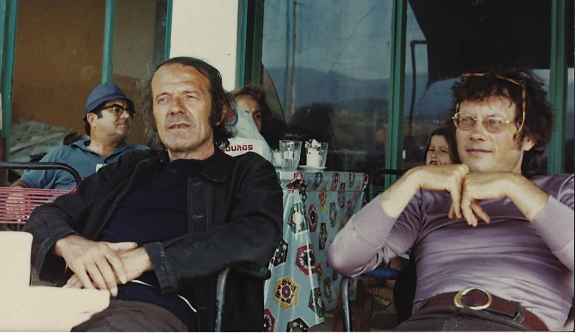
(Nick Land in Bolivia, circa 1997)


Anyone trying to work out what they think about accelerationism better do so quickly. That’s the nature of the thing. It was already caught up with trends that seemed too fast to track when it began to become self-aware, decades ago. It has picked up a lot of speed since then.
Accelerationism is old enough to have arrived in waves, which is to say insistently, or recurrently, and each time the challenge is more urgent. Among its predictions is the expectation that you’ll be too slow to deal with it coherently. Yet if you fumble the question it poses – because rushed – you lose, perhaps very badly. It’s hard. (For our purposes here “you” are standing in as a bearer of “the opinions of mankind”.)
Time-pressure, by its very nature, is difficult to think about. Typically, while the opportunity for deliberation is not necessarily presumed, it is at least – with overwhelming likelihood – mistaken for an historical constant, rather than a variable. If there was ever time to think, we think, there still is and will always be. The definite probability that the allotment of time to decision-making is undergoing systematic compression remains a neglected consideration, even among those paying explicit and exceptional attention to the increasing rapidity of change.
In philosophical terms, the deep problem of acceleration is transcendental. It describes an absolute horizon – and one that is closing in. Thinking takes time, and accelerationism suggests we’re running out of time to think that through, if we haven’t already. No contemporary dilemma is being entertained realistically until it is also acknowledged that the opportunity for doing so is fast collapsing.
The suspicion has to arrive that if a public conversation about acceleration is beginning, it’s just in time to be too late. The profound institutional crisis that makes the topic ‘hot’ has at its core an implosion of social decision-making capability. Doing anything, at this point, would take too long. So instead, events increasingly just happen. They seem ever more out of control, even to a traumatic extent. Because the basic phenomenon appears to be a brake failure, accelerationism is picked up again.
Accelerationism links the implosion of decision-space to the explosion of the world – that is, to modernity. It is important therefore to note that the conceptual opposition between implosion and explosion does nothing to impede their real (mechanical) coupling. Thermonuclear weapons provide the most vividly illuminating examples. An H-bomb employs an A-bomb as a trigger. A fission reaction sparks a fusion reaction. The fusion mass is crushed into ignition by a blast process. (Modernity is a blast.)
This is already to be talking about cybernetics, which also returns insistently, in waves. It amplifies to howl, and then dissipates into the senseless babble of fashion, until the next blast-wave hits.
For accelerationism the crucial lesson was this: A negative feedback circuit – such as a steam-engine ‘governor’ or a thermostat – functions to keep some state of a system in the same place. Its product, in the language formulated by French philosophical cyberneticists Gilles Deleuze and Félix Guattari, is territorialization. Negative feedback stabilizes a process, by correcting drift, and thus inhibiting departure beyond a limited range. Dynamics are placed in the service of fixity – a higher-level stasis, or state. All equilibrium models of complex systems and processes are like this. To capture the contrary trend, characterized by self-reinforcing errancy, flight, or escape, D&G coin the inelegant but influential term deterritorialization. Deterritorialization is the only thing accelerationism has ever really talked about.
In socio-historical terms, the line of deterritorialization corresponds to uncompensated capitalism. The basic – and, of course, to some real highly consequential degree actually installed – schema is a positive feedback circuit, within which commercialization and industrialization mutually excite each other in a runaway process, from which modernity draws its gradient. Karl Marx and Friedrich Nietzsche were among those to capture important aspects of the trend. As the circuit is incrementally closed, or intensified, it exhibits ever greater autonomy, or automation. It becomes more tightly auto-productive(which is only what ‘positive feedback’ already says). Because it appeals to nothing beyond itself, it is inherently nihilistic. It has no conceivable meaning beside self-amplification. It grows in order to grow. Mankind is its temporary host, not its master. Its only purpose is itself.
“Accelerate the process,” recommended Deleuze & Guattari in their 1972 Anti-Oedipus, citing Nietzsche to re-activate Marx. Although it would take another four decades before “accelerationism” was named as such, critically, by Benjamin Noys, it was already there, in its entirety. The relevant passage is worth repeating in full (as it would be, repeatedly, in all subsequent accelerationist discussion):
… which is the revolutionary path? Is there one?—To withdraw from the world market, as Samir Amin advises Third World countries to do, in a curious revival of the fascist “economic solution”? Or might it be to go in the opposite direction? To go still further, that is, in the movement of the market, of decoding and deterritorialization? For perhaps the flows are not yet deterritorialized enough, not decoded enough, from the viewpoint of a theory and a practice of a highly schizophrenic character. Not to withdraw from the process, but to go further, to “accelerate the process,” as Nietzsche put it: in this matter, the truth is that we haven’t seen anything yet.
The point of an analysis of capitalism, or of nihilism, is to do more of it. The process is not to be critiqued. The process is the critique, feeding back into itself, as it escalates. The only way forward is through, which means further in.
Marx has his own ‘accelerationist fragment’ which anticipates the passage from Anti-Oedipusremarkably. He says in an 1848 speech ‘On the Question of Free Trade’:
…in general, the protective system of our day is conservative, while the free trade system is destructive. It breaks up old nationalities and pushes the antagonism of the proletariat and the bourgeoisie to the extreme point. In a word, the free trade system hastens the social revolution. It is in this revolutionary sense alone, gentlemen, that I vote in favor of free trade.
In this germinal accelerationist matrix, there is no distinction to be made between the destruction of capitalism and its intensification. The auto-destruction of capitalism is what capitalism is. “Creative destruction” is the whole of it, beside only its retardations, partial compensations, or inhibitions. Capital revolutionizes itself more thoroughly than any extrinsic ‘revolution’ possibly could. If subsequent history has not vindicated this point beyond all question, it has at least simulated such a vindication, to a maddening degree.
In 2013, Nick Srnicek and Alex Williams sought to resolve this intolerable – even ‘schizophrenic’ – ambivalence in their ‘Manifesto for an Accelerationist Politics,’ which aimed to precipitate a specifically anti-capitalist ‘Left-accelerationism’, clearly demarcated over against its abominably pro-capitalist ‘Right-accelerationist’ shadow. This project – predictably – was more successful at re-animating the accelerationist question than at ideologically purifying it in any sustainable way. It was only by introducing a wholly artificial distinction between capitalism and modernistic technological acceleration that their boundary lines could be drawn at all. The implicit call was for a new Leninism without the NEP (and with the Utopian techno-managerial experiments of Chilean communism drawn upon for illustration).
Capital, in its ultimate self-definition, is nothing beside the abstract accelerative social factor. Its positive cybernetic schema exhausts it. Runaway consumes its identity. Every other determination is shucked-off as an accident, at some stage of its intensification process. Since anything able to consistently feed socio-historical acceleration will necessarily, or by essence, be capital, the prospect of any unambiguously ‘Left-accelerationism’ gaining serious momentum can be confidently dismissed. Accelerationism is simply the self-awareness of capitalism, which has scarcely begun. (“We haven’t seen anything yet.”)
At the time of writing, Left-accelerationism appears to have deconstructed itself back into traditional socialist politics, and the accelerationist torch has passed to a new generation of brilliant young thinkers advancing an ‘Unconditional Accelerationism’ (neither R/Acc., or L/Acc., but U/Acc.). Their online identities – if not in any easily extricable way their ideas – can be searched-out through the peculiar social-media hash-tag #Rhetttwitter.
As blockchains, drone logistics, nanotechnology, quantum computing, computational genomics, and virtual reality flood in, drenched in ever-higher densities of artificial intelligence, accelerationism won’t be going anywhere, unless ever deeper into itself. To be rushed by the phenomenon, to the point of terminal institutional paralysis, is the phenomenon. Naturally – which is to say completely inevitably – the human species will define this ultimate terrestrial event as a problem. To see it is already to say: We have to do something. To which accelerationism can only respond: You’re finally saying that now? Perhaps we ought to get started? In its colder variants, which are those that win out, it tends to laugh.
Nick Land is an independent writer living in Shanghai.
***
Note:
Urbanomic’s #Accelerate: The Accelerationist Reader, remains by far the most comprehensive introduction to accelerationism. The book was published in 2014, however, and a lot has happened since then.
The Wikipedia entry on ‘Accelerationism’ is short, but of exceptionally high-quality.
For the Srnicek and Williams ‘Manifesto for an Accelerationist Politics’ see this.

READ MORE CLICK HERE @ FREE microCOMMUNISM NETWORK


martedì 6 dicembre 2016

Edmund Berger: A Conspiracy Against the World: Comments on Andrew Culp’s “Dark Deleuze” @ Deterritorial Investigation Unit

“We do not lack communication,” Gilles Deleuze and Felix Guattari wrote in What Is Philosophy?, their final joint text. “On the contrary, we have too much of it. We lack creation. We lack resistance to the present.”[1] During the course of an interview with Antonio Negri, Deleuze raised a similar point, one that appears to have slipped past the autonomist: “The quest for ‘universals of communication’ ought to make us shudder… Maybe speech and communication have been corrupted. They’re thoroughly permeated by money—and not by accident but by their very nature. We’ve got to hijack speech.” In a similar mode of thought, the philosopher of the rhizome suggested in his infamous “Postscript on the Societies of Control” that the way power organized itself was transforming, moving away from the disciplinary societies that Foucault had so intently studied and towards the figure of the “continuous network”.
Deleuze’s interview with Negri had occurred in 1990, and What Is Philosophy? debuted in 1991. The “Postscript” appeared in the pages of October in 1992. This timing provides crucial context: the fall of the Soviet Union and the victory of a capitalist system entering its globalizing stage. The spread of information-communication platforms and the advent of the Dotcom Economy. This was the time in which the bi-polar world of the Cold War era was dissolving into a multipolar world, steered primarily by the first truly neoliberal regimes in the United States and the European, professing as they did the coming utopia of fluid trade, inter-state co-operation, and unlimited, global communication and knowledge sharing. It was this backdrop that Deleuze suggested to Negri that perhaps the way forward was a rekindling of new forms of resistance, forms that would take the techno-social substrate, deform them, break them, and ultimately “create vacuoles of noncommunication, circuit breakers, so we can elude control”.
For those familiar with Deleuzian thought, that non signals an interesting change in the philosopher’s perspective: it is a looming negativity, one that seems to stand in contrast to Deleuze’s life-long commitment to affirmation, to saying yes, and to cultivating joy. It is from this small glow of negativity, and the dozens of others scattered about Deleuze’s corpus, that Andrew Culp fashions a philosophical figure for our time: a Dark Deleuze.
I have to say it: this is an incredible book, and despite clocking in at a mere seventy pages, it is probably one of the most important books in the Deleuzian canon that I have read in a long time. What makes it stand out so much from other works is not simply its sense of political intransigence (much more on that momentarily), but that it doesn’t treat Deleuze like so many commentators have in the mad-rush to transform Continental, post-structuralist thinking into an academic cottage industry. Deleuze and This. Deleuze and That. Now, Culp’s work can read as part of the academic debate on Deleuzian philosophy and its future, but it is not reducible that. Unlike these other works, it takes up the challenge that Deleuze himself set out – to draw out from a thinker that which is present in the text, but not said, to take a philosopher and give him “a child that would be his own offspring, yet monstrous.” Indeed, Culp excavates the negative buried in Deleuze and brings it fully into the open: the insistence in Anti-Oedipus that the purpose of schizoanalysis is to destroy, Deleuze’s reflection Difference and Repetition that the book constitutes apocalyptic science fiction, his fascination with Artaud and the Theater of Cruelty, his identification of the body’s scream as the very center of philosophy itself. Sometimes we can even glimpse the negative lurking in plain sight by merely shifting perspective: what is becoming but the un-becoming of something else, a small death in its own right?
My politics differ a bit from Culp’s, and perhaps a bit from his Dark Deleuze. Dark Deleuze breaks with the celebration of connectivity and communication, while I believe that connectivity is intrinsic to revolutionary goals – though I fully agree that fighting for such a thing might require a step backwards or two. The ultimate goal of Dark Deleuze, Culp writes, is “full communism”. My position is rooted in anarchism-without-adjectives, with a strong lean towards market anarchism (so when a brief dismissal of ‘Proudhonism’ is offered, I cannot but protest). When he urges a move from “technoscience” to “political anthropology”, I want both – I have cast my lot with technoscience. In a critique of Landian accelerationism, Culp suggests that “Deleuze and Guattari’s ‘accelerationism’ has been too tarnished to rehabilitate”; as an accelerationist I again have to raise my hand in protest.
[I suppose I should point out, however, that my accelerationism stems neither from what was cooked up in the CCRU or aligns absolutely with the social democratic ‘left accelerationism’. If anything, it falls under what Land has recently described as “fundamentalist accelerationism” – and I strongly suspect that Culp’s Dark Deleuze falls squarely in this (non)tendency as well. Sorry, Andrew!]


Despite these perhaps very important political differences, I concur wholly with Culp that cultivating the negative is a task of utmost importance. The ultimate goal of this task, we read, is not the creation of concepts (per the traditional reading of Deleuze), but the destruction of worlds. Some might recoil in horror at such a notion. Worlds are destroyed everyday by the police and the military and even by the do-gooders of capitalism; the world itself may very well be destroyed under the ecological forces we arrogantly signify with the term “Anthropocene”. But these things are of the world as it is, because of the world as it is, and it is for this reason that this world must be destroyed. To talk of the “destruction of worlds” is to talk of the learning how to say no to this world, to refusal that which it offers and that which it stands posed to say. The impulse of negation, the specter of Dark Deleuze insists, is the only reasonable course of action “in an era of generalized precarity, extreme class stratification, and summary executions of people of color.”
It’s not too much of a leap from the classic Deleuzian focus on cultivating joy to developing hatred for this world. Joy and hatred are not necessarily elements on the opposite end of some spectrum. “His teeth were ground down to points”, Greil Marcus scrawled in Lipstick Traces, mashing up Johnny Rotten’s mouth, the Dadaist parody of the savagery of war, and the Situationist’s declaration the great town planners of the Fordist era were nothing more than builders of ruins.[2] Even though each has long since been recuperated, the affective register emanating from the negative runs through all, each reflecting a disgust with the world that became a hatred of the world, ultimately becoming a refusal of the world and steps to actively changing it. “We are here”, they answered in their own ways, to the question posed by Deleuze 1977: “who are our nomads of today?” To this, Culp adds that “[t]he nomads that will dissolve capitalism will are not cowboys but barbarians.” Barbarians indeed! Musty history aside, we find that joyous barbarism, that will to be against alive and well today. It’s present every time a mask donned, a window deliberately broken, a police force stymied, a fascist rally disrupted.
I don’t want to give the impression that Culp’s work operates merely at the affective level (though affect, as anyone familiar with Deleuze will tell you, is vitally important to developing political processes). In order to cobble together Dark Deleuze, it becomes essential to carry out a critique of the more common bearers of the Deleuzian flame. Chief amongst these are those that collapse A Thousand Plateaus’s celebration of the rhizome, the self-organizing principles of the war machine, and the dynamic geophilosophies into little other than a coded discourse on complexity theory. Such is the case with the tendency running from Manuel DeLanda down through the so-called “new materialisms”; while these works – and complexity theory writ large! – often do pose valid insights, they often interface with Deleuzian thought in a way that sheers off the sharp, political edge. Beyond this, however, there is an unfortunate tendency towards the sort of naturalistic thinking akin to that I have diagnosed in the works of Lewis Mumford. Culp writes that the slippery metaphor of complexity frequently “culminates in a ‘flat ontology’… [that] often leads to a ‘uniformization of diversity’ and “equalization of inequality”. The new materialisms, in other words, fold everything together into the same processes, and thus eliminate difference.

Dark Deleuze’s solution is an asymmetry between the elements or forces working in a system, or between relations of multiple systems. The purpose of this asymmetry is to allow difference to proliferate – and also to allow us to carry out critical separations between things. The immediate concerns of Dark Deleuze aside, such a notion would serve as quite useful a device in navigating the murky waters of complexity and emergence in general, as a kind of second-order mechanism that allows us to remain partially embedded in a system (say, a regional ecology, insofar as we can actually talk of such things) while also working against beyond it and against it (the movement of society at the infrastructural level). Such a mechanism would serve as “an indivisible asymmetrical relation”, to quote Deleuze from Difference and Repetition, “established between series of heterogeneous terms and expresses at each moment the nature of that which does not divide without changing its nature.”[3]
Also to be warded off are the democratic Deleuzians, a banishing that formally brings the figure of Dark Deleuze into the canon of delicious Negri-bashing that had been innovated by Tiqqun and their conspiratorial offshoot, the Invisible Committee. One doesn’t even have to read deeply into Deleuze and Guattari to put the silly notions of Deleuze-as-liberal to rest, and it is worth quoting Culp at length on this matter:
Deleuze and Guattari viciously criticize democracy in their collaborations, usually by calling it the cousin of totalitarianism. They discuss democracy, fascism, and socialism as all related in Anti-Oedipus. In A Thousand Plateaus they discuss “military democracy”, “social democracy” as the complementary pole of the state to “totalitarianism”, “totalitarian-social democracy”, and a poverty-stricken “Third World social democracy”. In What Is Philosophy? they speak of Athenian “colonizing democracy”, hegemonic democracy, democracy being caught up with dictatorial states, a social democracy that “has given the order to fire when the poor come out of their territory or ghetto”, and a Nazi democracy, which all lead them to conclude that their utopian “new people and a new earth… will not be found in our democracies”. Together, they can be neatly summarized: no matter how perfect, democracy always relies on a transcendent sovereign judgement backed by the threat of force.
Thus what Dark Deleuze ultimately draws out is what Deleuze and Guattari always were all along, but seemed so recalcitrant to admit it: anarchists of the most radical form. The figure of Dark Deleuze itself is not one of the future society, nor even the revolution which could deliver it; it is a ghost of an anarchist conspiracy haunting our current society. Anti-Oedipus was itself a great book of conspiracy, drawing its energy the Nietzsche that was revealed by Klossowski: the Nietzsche that formed a conspiracy “not only against his whole class, but also against the existing forms of the human species as a whole.”[4] It goes without saying that this conspiracy against humanity is not one of extermination, but of a Death of Man to follow the Enlightenment’s Death of God. The proclamation “God is dead” illustrates how under the march of civilization, the former power of theology was unmoored and lessened; with the proclamation “Man is dead!”, the dissolution of the power relations that set humans over humans.
In its short space, Dark Deleuze moves through these concepts and many others very rapidly. Just when one begins to feel out the argument being made, the next argument is already being deployed. Such treatment makes for fast reason, and is well suited for the excellent aphorisms that Culp drops along the way (I’m very jealous of “temporary autonomous zones have become special economic zones”). But I do hope we get a larger and more in-depth treatment down the line – yet perhaps this is precisely the sort of academic navel-gazing that Dark Deleuze intends to avoid. Culp tells us that “the ultimate task of Dark Deleuze is but a modest one: to keep the dream of revolution alive in counterrevolutionary times.” It is a book for the barricades.
[1] Gilles Deleuze and Felix Guattari What Is Philosophy? Columbia University Press, 1994, pg. 108
[2] Greil Marcus Lipstick Traces: A Secret History of the Twentieth Century Harvard University Press, 1990, pg. 27
[3] Gilles Deleuze Difference and Repetition Athlone Press, 1994 pgs. 237-238
[4] Pierre Klossowski Nietzsche and the Vicious Circle Continuum, 2005, pg. xiv

*** Picblog : by Zoorex 

giovedì 1 ottobre 2015

1.1.MONETA, RIVOLUZIONE E ACCELERAZIONE NELL’ANTI-EDIPO DI DELEUZE E GUATTARI - Capitolo I - Cuore di tenebra o locus classicus dell’accelerazionismo?

Moneta, rivoluzione e accelerazione nell'Anti-Edipo di Deleuze e Guattari


1.1. - Capitolo I - 


.............................................................................................
.............................................................................................

Tratto da «Moneta, rivoluzione e filosofia dell'avvenire. Nietzsche e la politica accelerazionista in Deleuze, Foucault, Guattari, Klossowski»


di Obsolete Capitalism


1.1. Cuore di tenebra o locus classicus dell’accelerazionismo?

Proseguiamo con questo saggio la nostra ricerca su una delle fonti primarie dell’accelerazionismo: l’intera parte finale del paragrafo La macchina capitalistica civilizzata (AE, 271-72). Le letture simultanee del saggio di Christian Kerslake Marxism and Money in Deleuze and Guattari’s Capitalism and Schizofrenia (Parrhesia, n. 22, 2015) e delle note di Matteo Pasquinelli Code Surplus Value and the Augmented Intellect (M.P. blog, 2014) ci hanno segnalato la persistenza di un nucleo di problemi riguardanti l’interpretazione di uno dei passi più significativi e cruciali dell’Anti-Edipo di Deleuze e Guattari. Il primo scopo del saggio sarà dunque la ricerca del significato più profondo dell’intero passo e il chiarimento della sua oscillazione tra le due polarità di moneta e rivoluzione. Il secondo scopo di questo saggio è la segnalazione di una conventio ad excludendum nei confronti di Friedrich Nietzsche da parte dell’accelerazionismo contemporaneo. Nel testo antologico «fondativo» dell’accelerazionismo, #Accelerate curato da Robin Mackay e Armen Avanessian (Urbanomic, 2014), fin dalle prime pagine notiamo un vuoto assordante, un silenzio rumoroso, una sanzione felpata nei confronti di Nietzsche. Nella scelta dei testi anticipatori del contesto accelerazionista, molto accurata, troviamo Marx, Butler, Fedorov e Veblen (#A, 8-11), ma nemmeno un testo dal Nietzsche post-Zarathustra, né dai Frammenti Postumi, né dal «cannoneggiamento» gemello di Al di là del bene e del male e di Genealogia della morale. Nella cronologia (#A, 3) inserita come memento significativo della progressione del pensiero sul tema accelerazione e macchina, tra il 1858 del Marx del Frammento sulle macchine e il 1970 di Firestone difetta proprio il 1887 del frammento «accelerazionista» di Nietzsche, I forti dell'avvenire. Uno degli obiettivi del presente testo è la giusta collocazione di Nietzsche e del suo pensiero all’interno dell’accelerazionismo e del pensiero di Deleuze e Guattari, in particolare nell’Anti-Edipo. Il filosofo di Röcken non ha forse parlato, in modo essenziale, di macchina totale, di solidarietà di tutte le ruote, di accelerare il processo? Si tratta, forse, di una peculiare difesa da parte degli estensori di #Accelerate, per non scorgere la tetraggine strisciante e la mostruosità sinistra che ci si para innanzi alla società moloch paventata da Nietzsche? Matteo Pasquinelli segnala in modo del tutto corretto l’epilogo di La macchina capitalistica civilizzata - noto come il passaggio della «via rivoluzionaria» oppure dell’«accelerare il processo» -  come il locus classicus dell’accelerazionismo per lo spessore che gli interrogativi di Deleuze e Guattari pongono; ma le risposte a quelle domande non sono ancora state individuate, e dunque rimangono sospese. Esse riguardano la strategia delle lotte rivoluzionarie, la vettorialità del capitalismo nichilista e le possibili vie d’uscita rispetto a una situazione politica, economica e sociale che segna la ruvida e deludente figura del cul de sac.
Riportiamo ora il testo oggetto della presente indagine:
"Solo dunque a livello di una teoria generalizzata dei flussi si può rispondere alla domanda: come si giunge a desiderare la potenza, ma anche la propria impotenza? Come un tal campo sociale ha potuto essere investito dal desiderio? E come il desiderio supera l'interesse oggettivo, quando si tratta di flussi da far scorrere o da tagliare! Certo, i marxisti ricordano che la formazione della moneta come rapporto specifico nel capitalismo dipende dal modo di produzione che fa dell'economia una economia monetaria. Rimane il fatto che il movimento oggettivo apparente del capitale, che non è per nulla un misconoscimento o un'illusione della coscienza, mostra che l'essenza stessa produttiva del capitalismo non può funzionare se non in questa forma necessariamente commerciale o monetaria che la governa, e i cui flussi e i rapporti reciproci contengono il segreto dell'investimento di desiderio. L'integrazione del desiderio avviene infatti a livello dei flussi, e dei flussi monetari, non a livello dell'ideologia. Quale soluzione allora? Quale via rivoluzionaria? La psicanalisi è di scarso aiuto, nei suoi rapporti più intimi col danaro, essa che registra, guardandosi bene dal riconoscerlo, tutto un sistema di dipendenze economico-monetarie nel cuore del desiderio di ogni soggetto che tratta, e che costituisce per suo conto una gigantesca impresa di assorbimento di plusvalore. Ma quale via rivoluzionaria, ce n'é forse una? Ritirarsi dal mercato mondiale come consiglia Samir Amin ai paesi del Terzo Mondo, in un curioso rinnovamento della «soluzione economica» fascista? Oppure andare in senso contrario? Cioè andare ancora più lontano nel movimento del mercato, della decodificazione e della deterritorializzazione? Forse, infatti, i flussi non sono ancora deterritorializzati, abbastanza decodificati, dal punto di vista di una teoria e di una pratica dei flussi ad alto tenore schizofrenico. Non ritirarsi dal processo, ma andare più lontano, «accelerare il processo», come diceva Nietzsche: in verità, su questo capitolo, non abbiamo ancora visto nulla." (AE, 271-72)


domenica 1 settembre 2013

Nick Land: Phylosophy of War @ Dissolution


Nick Land: 
Phylosophy of War 
@ Dissolution (Fight more...)

“War is deception” – Sunzi
“War is the father of all things” -- Heraclitus
“War is god” -- Cormac McCarthy (Blood Meridian)
“You have made your way from the worm to man, and much within you is still worm.” – Nietzsche (Thus Spake Zarathustra)


Camouflage
In a reality at war, things hide. The alternative is to become a target, a casualty, and thus – in the course of events – to cease to be. When war reigns, ontology and occultation converge. The oldest of all alliances binds survival to the shadows.
Absent a sovereign peace, of the kind an all-powerful and benevolent God -- or its political proxy -- could ensure, existence is a jungle of lies. Within such an environment truth, or unconcealment, is a way to get things killed.
To see is to eliminate, actually or virtually, and with virtual elimination comes dominion. This is to return to pacific sovereignty on a darker (but illuminated) path. If no God is found already at work, announced unambiguously through a manifest peace, then a substitute has to be made from the suspension of war -- and that presupposes a war. A God who hides blesses only battlefields, because his stand-in will be a state.
In a war there can be no philosophical innocence (and there has never been philosophical innocence).
Even when epistemology pretends to concern itself with things that we just happen not to know, its objects infect it with dissimulation, camouflage and secrecy, making it complicit in the transmission of the lie. It plays out war games of concealment and exposure, disinformation, distraction, and feint, entangled in the complex skein of signal manipulation and evaluation known to all militaries as ‘intelligence’.

To know, or not to know – these matters are too important to be ignored by the war. It is through such discrimination that the difference between life and death is decided, and distributed. This is how the administrators of war, at their most confidently articulate, speak:
There are known knowns. These are things we know that we know. There are known unknowns. That is to say, there are things that we know we don’t know. But there are also unknown unknowns. There are things we don’t know we don’t know. Who are we? (‘We’ don’t know ...)


Escalation
Before beginning over, from the end, there are some things to be said about ends. What modernity finds thinkable in war is owed, above all, to Carl von Clausewitz, and his great synthesis of organized bellicosity with rational statecra,, under the principle that war is politics by other means . Politics supplies the end, and thus the war aim, to which all strategy and tactics is subordinated, in accordance with a rigorous teleological scheme. Military purposes have their final cause in the rational self-interest of the state.
Within the Clausewitzean philosophical system, the military apparatus is essentially technological. The entirety of its social and technical composition is comprehensible as teleological machinery, integrated in accordance with a command-control hierarchy of cascading purposes, connected to a transcendent political will. From the boots and bullets that constitute its simplest pieces of equipment, through tactical drills and maneuvers, to large scale strategic plans and operations, it can always meaningfully be asked: What is this for? Furthermore, this question is necessarily strictly equivalent to asking: How does this serve the ultimate war aim? War in-itself, however, is an emergent phenomenon, arising between states – rather than in subordination to them – and thus eluding the political meaning that corresponds to finalistic intelligibility. A war, as such, is not for anything (not even ‘for oil’), unless it is misleadingly identified with the highest level strategy of one or other antagonist. Within the war no less than two ultimate aims, or political wills, collide, so that -- of necessity -- it can have no unambiguous purpose. Consequently, we cannot ask: Who is the war? Or: What does it want? (that would, or course, be insane.)
Nevertheless, Clausewitzean war has an inherent gradient, which simulates purpose to an arbitrary level of approximation.  In accordance with its own nature, to which the antagonistic agents are pressed into compliance, war tends to an extreme. In other words, any restricted form of warfare is conceived as fragile political artifice, stubbornly subverted by a trend to escalation that expresses the nature of war in-itself, and which thus counts – within any specific war -- as the primary axis of real discovery.  A crypto-teleology proper to war itself is demonstrated by the inclination of violent, politically-uncircumscribed conflict to escape all limitation.
From the perspective of the state and its serious games – which, as we shall see, can be transferred beyond the state onto trans-political confrontations of an even more radical nature – it is not di cult to understand how escalation (the autonomization of war) takes over. Insofar as the state approaches its historical essence, as a sovereign or ultimate entity, military defeat is a catastrophe that cannot in principle be transcended. From the intrinsic character of the state, it follows that no measure required to avoid defeat can be excessive. The epoch of nuclear confrontation, which – contrary to superficial appearance – has scarcely begun, has facilitated the rigorous formalization of this macro-political incentive to the abandonment of limitation, all the way to Mutually Assured Destruction.
Conceived concretely as a relationship between antagonists, rather than abstractly as a gradient of war in-itself, escalation is a zig-zag of reciprocal incitement, or a cybernetic circuit without negative (dampening) links. The structural predisposition of each party to escalation is carried forwards, or advanced in time, as an efficient virtuality, reinforcing the positive trend with a supplementary motive for pre-emption. The probability that the enemy will at some point escalate becomes a prompt for anticipatory counter-escalation, creating a wave of intensified war effort with reversed time signature. The model war is maximally-accelerated escalation provoked by the future: Time pressure.


Threat Matrix
Respond now to what the enemy might do, and science fiction has become a component of military strategy (operating as an escalator). Nowhere is this more dramatically evident than in the work of Hugo de Garis, where a reverse cascade of threat anticipation embeds war in-itself within contemporary information technology. First implemented in military cryptography machines, and later distributed across robust networks designed to survive nuclear attack, military imperatives have been hard-coded into computational infrastructure from the start. Advanced technology conducts political teleology by adapting C4 systems (command, control, communications, and computation) to the Clausewitzean conditions of intensified war – whether actual or virtual – characterized by extreme escalation, ‘fog’ and ‘friction’. The emergent abstract factor is resilient intelligence, the most flexible (general-purpose) principle of competitive advantage. The crypto-teleology of war (in-itself) becomes increasingly identified with artificial intelligence production.
As a high-level technical theoretician practically promoting the development of artificial brains, Hugo de Garis is implicitly connected to this lineage, despite his avoidance of formal links to military research programs. This distance from overt defense work – which might have lured a less scrupulous intelligence into fantasies of philosophical innocence – prompted de Garis into a conceptual escalation beyond the Clausewitzean framework. Rather than envisaging technology as the conductor of the state war aim, he began to suspect that it was itself an unsubordinated teleological element, displacing the state as final cause.
Against the limited conception of a war waged through technology, escalated by disciplined science fiction speculations intrinsic to the military apparatus, de Garis turned (through an escalated science fiction) to the model of an unlimited or ‘gigadeath’ war waged over and about (while also still through) technology. The fate of technology would no longer be decided by the wars among states, but would itself become a polarizing cause, determining a trans-political war, with states as teleologically-subordinated components (or large-scale technological parts). The point of contention: Will super-human artificial intellects (or ‘artilects’) be permitted to happen?
The coming Artilect War – “almost inevitable before the end of the 21st century” . – subsumes everything into the axis of escalation, pitting ‘Cosmist’ proponents of technological extrapolation without limit against the ‘Terran’ resistors who oppose it. The retro-chronic dynamics of escalation are driven to an ultimate limit by fundamental game-theoretic dissymmetry. The Terrans cannot possibly escalate too hard, too fast, because the Cosmists are aligned with escalation, and therefore win automatically if the war is prolonged to its intrinsic extreme. The Terrans cannot allow the war to take its time, knowing that anything other than a ‘prematurely’ concluded war is a Cosmist success. Time pressure reaches its maximum, through the condensation of an absolute threat that is intricately entangled with the means required to counter it.


End Game
Even in an extreme formulation of the de Garis Artilect War, the Cosmists are still a ‘side’. While aligned exactly with the inherent trend of war in-itself, they supply it with a recognizable ideological subjectivity, preserving a residue of dialectical intelligibility. Artilects are double counted, at the bottom and top of the teleological order – as mere weapons, and as final causes. Simply tracking the tangled circuitry of this model would eventually describe complexities beyond pursuit. What can already be comprehended of the Terran perspective is enough to demonstrate that – for the human resistance – it cannot begin quickly enough. If tomorrow is too late, and yesterday none too soon, it crashes through the present to embed itself deeply within the (apparent) epoch of Clausewitzean war. With no Cosmists to represent the cause of escalation, war’s crypto-teleology – the ultimate enemy – hides itself among the cross-currents of state-political antagonism.
The question then arises: is Stuxnet a soft-weapon fragment from the future war? When its crypto-teleological significance is finally understood, will this be confined to the limited purpose assigned to it by US-Israeli hostility to the Iranian nuclear program? Does Stuxnet serve only to wreck centrifuges? Or does it mark a stage on the way of the worm, whose final purpose is still worm? Are Cosmists even needed to tell this story?
The answer depends upon the limitation of war, which can be represented by the proxy of anti-proliferation. If state-political objectives are able to subordinate – or indefinitely master – the crypto-teleology of escalation, then Stuxnet will have ‘always been’ an instrument of policy, or never significantly more than a weapon.  Despite the ‘fog’ of war, the ‘friction’ of unpredictable events, and the tendency to techno-military escalation it demonstrates, there would be no reason to think a more-or-less exhaustive explanation for its existence were not already available in principle, however deeply encrypted. Then we could know, even if (befogged and disinformed) we concretely do not, that it was designed to prevent escalation – in the guise of Iranian nuclear capability – from escaping the politically-circumscribed order of the world.
If, on the contrary, war is going to escape, then nothing we think we know, or can know, about its history will remain unchanged. State-politics will have been the terrain in which it hid, military apparatuses the hosts in which it incubated its components, antagonistic purposes the pretexts through which – radically camouflaged – it advanced. Its surreptitious assembly sequences would be found scattered backwards, lodged, deeply concealed, within the disinformational megastructure of Clausewitzean history.
“War is god” asserts Cormac McCarthy’s Judge Holden. It has its own order of providence and its own laws. It is the ultimate meaning of things.
We are under no compulsion to believe a self-declared fiction, or to listen uncritically to a character within it. We have only to think about the ways things hide, or – less demandingly still – to accept that thoughtlessness loses wars.
Does the war think? We don’t know (but the idea sounds insane).


On War, by General Carl von Clausewitz, translated by Colonel J.J. Graham, http://www.gutenberg.org/)les/1946/1946-h/1946-h.htm
. Hugo de Garis (2005). The Artilect War: Cosmists Vs. Terrans: A Bitter Controversy Concerning Whether Humanity Should Build Godlike Massively Intelligent Machines. Palm Springs, CA: ETC Publications. ISBN 0-88280-154-6.