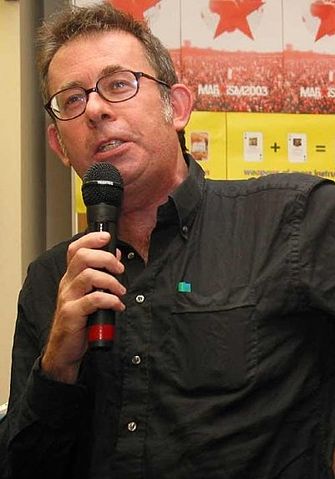
Mikhail Khazin was born in 1962 in Moscow. He completed his comprehensive study of mathematics in Moscow. For the next 10 years he ran mathematics workshops in various schools and taught students of math-stream classes. After failing to gain admission to the Mechanics and Mathematics faculty at Moscow State University (due to ethnic profiling existing at the time), he enrolled in the Mathematics faculty at Yaroslavl University. In 1980 he transferred to the Probability Theory Department of the Mechanics and Mathematics Faculty at Moscow State University.
After graduating from the university in 1984, M. Khazin worked in the Laboratory of Computational Mathematics at the USSR Academy of Sciences’ Institute of Physical Chemistry. In 1989 he was employed at the USSR Central Statistical Directorate’s Institute for Statistics and Economic Research. In 1992, together with his friends and former students, M. Khazin worked as a head of Analytics Department in one of the then-biggest banks of Russia, ELBIM-Bank.
In 1993 M. Khazin entered public office. He worked first for the Labour Centre for Economic Reforms, created by Yegor Gaidar with the purpose of theoretically justifying the reforms, then in the Russian Federation’s Ministry of Economy under the ministers A. Shokhin and later E. Yasin. Meanwhile, divisive issues with the so-called Gaidar-team started emerging, in that there was increasing evidence of embezzlement of government funds, sabotage and unabashed corruption on the part of the Gaidar team.
In March of 1997 M. Khazin became a Deputy Chief of the Economic Directorate at the Presidential Administration. In June of 1998 he was discharged from public service for attempting to fight corruption during the privatization (in other words, for standing up against the Summers-Chubais team) and to avert governmental policies that led to the default of 1998. Khazin was unemployed for 2 years and for the next 10 years he was not permitted to leave Russian territory.
Since the summer of 2000 Khazin has been employed as a consultant. On September 10, 2001, when participating in the Expert journal’s forum and analyzing the economic situation in the United States, he foresaw a high likelihood of large-scale terrorist attacks organized by the U.S. authorities to explain the deterioration of the economic situation in the country. M. Khazin and his associates at the time elaborated the theory of modern economic crisis. At the beginning of 2002 Khazin published a paper dedicated to the basics of structural crisis in the USA which outlined the scale of the current crisis. 2004 saw the publication of the book ‘The Decline of the Dollar Empire and the End of Pax Americana’, written in 2003 in collaboration with A. Kobyakov.
Since 2002 M. Khazin has been the President of the consulting company Neokon, which mainly specializes in strategic crisis planning. He actively investigates economic theory within a framework of enhanced understanding of modern economic mechanisms that are figuratively and collectively referred to as neoconomics. At present M. Khazin takes a principal interest in studying the structural proportions of post-crisis economics and prices. A number of his articles and interviews about economic problems have been featured in various media.
Questions
Pertaining to the Russian Central Bank. Who owns it and who controls it and who profits from it? Do foreign interests have a role to play within it and the bank's ability to inject liquidity into the Russian economy? Can the Russian government instruct the Russian central bank in policy decisions? Can they create an alternative to western based financial institutions like SWIFT, Visa etc. to a system based on rubles?
How is Russia’s national money supply structured presently and Why is the Russian Central Bank still depending on accumulation of US dollars before issuing Ruble’s and if this policy will change in the future, how will that affect financing of the Russian national economy from domestic sources like from Sberbank instead of relying on foreign investment?
T1, Princeton NJ
Malcolm Donald
James, Canada
Vic, Northern Ireland
Roxz, Sweden
Colin McKay Australia
Answer
There is a law that states that the Central Bank is independent of the government. Theoretically, the Central Bank has the right to set its own monetary and money creation policy. However, there are two limitations. The first is the IMF policy. Since the Russian Federation signed an agreement with this organization, the Central Bank sees itself as the main instrument for the implementation of the agreement. Of course, it is largely determined by personalities - while the head of the Central Bank, Gerashchenko, was indeed a distinguished banker and statesman, the Central Bank's policy was relatively independent of external sources; with Ignatiev and Nabiullina the situation has changed and the latter leaders try not to argue with the IMF.
The second limitation is the National Banking Council, which includes several representatives from the President Office, government and Parliament. A longstanding Russian Finance Minister, Alexei Kudrin, who is not only a personal friend of President Putin but is also close to the IMF Russian expert, played a key role on the Council until recently.
Today, the situation is gradually beginning to change. It is already clear that the old policy of the Central Bank (that reflects the vision of the IMF in its most orthodox form) does not produce the desired effect and there is a growing criticism in the country of the policy of the Central Bank and the government. However, so far, the leadership of the Central Bank is withstanding this public criticism and does not intend to change its policy. At the same time, the government keeps pressure on the Central Bank to achieve specific results for itself. In particular, the devaluation of the ruble in the last two months is largely due to the fact that the government has too optimistically promised economic growth, which is clearly not there. An attempt was made to stimulate it with the Central Bank agreeing to go against its core mandate, which requires ensuring stability of the national currency’
The Central Bank’s investment policy is similarly pulled by the opposing forces of IMF rules and the country’s economic needs. During Gerashchenko’s tenure, the Central Bank was actively increasing domestic capital (from late 1998 until 2003, the money stock M2 increased approximately 10-fold relative to GDP, from 4% to 40%, and about 15 times in absolute terms). The post-Gerashchenko Central Bank has been pursuing a strict policy of keeping the ruble from becoming an independent investment vehicle (in compliance with the principles of the Bretton Woods system, in which the dollar should be the only investment source). It has become clear today that there won’t be foreign investment in Russia at a significant scale and therefore it is necessary to stimulate the ruble investment process. However, the current leadership of the Central Bank refuses to take any steps in this direction. Thus there is a reason to believe that the management of the Central Bank will change in the medium term.
Questions
Distinguished Western economists have pointed out that for years naked gold short selling through manipulation of paper contracts have been used to prop up the United States Dollar and Western allied-currencies against the threat of greater depreciation versus gold. Can Russia and China break the West's gold shorting scam?
Would this be an effective way for Russia to retaliate against the Western-Saudi economic warfare that is driving down the ruble and oil price?
In particular, is there any serious likelihood Russia and China could coordinate to take delivery of large quantities of physical gold at the newly opened Shanghai Gold Exchange in order to create an arbitrage between the fake, naked short created paper gold price on the COMEX London market and in Shanghai, resulting in the end of the COMEX as a serious vehicle for gold price discovery that the central bankers can manipulate? (In other words, breaking the West's quasi-monopoly on 'price discovery' in the precious metals market, of which Russia and China are the world-leading producers).
For many years gold analysts like Dr. Jim Willie and 'King World News' have suggested Russia and China have been willing to tolerate the Western manipulation of gold because this has created a fantastic buying opportunity for Russia and China to stockpile the strategic metals at a huge discount. But with the COMEX price being below the Russian if not Chinese mining cost of production at what point do Moscow and Beijing defend their long term gold mining interests (e.g., Magadan miners in Russian Far East) and corporations from predatory undercutting?
Does the Moscow economic elite see the gold price as an Anglo-American weak spot, to hit back at the West for trying to drag down the ruble and the oil price?
What chances are there of the BRICS nations using a debt-free or gold-backed money system?
Will gold replace the USD as the world reserve asset and unit of settlement for international trade?
James, USA
Corto, Netherlands
Mcbuffalo, Arizona
NotRelevant, The Netherlands
James Bond, Australia
bob kay
Answer
It had been clear to many economists for a long time that the role of gold in the world will grow and, most likely, will return to its position as a single measure of value. In particular, we wrote about the current crisis back in 2004 in our book "The decline of the dollar Empire and the end of the ‘Pax Americana’.” There's a whole Chapter devoted to the role of gold and its manipulation. However, Russian economic leaders close to the IMF ignored this position at the time. This only began to change in the last couple of years. China has been serious about gold for almost the entire last decade and is now actively preparing for a potential transition to a "gold standard," at least in economic relations between the so-called "currency zones," which, in our opinion, will emerge after the single world dollar system falls apart.
But Russia and China cannot stop these manipulations, because the price of paper gold is determined on the speculative dollar markets. They can’t provide "leverage" that would be comparable to that of major U.S. banks that have access to an unlimited issuing resource. The only thing they can do is increase the gap between the price of "paper" and "physical" gold by constantly buying the latter on the world markets. Of course, this increases the instability in the global gold market and creates potential losses for the main "gold dealers" who work with the Federal Reserve on leasing programs, but the degree of imbalances has not reached a critical value yet. It seems to me that the sharp rise in gold prices will start after the burst of the next "bubble" in the US stock market.
With regard to the potential price of gold, as I wrote back in the early 2000's, it is determined by a “fork,” the lower limit of which is the gold price in 1980, when it had its local peak after the dollar was decoupled from gold (USA default) in August 1971, and the upper limit of which is the purchasing power of the dollar in the early twentieth century, when gold was actual money. Today this “fork” (in current dollars) is seen somewhere at the level of $ 4,500 - $ 15,000 per Troy ounce.
Questions
American industry is currently oriented chiefly towards weapons production. What danger do you see for Russian industrialization to take the same precipitous path?
It will be interesting to see if Russia can solve this modern riddle of the Sphinx: how to fold the economic surplus back into the economy, while the oligarchs are doing everything in their power to prevent such a thing. What safeguards Russia may have against the aggrandizement of power corporate entities, especially militarily oriented ones, as has been achieved in the USA?
Who are the groups participating in the discussions to promote the development of Russia industrially and culturally, is it the RAS, Valdai Club, think-tanks, etc? What are the main elements being considered for the proposal? Are foreigners somewhat allowed to participate at some point in the proposal?
Canada shares important features of Russia’s new economy such as growing dependence on resource extraction. Both countries are becoming petro-states, more or less rapidly. My question concerns the extent of de-industrialization in Russia. Is it fair to say that industrial development is now geared to servicing the extraction industries and to what extent is this a trend or not?
After the savage destruction of Novorossiya by the ATO an investment in the hundreds of millions, if not billions, will be required just to get the region back to where they were before they were attacked. On top of the money required for infrastructure, when separation occurs, Novorossiya will be billed, with some justification, their portion of the national debt. Where will the money come from? What role do you think Russia should play in the financing of the rebuild?
juliania New Mexico, USA
12 chair fan
from Patagonia
Da Ric Edmonton, Alberta, Canada
rrell Rankin Canada Winnipeg, Manitoba
Answer
The situation with industry in the US in the past couple of years has somewhat improved. There are two reasons: changing energy prices in the US (and here we must say good words for the Obama administration), and the rising cost of production in China. However, the main factor for long-term growth - private demand – is in decline. This suggests that growth in the US does not even have a medium-term prospect. The drop in private demand is the main impact of the economic crisis, which has continued since 2008. Nothing can be done here, because the main mechanism of its stimulation - the refinancing of private debt in an environment of a decline in the cost of credit - is no longer working. Recall that the discount rate of the US Federal Reserve, which was 19% at the beginning of the “Reaganomics” policy (the main tool of which was increasing lending to households), declined almost to zero by December 2008. It’s impossible to raise the rate now, because it will bring down the whole pyramid of debt around the world.
Today US households consume every year about $3 trillion more than they earn. The situation in the EU is not much better. This means that aggregate demand in the world will be sharply decreasing. In other words, continuing to keep the trading and financial infrastructure of a global system of division of labor won’t be cost-effective. The world will most likely return to regional systems of division of labor. Each such system will have to provide domestic production of basic consumer and investment goods. The territory of their self-sufficiency will be regional, with high enough inter-zonal trade barriers. In this scenario the WTO has no prospects.
An investment source for creating (or restoring) the relevant industry will be the issue of regional currencies (in our 2004 book these regional systems of division of labour are called “currency zones”). In this sense, Canada is very different from Russia. Russia, most likely, will be one of the leaders of the “Eurasian” currency zone and will actively participate in the development strategy of the division of labor and emissions in the zone. Canada will be a part of the “dollar” zone with its strategy prescribed by Washington. So if our description of the development strategy in the short-term is true, then Russia and the US will restore their industrial production. In the US, due to a significant fall in demand and the loss of many foreign markets, it will be much easier to do this. Canada, however, will remain a “resource extraction” economy.
In general, how the “currency zones” will be configured after a sharp reduction in the global aggregate demand is a very interesting question. In particular, I did not believe the independence referendum in Scotland would result in separation from the UK. However, if the elite of Britain decided to enter the dollar currency zone, then Scotland would almost certainly separate because it is obviously attracted to continental Europe. Canada can see the intrigue with the separation of Quebec revived and its subsequent accession to the renewed EU. But I repeat, all these issues will become relevant only after the sharp fall in aggregate demand.
It seems to me that Novorossiya (and Ukraine, like many other countries in Eastern Europe, after the configuration change of the European Union), will be restored using the ruble as the issuing resource. The ruble may remain the national currency of Russia or become, perhaps under a slightly different name, the Eurasian Economic Union currency, which theoretically can include (out of major countries) Turkey, Japan, and United Korea. The last two countries, which are highly oriented towards external markets, will have no other options for regional economic cooperation after the U.S. returns to a policy of isolationism, without which they will not be able to recover their economies.
The Russian expert institutions are divided into three large groups. The first comprises the fragments of the ex-Soviet system of the Academy of Sciences. They partly have lost their quality, but until recently were able to maintain a relative independence. It is this independence, especially in the economic sphere that has infuriated the liberal crowd, which tried to completely destroy the Academy of Sciences as an independent public and expert institute. It is possible to work effectively with some institutions within the group; in particular, some of its representatives were among the Russian participants at the recent XVIII Dartmouth Russian-American conference in Dayton.
The second group is created and funded, either directly or indirectly, by Western grants (the most famous in the economic sphere is the Higher School of Economics, in Russia known as the “Russian Economic School”). Organizations within this group represent the interests of the grantors, and their authority has lately fallen rapidly.
The third group comprises people who try to address the real problems with the money that they can find, bypassing the State. I, for example, am among these people. Among the members of this group are independent (from the international heavyweights) consulting companies and research institutes that were created by real producers, and so on. They have done quite a lot in recent years (in the early 2000s we, for example, created a theory that describes the current crisis), but their “weight” within the framework of the State is quite limited. These institutions or individuals can be very interesting from the point of view of purely informational and even non- monetary interaction. Their influence in Russia will grow strongly.
Questions
In contrast to the US Dollar, how is the Russian Ruble supported by the Russian economy? and its flexibility in working together with the basket of other currencies forming the next world trade mechanism outside of the US Dollar.
There has been some talk about giving the Russian state the right to issue currency to fund public infrastructure development and to give low interest loans for business in the productive sectors. What are the chances of such a thing happening and in a timely manner in the near future?
Why don’t Russia revise contracts from countries that sanctioned Russia – so that all future transactions for Russian Gas & Oil have to be made in either Gold Bullion and/or Russian Ruble’s?
Christian Witting Mandal, Norway
Blue Northern Illinois, US
Catrafuse, Timisoara Romania
zerone Germany
André Montreal Canada
Ricardo Valdivia Chile
JH Québec
Julian, Melbourne
Answer
As I have written elsewhere, today’s economic leadership of Russia - the Government and the Central Bank - consider the ruble exclusively within the framework of the Bretton Woods system; as secondary to the US dollar. Accordingly, they hold the economy of Russia open to the world financial system, constrain investment opportunities for the ruble (by overstating the value of dollar-denominated loans) and rely on foreign investment.
In this situation, the stability of the ruble is determined by purely speculative factors of global markets: a price of crude oil, capital outflows, foreign investments, and a foreign capitalization of major Russian exporters. However, the situation can change if we establish a domestic ruble investment system, create development institutions that will provide cheap ruble credit to the real sector of the economy, change the tax system from pure raw materials (with high value-added tax) to industrial, and begin to stimulate small and medium businesses engaged in innovation and production.
While the ruble is seen as secondary to the US dollar, all the above-mentioned suggestions are highly controversial. As long as a main objective of any business in Russia is to increase its dollar capitalization, get a large dollar loan, place shares on the New York or London stock exchanges or sell something for export, the idea of selling oil for rubles will not be greeted with enthusiasm. First, it is necessary to create a ruble-denominated financial infrastructure, then build a business that is oriented on this infrastructure, and only then start a strict policy for its separation from the dollar system. This in any case will require a major change of personnel of the Russian political elite.
Questions
Will the oil-price war currently being waged seriously damage the Russian economy, or is the Russian economy sufficiently diverse to “weather the storm”? Do the falling price of oil AND the falling value of the Ruble effectively offset each other? Is Russia able and/or willing to take retaliatory measures and what might they be? Is the Russian oil industry dependent on Western technology for its operation?
Michael Schaefer Schwerin, Germany
teranam13 from N. California
Ric Edmonton, Alberta, Canada
Dick Lenning Canada
jc Southern California
Answer
The oil topic is always very complex. There is a huge number of factors, comprising the short-term (increasing the oil production from Libya and partial lifting of sanctions against Iran), medium-term (development of new, more expensive oilfields, and shale “revolution”, etc.) and long-term (change in economic structure and in energy technology). No concurrent view about this problem exists, so it is needless to talk about long-term trends, which, undoubtedly are present, but barely known. The short-term trends, including the recent downturn in prices, will cost the “organizers” quite a lot if they develop against medium- and long-term trends.
From the macroeconomic prognosis (it has been revised many times within the past 10 years, but the core components were set at the beginning of 2000s, that is why we trust it) the main macroeconomic trend of the next decade will be the division of the world into currency zones. Each zone will have its own price formation mechanism (as was the case in the 70-80s in “Western” and Soviet economic zones). Therefore the drop in oil prices prepares Russia’s economy for different day-to-day realities rather than merely damaging it.
I’d like to point out that Russia invested surplus profit from the sale of oil into assets in the West. Therefore the decrease in profits will rather bring problems to the US, in whose treasuries the oil money was being allocated. Our budget, even accounting for capital outflow, is in surplus. There are problems with investment resources, but they could be overcome if the economic policies are changed. Retaliatory measures are rather political. By the counter sanctions Russia shows that this is not the way to treat allies. And if they are not allies, then are they enemies? In other words, does the US push Russia into an anti-American union with China? Certainly, the union with China is a disputable matter, but if there is nobody to talk to in the European Union (where the situation can change, just look at Marine le Pen in France and Viktor Orbán in Hungary), if the political elites of the EU are subservient to Washington, and if the U.S. behaves inappropriately, then what are the options?
Sanctions have shown that the US these days is impossible to negotiate with. It means that the matter is not whether Russia can do without American technologies or not; in fact, it is about how it needs to proceed without them. If the economy were healthy, then while Russia would resolve all her current problems, the US would go forward, but amid sagging demand… The US will likely go backwards; this is a standard expectation amid long crises. Sure, the problems of Russia won’t be resolved on their own, it is necessary to update the economic policy. On the whole, sanctions do not constitute a critical matter for the time being. They even can be increased, but there is no guarantee that it will not precipitate a crisis in the US.
David Northern Californi
Tom Mysiewicz Reedsport, OR
Rhysaxiel Bordeaux, France
Paul from Tokyo
R-27 ER/ET Santiago, Chile
Question
What effect will sanctions have on the Russian economy over the next few years? Will they lead to better integration with the BRICS economies and other non-Western countries and how could this help Russia to deal with the sanctions regime? Will the sanctions ultimately provide the catalyst for the development of an alternative reserve currency?
Answer
I’ve already addressed part of this question so I’ll take the opportunity to refine what I’ve said before. Regarding the use of a different currency, this is already decided – There will be one, probably more than one. There is no other way to support investment, apart from by issuing regional currency and it should go without saying that ‘Whoever pays the piper calls the tune’ To put it another way, If and when regional these regional currency issuing centres appear it will quickly become clear who are ‘patriots’ and who are ‘collborators’. It’s all quite straightforward: If you export capital, the destination country will receive the investment. It will become clear quite quickly
It’s a completely different matter why the United States chops off the branch on which it is sitting (ie. stimulating the creation of alternative reserve currencies). The answer is similarly straightforward. They simply can’t conceive of their own collapse. However this belief is not simply a matter of idealistic ‘American Exceptionalism’ (We are the dominant, thus we shape history, not the otherway round), but it is also a belief held by the elite, as it forms a critical tool of social governance. Furthermore, if we admit that the official economic doctrine simply doesn’t acknowledge the crisis (To be more exact, it is impossible for the theory to recognise the crisis as the theory lacks the terms of reference to describe the cause) then the crisis actually becomes inevitable, if not inescapable: The economics are themselves founded on axioms which themselves are impelling the economy to catastrophe. There is nothing more to say here. ‘Those whom the gods want to destroy, they first make mad’
The BRICS, moreover is a pretty artificial phenomemon, dreamt up by Goldman Sachs, the famous investment bank for purely commercial reasons. (In fact to issue new securities onto the market). From our side the BRICS countries look like the leaders of regional economic zones (Brazil and South Africa in one (‘Southern’). Russia (‘Eurasian’), China with its own Chinese and India with its own national zone, given its huge population. It looks likely that the Indian zone will most closely follow the Eurasian Zone. In these zones co-oporation will increase as will the attempts of the United States to solve their internal problems by forcing other countries to pay their debts, using the institutions and frameworks set up under the Bretton Woods which established the dollar as the sole reserve currency. These efforts of the United States are only likely to speed up the process of regional integration.
Question
In the absence of exchange controls, has consideration been given to creating a split domestic-foreign ruble to support the currency and minimise the impact of sanctions and of commodity and currency speculators?
Answer
Russia has a whole collection of legislation to regulate its currently which are simply not ative at the moment because their activation would contradict the ideology which drives the financial elites. There is the mechanism of enforced conversion of foreign revenues (Set at zero percent at the moment). There are limits on declared FX positions and other FX regulations which are similarly not active. I am not at all sure that new legislation is required, those which exist are wholly sufficient should the will be therr to activate them.
I have a suspicion that the government and the Central Bank (and this refers a united ideological, commercial and political ‘team’ which are labelled by the media as ‘Liberals’, although the term potentially misleading), who promised the national political leadership economic growth although were unable to maintain it, have decided to resolve the situation by devaluation. However they simply don’t understand economics, rather they do not understand that devaluation will only benefit GDP in teo specific cases: Either there is a large amunt of idle capacity (like in 1998), or there is a large amount of freely available credit. At the moment there is neither. FX investments are not profitable and no one will invest. As for the ruble the central bank has simply refused to open up the credit market. This means that there can be no positive consequences from devaluation only negative ones. The most obvious will be a collapse in living standards amongst the normal population as the majority of consumer goods are imported. This brings us to the hypothesis that the governance of the central bank is in cahoots with Washington with the shared aim of subverting Putin. The hypothesis is already mainstream in the Russian Media.
Question
Is there enough political will and influence inside the Kremlin and the Russian Government to launch agricultural modernisation and improvement projects given that sanctions have been imposed on agricultural imports?
Answer
At the moment the Kremlin is making demands regarding the state-led modernisation of agriculture which contradict the Governments ideology. Naturally this leads to open sabotage. This is absolutely clear both in the investment environment (The government directly is responsible for the flow of investment but actually plays the opposite role at the moment) and in the implementation of the Russian payments system as just one example of many. If the kremlin has the political will to change the government then the situation will improve and with that, agriculture. If not the situation will continue to deteriorate.
Question
In your recent appearance on TV with Sergei Glazyev, you suggested that the use of sanctions by the US was a sign that the current system was breaking down. Can you elaborate on what you mean?
Answer
I have shown above that the current political situation in the United States will lead to the intensification of problems for the United States itseld, most obviously in the destruction of the dollar as the global currency. If you see that in order to sustain one of the ‘rules of the game’ that this can only be done at the expense of other rules then it is abundantly clear that the rules are no longer relevant and that they need to be changed.
Question
It appears that the economies of some countries that have followed the US lead in sanctions are being affected. Do you believe the US has promised to subsidize the losses of its allies? Why do you believe these countries have been willing to risk their economies?
Answer
No, the US will be giving money to no-one. Those countries that have acted against their own interests have done so as their elites have been effectively captured by the US. It’s no secret and in fact many write in the independent European media that it is impossible to make a career in politics with support from the US. The only ones therefore who can have a career are those frimly ‘on the hook’. Often the United States will create that hook themselves (Profitable contracts, grants, sometimes bribes and even blackmail). It’s not surprising that they control the entire extent of the EU, eavesdrop on all telephone call etc etc. It just needs the exposure of an affair, a few hundred euros of income hidden from the tax authorities or a recording of an indiscrete telephone call (maybe criticising the Gay Parade) – they would all be enough to, when exposed to the national press, to deprive an individual of his social status or a significant part of his income. Who would go against that?
There were a lot of scare stories in the 90s about the ‘Stasi’, who allegedly held records of every citizen of the German Democratic Republic. We now understand that, in comparison with the practices of the United States now that this period was actually an unexpected utopia of personal freedom. To give examples, The Stasi may have known who slept with whom, but it did not have recordings of discussions held during these intimate rendezvous. Ask yourself: Is it pleasant to think that there are people who can, without oversight, scrutinise recordings directly relating to your personal life? Furthermore are their many people on this earth who would not be vulnerable to blackmail in their personal life? And how many people are there really who would refuse to the the bidding of the United States knowing that such information is not only in their hands but ready to be used against them?
Question
What could be the response of Russia if the situation with the oil prices, sanctions, economic warfare and military pressure becomes critical? How will it mobilize its allies and how could it strengthen its economy and military, especially the air force and missile defense?
Answer
Well Russian has practically no allies, if we think of them in the sense like there were in 1939. Belarus, Kazakhstan and maybe a couple of other small countries. However there a lot of countries that understand that the United States is single handedly destroying the world order and with it global security (This is exactly what Putin said in his ‘Valdai’ speech in Sochi). There are also people in the United States who understand this. Morover the recent mid-term election results, a week ago, in the United States clearly showed that there are people, especially in the older generation, who without having a deep knowledge of the particulars feel that the current elites in the US are leading the world to catastrophe. We would simply hope that the world will not be led to catastrophe.
Vic, Northern Ireland
Song, Canada
Gagarin Thespaceman Cape Town, South Africa
Question: Eurasian Union
What do you foresee in terms of the evolution of the Eurasian Union, both in terms of internal economic/political dynamics and its relations with other states (and in particular the US/NATO/EU bloc)? Does it have the possibility to expand outside of the former Soviet Union? Are other regional cooperation organizations such as the CIS and CSTO still relevant?
Answer
As I have already said, according to our theory the world could split into several monetary zones – more or less independent systems of divisions of labor. The Eurasian Union is one such zone. In a long-term outlook it may include such prominent countries as Turkey, Japan and United Korea. The last two have no choice: the U.S. and the EU won’t purchase their produce, and they don’t want to be friends with China. So, the Eurasian Economic Union has a promising future, but it also means that we need to work hard to achieve positive results.
Questions: European Trade
In the past much has been made of a “Lisbon to Vladivostok” trade zone. What do the parameters of such a zone look like, and given the current hostility of the EU towards Russia, is there any realistic prospect of making it a reality in the near- to mid-term? What circumstances could make this more viable in the future?
Answer
I think there is no such prospect as of today. The situation in Ukraine has shown that the current EU leadership will not take Russia’s interests into consideration. Any attempt to discuss these interests causes a torrent of statements blaming Russia for “imperial politics”, “restoration of the USSR” and so on. We can argue about Germany and France being outright blackmailed by the Baltic states and Poland, the role of Washington etc., but the fact is that in its current configuration the EU and Russia cannot be “friends” (in the broad sense of the word). We can resume such discussions if a reconfiguration of the EU takes place and the Eastern European countries leave the EU.
Question: Payments/SWIFT
One of the purportedly heaviest weapons in the US/EU sanctions arsenal would be to cut Russia off from the SWIFT payments settlement system. Much has been made of efforts to create an internal system or to link with China’s system. What are the challenges facing Russia as it seeks to end its reliance on this particular Western system, and what is a realistic timeline for implementation?
Answer
This could have been implemented promptly, but the Central Bank has sabotaged all the efforts. As of today, nothing has been done, so we will have to return to this topic when the Central Bank has new leadership. The current leadership won’t do anything in this direction.
- Geopolitics & Foreign Relations
Question: Russia and relations with BRICs/Emerging Markets
Russia has been very clear that in light of the West’s aggression that it would redouble its efforts to form an alternative geopolitical grouping, both among emerging markets generally and China specifically. Can you comment on:
Which countries (particularly among the BRICs) are likely to support Russia going forward?
China is probably the most critical relationship for Russia going forward – however given the often strained relationship between the two, many are skeptical of the ability to form a true partnership. Why is today different?
Russia has been actively seeking to expand its trade links with Emerging Markets generally and the BRIC nations specifically. Where do you see the best opportunities for Russia in terms of expanding trade links with these nations or even creating more formal/multinational trade structures? Along these lines, do other EM nations share Russia’s interest in potentially de-dollarizing global trade? Is there any chance Russia and/or others actually de-dollarize and, if so, what are the potential benefits and risks to Russia?
Emmanuel from Ames, Iowa. USA
Anand from India
NotSoFast from Luxembourg
Answer
I’ve already said something about it. All the questions above imply the preservation of the present Bretton Woods system and describe possible (or hardly possible, if not impossible) scenarios for developments in the world. However, according to our concept Russia and China won’t form a single alliance, they will be leaders of two different regional alliances – one is the more centralized (China) while the other more democratic. Today’s convergence between China and Russia is not due to the fact that they foresee their common future, but for the reason that they consider existing model unsustainable. The U.S. tries to describe the Russian and Chinese policies from the perspective of sustaining of the current order. This results in a fairly contradictory picture. Once seen from the right point of view, the picture becomes clear. By the way, according to this worldview the U.S. becomes a regional leader just like Russia and China or, let’s say, Brazil.
Question: Europe
Even if Russia turns towards Asia and the Emerging Markets, Europe will remain a critical part of Russian geopolitical strategy. In light of Europe’s current stance, is there anything Russia can do to improve relations (short of unacceptable concessions)? How does Russia manage around the virulently anti-Russian bloc led by Poland, the Baltics and (Western) Ukraine?
David Vienna, Austria
Corto Netherlands, Serb origin
123abc Germany
Answer
I’ve already explained that friendship between Russia and today’s European Union is impossible as long as the U.S. likes it, but this is just for a while, because as soon as safety considerations become the forefront concerns, the U.S. will most likely change its position. What happens to the current elites of the main anti-Russian countries seems to be interest to no one; they [elites] will have to go away, because they won’t be able to change their rhetoric, which will make it impossible for Russia to deal with them. For the time being Russia has nothing to talk about with the European Union for various reasons. The first one is rather obvious: trying to find a consensus whithin the framework of the European Union, the general position of this organization will always be strongly anti-Russian. The second one is that Brussels doesn’t have an independant position; it pursues the Washington’s policy. The third reason is that the current European Union has no future. We need to discuss this issue in detail.
If we place the current European Union on the USSR’s timescale, it can be compared with the period of 1989-1990. The problems are the same. Certain rules were adopted in the context of certain historical, financial and economic situation, and then later codified. Today economic and historic conditions have changed, but it’s nearly impossible to amend legislative policies. Each specific issue might be settled, although it’s unclear when, but there are tens of thousands of those issues and the time is extremely limited. The only chance to accomplish something is to abolish all them at once or, in other words, to dissolve the European Union. It can be assembled again, but the re-assembling will be done according to new regulations.
In particular, it can be said that Eastern Europe won’t be part of the “new” European Union. That’s for sure. It has no industry and thus presents no value. There was a political need to “tear them off” from the USSR/Russia and then feed them (to smooth the negative effect from renouncing socialism). Today’s youth doesn’t remember socialism, it means that it is okay to just dump those people and let them survive on their own. They are not of any interest. As we know from the European history of the nineteenth century, they will sink into extreme poverty. But, I repeat, those are their problems.
Coming back to the original question… It’s foolish to make arrangements with the European Union in such environment. That’s why it’s necessary to build our own system of labour division without taking into account the interests of the European Union. If Russia has decided to start building import substitutions, it is simply needs to introduce counter sanctions to a relevant commodity group, since the EU and the U.S., by pursuing sanctions policy, have burried all the norms of the World Trade Organization.
Question: Russia
Given the lack of popular support domestically for the liberal/Atlantacist agenda, how do they continue to retain a power bloc within Russian politics? On the other hand, how do the Eurasian Sovereigntists envision ensuring economic growth, with so many autarkist/state capitalist models having shown severe weakness in recent years? What factor are Great Russian nationalists likely to play going forward, in particular the more radical/national socialist types?
Kermit Heartsong San Francisco Bay Area, Author, Ukraine:
ZBig's Grandchessboard & How The West Was Checkmated
Answer
First of all, these people (“liberals”) control a considerable part of Russia’s property; second, they are under the protection of the USA; and third, from the point of view of the political elite, they undertook important tasks such as making agreements with the world’s financial system, investments, and economic growth. Today it has become clear that there is no economic growth, there will be no investments, and the USA are not treating us as partners. It means that the “liberals” have lost the political support and will be forced out of the political arena. The main question is: how fast this process is going to be.
As for the USA, they have already realized that they did something wrong. The problem is that the Russian “liberal” team has emerged from the privatization that was a grand theft. Today in Russia the words “liberal” and a “thief” are synonyms. In this sense, for instance, a European court ruling on “Yukos” to exact $50 bln is a grave political mistake on the part of the West because everyone in Russia knows beyond doubt that “Yukos” was stolen. The people, who bought it, were fully aware that it was a stolen property and thus no one owes them anything. In other words, for the vast majority of the Russian public the court decision is the clear evidence that the only interest of the West in relation to Russia is to take away (to loot) the assets that belong to the people (the government). That is, the western elite, including its legal system, deliberately make decisions that favor “their own”, even though those people are professed thieves. This is a hard blow to the trust towards the USA and EU; the blow is even harder than the sanctions.
As far as the nationalists are concerned, there is a colossal difference among them. There are three large nationalist groups in Russia: Russian nationalists (in a way, they are similar to Ukrainian Galician nationalists, although, of course, they are more decent so far as methods and slogans are concerned); the national and religious nationalists (including Muslim nationalists in the ISIS style), and imperial nationalists (the ones who want to revive the great state and who don’t care about national differences among its citizens). The latter are divided into monarchists, communists and “neoliberal” capitalists who want to build a “true” capitalism that is independent of the west.
It is impossible to understand who will win considering the complex processes that are going on in the country. Some of them can form local alliances, but they all have different objectives. That means that a separate set of relationships need to be build with each of these groups. At the same time, there is no point in counting on liberals, in spite of their current power – they have no electoral potential, they will at most receive 3-5 % of votes. They had illusions that a new generation would grow up not remembering the privatization. But the new generation faced the situation when all the “upward paths of vertical growth” are chock-full of children of those liberals and of “siloviki” (national security) they have raised. This is why it is inevitable that new political powers in Russia will be anti-liberal, or anti-West. “Navalnys” have no chance – they defend wrong positions. The West, if they want to have relations with Russia, has to become aware of this situation and correct it. Right now they don’t want to do that, which means that there are no positive prospects.