Visualizzazione post con etichetta Assiomatiche del Capitale. Mostra tutti i post

venerdì 4 settembre 2015

Obsolete Capitalism - Futuri futuribili: sfida al monopolio della rivoluzione tecno-scientifica - Parte V - Recensione del libro Gli Algoritmi del capitale (curato da Matteo Pasquinelli)


Futuri futuribili: sfida al monopolio della rivoluzione tecno-scientifica


L’idea di futuro che ci propongono i giovani teorici dell’accelerazionismo è imperniata sulla sfida globale al capitalismo, e più precisamente sull’idea che i rapporti tra capitalismo e progresso tecnologico possano trasformarsi dall’attuale divergente accordo a una più dinamica divaricazione perpetua. A differenza di coloro che ritengono l’attuale sviluppo tecnico causato e persino incarnato dalle dinamiche stesse messe in moto dal capitalismo - riprendendo questa posizione critica dal Marx dei Grundrisse - Pasquinelli e gli autori del libro ritengono che la tecno-scienza possieda una sua autonomia e possa, in futuro, essere separata dai laboratori di R & S del mondo industriale e dalle istituzioni del sapere foraggiate dalle forze neo-liberiste. Questa posizione «accelerazionista», a sua volta, è stata accusata, da più parti e da critici protervi, di provvidenzialismo crollista, tardo-positivismo, neo-prometeismo e apologetica tecno-feticista; alcuni hanno già tacciato i giovani filosofi di aver solamente aggiornato il vecchio slogan di Lenin, “soviet + elettricità”, nel ben più accattivante “soviet + cibernetica”. Al di là delle polemiche contingenti, rimane il fatto che la sfida posta è ambiziosa, ben argomentata e di notevole spessore intellettuale e tattico. Grazie al rinnovato slancio degli accelerazionisti, la sinistra - anche se questo termine andrebbe ridiscusso in profondità, a cominciare proprio dagli autori della presente opera - recupera quel minimo margine di manovra politica e di tracotanza intellettuale che le permette, dopo tempo immemore, di lanciare il guanto di sfida sullo stesso terreno simbolico del capitale, ovvero la competizione tecnologica. Questi giovani intellettuali saranno all’altezza del compito che si sono auto-attribuiti? ( segue QUI )

(Nota dell'editore: il testo completo si compone di 22 paragrafi che verranno pubblicati giorno per giorno, a partire dal 31 agosto 2015. Il titolo del breve saggio/recensione è Dromologia, bolidismo e accelerazionismo marxista. Frammenti di comunismo tra al-Khwarizmi e Mach)


Picblog: Euthanasia Coaster by Julijonas Urbonas: Challenging the physical and psychological limits of the human body, this speculative design is intended to slowly ascend 1,700 feet into the air before launching passengers down seven loops at a mind-boggling speed of 330 feet per second. The roller coaster aims to give its riders a diverse range of experiences from euphoria to thrill, tunnel vision to a loss of consciousness and, eventually, to the end result: death.

lunedì 17 agosto 2015

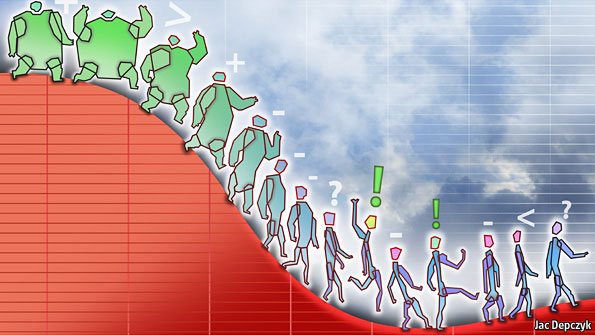
Joseph E. Stiglitz: Towards a General Theory of Deep Downturns @ Economist's View 17Ago2015 by Mark Thoma


This is the abstract, introduction, and final section of a recent paper by Joe Stiglitz on theoretical models of deep depressions (as he notes, it's "an extension of the Presidential Address to the International Economic Association"):
Towards a General Theory of Deep Downturns, by Joseph E. Stiglitz, NBER Working Paper No. 21444, August 2015

Abstract This paper, an extension of the Presidential Address to the International Economic Association, evaluates alternative strands of macro-economics in terms of the three basic questions posed by deep downturns: What is the source of large perturbations? How can we explain the magnitude of volatility? How do we explain persistence? The paper argues that while real business cycles and New Keynesian theories with nominal rigidities may help explain certain historical episodes, alternative strands of New Keynesian economics focusing on financial market imperfections, credit, and real rigidities provides a more convincing interpretation of deep downturns, such as the Great Depression and the Great Recession, giving a more plausible explanation of the origins of downturns, their depth and duration. Since excessive credit expansions have preceded many deep downturns, particularly important is an understanding of finance, the credit creation process and banking, which in a modern economy are markedly different from the way envisioned in more traditional models.
Introduction The world has been plagued by episodic deep downturns. The crisis that began in 2008 in the United States was the most recent, the deepest and longest in three quarters of a century. It came in spite of alleged “better” knowledge of how our economic system works, and belief among many that we had put economic fluctuations behind us. Our economic leaders touted the achievement of the Great Moderation.[2] As it turned out, belief in those models actually contributed to the crisis. It was the assumption that markets were efficient and self-regulating and that economic actors had the ability and incentives to manage their own risks that had led to the belief that self-regulation was all that was required to ensure that the financial system worked well , an d that there was no need to worry about a bubble . The idea that the economy could, through diversification, effectively eliminate risk contributed to complacency — even after it was evident that there had been a bubble. Indeed, even after the bubble broke, Bernanke could boast that the risks were contained.[3] These beliefs were supported by (pre-crisis) DSGE models — models which may have done well in more normal times, but had little to say about crises. Of course, almost any “decent” model would do reasonably well in normal times. And it mattered little if, in normal times , one model did a slightly better job in predicting next quarter’s growth. What matters is predicting — and preventing — crises, episodes in which there is an enormous loss in well-being. These models did not see the crisis coming, and they had given confidence to our policy makers that, so long as inflation was contained — and monetary authorities boasted that they had done this — the economy would perform well. At best, they can be thought of as (borrowing the term from Guzman (2014) “models of the Great Moderation,” predicting “well” so long as nothing unusual happens. More generally, the DSGE models have done a poor job explaining the actual frequency of crises.[4]
Of course, deep downturns have marked capitalist economies since the beginning. It took enormous hubris to believe that the economic forces which had given rise to crises in the past were either not present, or had been tamed, through sound monetary and fiscal policy.[5] It took even greater hubris given that in many countries conservatives had succeeded in dismantling the regulatory regimes and automatic stabilizers that had helped prevent crises since the Great Depression. It is noteworthy that my teacher, Charles Kindleberger, in his great study of the booms and panics that afflicted market economies over the past several hundred years had noted similar hubris exhibited in earlier crises. (Kindleberger, 1978)
Those who attempted to defend the failed economic models and the policies which were derived from them suggested that no model could (or should) predict well a “once in a hundred year flood.” But it was not just a hundred year flood — crises have become common . It was not just something that had happened to the economy. The crisis was man-made — created by the economic system. Clearly, something is wrong with the models.
Studying crises is important, not just to prevent these calamities and to understand how to respond to them — though I do believe that the same inadequate models that failed to predict the crisis also failed in providing adequate responses. (Although those in the US Administration boast about having prevented another Great Depression, I believe the downturn was certainly far longer, and probably far deeper, than it need to have been.) I also believe understanding the dynamics of crises can provide us insight into the behavior of our economic system in less extreme times.
This lecture consists of three parts. In the first, I will outline the three basic questions posed by deep downturns. In the second, I will sketch the three alternative approaches that have competed with each other over the past three decades, suggesting that one is a far better basis for future research than the other two. The final section will center on one aspect of that third approach that I believe is crucial — credit. I focus on the capitalist economy as a credit economy , and how viewing it in this way changes our understanding of the financial system and monetary policy. ...
He concludes with:
IV. The crisis in economics The 2008 crisis was not only a crisis in the economy, but it was also a crisis for economics — or at least that should have been the case. As we have noted, the standard models didn’t do very well. The criticism is not just that the models did not anticipate or predict the crisis (even shortly before it occurred); they did not contemplate the possibility of a crisis, or at least a crisis of this sort. Because markets were supposed to be efficient, there weren’t supposed to be bubbles. The shocks to the economy were supposed to be exogenous: this one was created by the market itself. Thus, the standard model said the crisis couldn’t or wouldn’t happen ; and the standard model had no insights into what generated it.
Not surprisingly, as we again have noted, the standard models provided inadequate guidance on how to respond. Even after the bubble broke, it was argued that diversification of risk meant that the macroeconomic consequences would be limited. The standard theory also has had little to say about why the downturn has been so prolonged: Years after the onset of the crisis, large parts of the world are operating well below their potential. In some countries and in some dimension, the downturn is as bad or worse than the Great Depression. Moreover, there is a risk of significant hysteresis effects from protracted unemployment, especially of youth.
The Real Business Cycle and New Keynesian Theories got off to a bad start. They originated out of work undertaken in the 1970s attempting to reconcile the two seemingly distant branches of economics, macro-economics, centering on explaining the major market failure of unemployment, and microeconomics, the center piece of which was the Fundamental Theorems of Welfare Economics, demonstrating the efficiency of markets.[66] Real Business Cycle Theory (and its predecessor, New Classical Economics) took one route: using the assumptions of standard micro-economics to construct an analysis of the aggregative behavior of the economy. In doing so, they left Hamlet out of the play: almost by assumption unemployment and other market failures didn’t exist. The timing of their work couldn’t have been worse: for it was just around the same time that economists developed alternative micro-theories, based on asymmetric information, game theory, and behavioral economics, which provided better explanations of a wide range of micro-behavior than did the traditional theory on which the “new macro - economics” was being constructed. At the same time, Sonnenschein (1972) and Mantel (1974) showed that the standard theory provided essentially no structure for macro- economics — essentially any demand or supply function could have been generated by a set of diverse rational consumers. It was the unrealistic assumption of the representative agent that gave theoretical structure to the macro-economic models that were being developed. (As we noted, New Keynesian DSGE models were but a simple variant of these Real Business Cycles, assuming nominal wage and price rigidities — with explanations, we have suggested, that were hardly persuasive.)
There are alternative models to both Real Business Cycles and the New Keynesian DSGE models that provide better insights into the functioning of the macroeconomy, and are more consistent with micro- behavior, with new developments of micro-economics, with what has happened in this and other deep downturns . While these new models differ from the older ones in a multitude of ways, at the center of these models is a wide variety of financial market imperfections and a deep analysis of the process of credit creation. These models provide alternative (and I believe better) insights into what kinds of macroeconomic policies would restore the economy to prosperity and maintain macro-stability.
This lecture has attempted to sketch some elements of these alternative approaches. There is a rich research agenda ahead.

Read more @ EV blog 

mercoledì 18 febbraio 2015

Luca Doninelli: Minima moralia, "istruzioni" per resistere al potere @ Il Sussidiario.net, 18Feb2015


Luca Doninelli: 
Minima moralia, "istruzioni" per resistere al potere 
@ Il Sussidiario.net, 18Feb2015

Read more @ Il Sussidiario.net

Questa sera, presso la Sala Verri del Centro Culturale di Milano, avrà luogo un evento inatteso. Si festeggerà un compleanno speciale. Ci saranno Sergio Belardinelli, Mauro Magatti e altri amici. 
Non so se qualcun altro festeggerà. Sarà perché sono settant'anni — quando mai si festeggia un settantennio? —, anche se il festeggiato è di quelli che bisognerebbe ricordare sempre. 
E' un libro, uno dei più grandi libri del XX secolo, uno dei più necessari, uno dei grandi capolavori. Il suo autore, Theodor W. Adorno, e la Scuola di Francoforte, di cui faceva parte (con Max Horkheimer, Herbert Marcuse e, spiritualmente, Walter Benjamin) hanno goduto, quando "c'era il pensiero" (G. Gaber), di grande prestigio. Ma quando il pensiero passa di moda, anche di loro si parla meno. 

Il titolo del libro, Minima Moralia, dovrebbe risuonare nelle orecchie dei non più giovani. Scritto in America tra il 1944 e il 1945, anche se pubblicato nel 1951, Minima Moralia è tra i primi grandi testi che costellano l'ultima fase — quella editorialmente più produttiva perché finalmente realizzata in tempo di libertà — della Scuola di Francoforte. 
Se mi permetto di sottolineare l'evento non è perché io abbia una qualunque autorità per parlare di questo libro, ma solo perché Minima Moralia mi accompagna da almeno trent'anni, e si può dire che, con I Demonidi Dostoevskij, sia il libro che ho riletto più volte nella mia vita.  Michel Foucault diceva che il pensiero teorico ci è utile, se non altro, per essere "un po' meno governati". Minima Moralia rappresenta il punto più alto in quest'ordine di esigenze. E', si potrebbe dire, il capolavoro di un pensiero resistenziale che coincide con il pensiero stesso, che è una sorta di "resistenza nella differenza". 
Mi spiego. Tutto è potere, a questo mondo: non solo quello politico o economico o dei mezzi di comunicazione ma anche quello quotidiano, che si esercita in un ufficio, alla stazione del metrò, in famiglia e perfino all'interno di un atto creativo come girare un film, o scrivere un romanzo. 

La caratteristica del potere è quella di omologare tutto. L'ideale è che tutti la pensino allo stesso modo, preferiscano le stesse cose, abbiano le stesse opinioni, guardino gli stessi film e così via. L'eliminazione delle differenze è il solo imperativo rimasto a un potere che si concepisce da solo (perciò non sa risolvere nessun problema). Lo chiamano "pensiero unico" ma del pensiero non ha niente. Per combattere l'omologazione occorre starci dentro: dentro la politica, l'economia, dentro il metrò, dentro il romanzo. Affermando un pensiero quotidiano, tattico, espresso perlopiù in piccoli gesti, che è come la materia oscura che costituisce il 90 per cento della massa dell'universo, noi opponiamo un argine a tutto ciò che cerca di delegittimare il nostro io, mostrandone la debolezza.
Scritto negli anni degli orrori nazisti, Minima Moralia non è solo un libro contro l'oppressione e il fanatismo ideologico, ma allarga la visuale: il tiranno più odioso non è, nonostante tutto, che una metafora di un'alienazione universale, di una falsificazione cui nemmeno i "salvatori" americani sono estranei.  Le vicende storiche che Adorno aveva davanti agli occhi lo condussero a identificare il movimento di falsificazione (dell'intelligenza, degli affetti, dei rapporti, di tutto) come un movimento universale. E anche se la critica marxista gli offre gli strumenti per leggere e descrivere questo baratro, tuttavia il marxismo si mantiene in lui a livello fenomenologico. 
Attraverso la fatica quotidiana del pensiero — che ci obbliga a essere sempre un po' diversi da noi stessi, disponendoci al nuovo, vorrei dire alla realtà se non fosse una parola molto ambigua — noi facciamo esperienza della grande falsificazione (possiamo anche ignorarla godendone i vantaggi) e al tempo stesso comprendiamo che non si esce dalla menzogna se non assumendo, nei confronti di tutte le cose, la prospettiva della loro redenzione.
In uno scritto tardivo, il grande amico di Adorno, Max Horkheimer, identificherà questo atteggiamento del pensiero come nostalgia del totalmente-Altro, rivelando la natura religiosa che ogni esperienza intellettuale ha nel tentativo stesso di mantenersi viva sotto i bombardamenti del potere e della menzogna.

lunedì 1 dicembre 2014

DAVID HARVEY: CRISIS THEORY AND THE FALLING RATE OF PROFIT (This is a draft of an essay to be published in 2015 in: The Great Meltdown of 2008: Systemic, Conjunctural or Policy-created?)


DAVID HARVEY:
CRISIS THEORY AND THE FALLING RATE OF PROFIT 


This is a draft of an essay to be published in 2015 in:

The Great Meltdown of 2008: Systemic, Conjunctural or Policy-created? 

Editors: Turan Subasat (Izmir University of Economics) and John Weeks (SOAS, University of London); Publisher: Edward Elgar Publishing Limited


In the midst of crises, Marxists frequently appeal to the theory of the tendency of the rate of profit to fall as an underlying explanation.1 In a recent presentation, for example, Michael Roberts attributes the current long depression to this tendency.
The tendency/law operates as follows:
1) Competition forces capitalist producers to invest in labour-saving technologies in order to preserve market share.
2) The value of the means of production consumed (c, the constant capital) tends to outstrip the value of labour power (v, the variable capital) employed.

3) The ratio of constant to variable capital employed (the productivity or value composition of capital, c/v) rises. If the rate of exploitation (s/v, the ratio of surplus value produced to variable capital employed) is unchanged, then the rate of profit, (s/c+v) will fall.
4) There are, however, counteracting tendencies. The rate of exploitation of labour power can rise. Constant capital can become cheaper with increased productivity in the sectors supplying machinery, raw materials and intermediate products. But these counteracting tendencies are insufficient, it is held, to offset the downward trend in the profit rate in the long run. “Thus,” Roberts concludes, “profitability tends to fall and capitalism tends towards crises, a movement interrupted only by short periods of growth.”  (...)

(Read more @The Next Recession blog)


Notes
  1. 1  Among others see Carchedi, G., Behind the Crisis: Marx’s Dialectics of Value and Knowledge, Brill, Leiden, 2011; Kliman, A., The Failure of Capitalist Production: Underlying Causes of the Great Recession, London, Pluto Press, 2011; Shaikh, A., “The First Great Depression of the 21st century,” (see http://homepage.newschool.edu/~AShaikh/); Moseley, F., The Falling Rate of Profit in the Postwar United States Economy. New York: St. Martin’s Press, 1990; Maito, Esteban Ezequiel, “The Historical Transience of Capital: The Downward Trend in the Rate of Profit since XIX Century,” unpublished paper, University of Buenos Aires, Argentina, n.d.

  2. 2  Power point presentation: Michael Roberts, “The Nature of Current Long Depression,” Marxism 2014; 11 July 2014 

martedì 2 settembre 2014

Matteo Pasquinelli (ed.) Gli algoritmi del capitale. Accelerazionismo, macchine della conoscenza e autonomia del comune. Verona: Ombrecorte, 2014


L’immaginario politico e l’idea di futuro sembrano oggi cancellati dall’imperativo dell’austerity. Ma quale sarebbe il vero passaggio rivoluzionario, si chiedevano un tempo Deleuze e Guattari: ritirarsi dal mercato globale o, al contrario, andare ancora più lontano, “accelerare il processo”? L’economia è in crisi, ma la tecnologia continua a evolvere sotto i nostri occhi: i social network sono sempre più pervasivi, la logistica delle merci sempre più veloce e digitalizzata, servizi segreti e finanza usano algoritmi sempre più sofisticati per analizzare e prevedere i comportamenti di massa. E se l’impasse politica fosse legata all’incapacità di comprendere le nuove astrazioni del capitale e del lavoro, gli algoritmi che controllano le relazioni sociali tanto quanto il tempo collettivo congelato dalla finanza in futures e derivati? Un nuovo nomos tecnologico sembra prendere forma a livello planetario, dove i poteri tradizionali degli Stati nazione si intrecciano con le grandi corporation della rete. Un ex direttore della Cia lo ha riassunto in modo cinico ma efficace: “Uccidiamo persone sulla base dei metadati”. Rispondendo al recente Manifesto accelerazionista e rilanciando la tesi del capitalismo cognitivo, gli autori del presente libro sostengono che lo sviluppo tecnologico possa essere ridisegnato in senso rivoluzionario, che l’astrazione più estrema dell’intelligenza debba diventare arma politica e che il futuro sia da riconquistare come terreno visionario.
 *
Franco “Bifo” Berardi, Mercedes Bunz, Nick Dyer-Witheford, Stefano Harney, Christian Marazzi, Antonio Negri, Matteo Pasquinelli, Nick Srnicek, Tiziana Terranova, Carlo Vercellone, Alex Williams.
 *
English blurb. The political imaginary and the idea of the future appears to be obliterated by the imperative of austerity. But which would be the real revolutionary path, Deleuze and Guattari asked once: “to withdraw from the world market… or to go in the opposite direction… to accelerate the process?”. Economy faces a financial crisis, but technology keeps on evolving: social networks become more pervasive, logistics gets faster and digitalizes any step, intelligence agencies and finance adopt more and more sophisticated algorithms to analyze and forecast mass behavour. What if the current political impasse is related to the inability to grasp the new abstractions of capital and labour, the algorithms that control social relations as well as the collective time frozen by finance into futures and derivatives? A new technological nomos is shaped on a planetary scale, where the powers of traditional nation states are interwoven with the global corporations of the internet. A former CIA director said it in a cynical yet concise way: “We kill people based on metadata”. Responding to the recent accelerationist manifesto and addressing the thesis of cognitive capitalism, the authors of the book believe that the technological progress can be redesigned in a revolutionary way, that the most extreme abstractions must become a political weapon and that the future has to be reclaimed as a terrain of collective imagination.
*
Indice
Introduzione: A mezzo secolo dalla ricezione del ‘Frammento sulle
macchine’ di Marx
Matteo Pasquinelli

Parte Prima: Accelerazione e crisi
Manifesto per una politica accelerazionista
Alex Williams e Nick Srnicek
Riflessioni sul “Manifesto per una politica accelerazionista”
Antonio Negri
L’accelerazionismo in questione dal punto di vista del corpo
Franco “Bifo” Berardi
Il lavoro dell’astrazione. Sette tesi su marxismo e accelerazionismo
Matteo Pasquinelli
Piattaforme per una abbondanza rossa
Nick Dyer-Witheford

Parte seconda: Astrazione algoritmica
Capitalismo macchinico e plusvalore di rete. Note sull’economia politica della macchina di Turing
Matteo Pasquinelli
Algoritmi della conoscenza e trasformazione del lavoro
Mercedes Bunz
Istituzioni algoritmiche e capitalismo logistico
Stefano Harney
Red stack attack! Algoritmi, capitale e automazione del comune
Tiziana Terranova

Parte terza: L’autonomia del comune
Nuove note sul capitalismo cognitivo. Crisi e istituzioni del welfare
Carlo Vercellone
Sulla natura linguistica della moneta
Christian Marazzi

domenica 26 gennaio 2014

Luciana Parisi - For a New Computational Aesthetics: Algorithmic Environments as Actual Objects @ BKM, 07.11.2012


Luciana Parisi - For a New Computational Aesthetics: Algorithmic Environments as Actual Objects. from bkm on Vimeo.
Algorithms are at the core of the computational logic. Formalism and axiomatics have also determined how the shortest algorithmic set or program deploys the most elegant form. This equivalence between axiomatics and beauty however hides a profound ontological ground based on order, rationality and cognition. However, this paper suggests that the pervasion of ubiquitous media and in particular of software agencies (from page ranking software to software for urban design) point to the formation of a new computational aesthetics defined by prehending algorithms. The paper will argue that this new mode of prehension defies the ontological ground of order and cognition revealing that randomness (or non-compressible data) is at the core of computation. The paper will draw on Alfred N. Whitehead’s notion of actual objects and Gregory Chaitin’s theory of the uncomputable to suggest that algorithms need to be understood in terms of ecology of prehensions. This understanding implies a notion of computational aesthetics defined by the chaotic architecture of data hosted by our programming culture. Luciana Parisi is a Senior Lecturer in Interactive Media at the Centre for Cultural Studies at Goldsmiths, University of London. She is author of Abstract Sex. Philosophy, Bio-Technology and the Mutations of Desire (London/New York 2004) and a progressive thinker in the emerging field of mediaecology and technoecology. Her research looks at the asymmetric relationship between science and philosophy, aesthetics and culture, technology and politics to investigate potential conditions for ontological and epistemological change. Her work on cybernetics and information theories, evolutionary theories, genetic coding and viral transmission has informed her analysis of culture and politics, the critique of capitalism, power and control. She has published articles about the relation between cybernetic machines, memory and perception in the context of a non-phenomenological critique of computational media and in relation to emerging strategies of branding and marketing. Her interest in interactive media has also led her research to engage more closely with computation, cognition, and algorithmic aesthetics. She is currently writing on architectural modeling and completing a monograph: Contagious Architecture. Computation, Aesthetics and the Control of Space (MIT Press, Nov. 2013).