Visualizzazione post con etichetta Algorithms. Mostra tutti i post

venerdì 18 settembre 2015

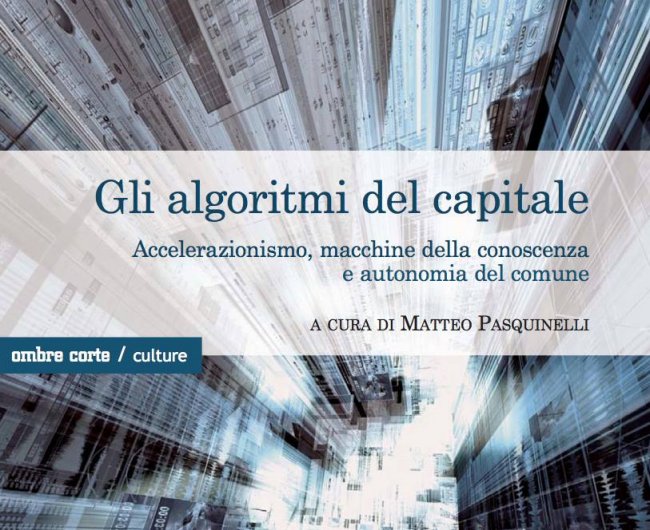
Macchina algoritmica di Google e accelerazione cibernetica - Parte XIX - Recensione del libro "Gli algoritmi del capitale" (curato da Matteo Pasquinelli)

Macchina algoritmica di Google e accelerazione cibernetica


"La velocizzazione che aveva contraddistinto il divenire della tecnica sino alla rivoluzione delle comunicazioni e dei trasporti è superata dall'accelerazione cibernetica che, a ben guardare, supera e rende obsoleto il concetto stesso di movimento. È più opportuno, a questo punto, postulare l'idea di uno spazio virtuale contraddistinto per sua natura dal tempo dell'accelerazione, un tempo che non necessita di movimento ma che appunto si esprime in presa diretta."
(Tiziana Villani - Il tempo della simulazione, pg. 10)


Nella critica serrata alla governance algoritmica da parte di Pasquinelli, si scorge in filigrana l'altro grande pericolo a cui va incontro il genere umano, una strada inquietante che porta diritto alla singolarità tecnologica, al limite di uno sviluppo alieno incontrollabile di macchine con potenza di calcolo infinita che accelerano con altri sistemi strutturati di macchine, i cui utenti finali potrebbero anche essere non umani, come previsto, in forma embrionale, dall'Internet delle cose. A fine millennio (1999) è comparsa la prima vera e propria corporation post-umana, Google, il nuovo stadio del capitalismo metalinguistico e metamatico che vorremmo pensare, seguendo le analisi di Guattari, come collasso della semiotica antropologica del XX secolo. Grazie ai giacimenti sapienziali sui quali basa la propria potenza calcolante inumana, Google supera con eleganza matematica e vigore cristallino ogni precedente assiomatica ottocentesca del conflitto in quanto Brin et alii valorizzano a costo zero sia la propria forza lavoro, cioè i produttori di contenuti dell'infosfera, sia la materia prima del proprio prodotto, ovvero il Sapere del genere umano, attivando ciò che Bernard Stiegler chiama, rifacendosi a Simondon, 'il nuovo stadio del processo di transindividuazione capitalistica' (Reincantare il mondo, Orthotes, 2012). Pensare Google, questo è il nuovo compito; Pasquinelli lo ha già iniziato a fare con il saggio sul plusvalore di Rete (Capitalismo macchinico e plusvalore di rete, 2011) ma è necessario continuare ad indagare Google ora, a causa del pensiero alieno che opera sul 'processo di transindividuazione, vale a dire la maniera di prodursi collettivamente come soggetti'. Pensare Google, secondo Stiegler, significa 'come fare di Google uno spazio critico e non solo un oggetto della critica'. Significa anche oltrepassare le assiomatiche marxiste, nonostante la loro ricchezza, e il pensiero conflittuale dell'età industriale, per porre le basi di un pensiero che si faccia carico dell'algoritmo che connette infinite macchine soffici e milioni di nuvole nella sua complessità. Quest'alba di un nuovo pensiero è il compito, il punto chiave del libro Gli algoritmi del capitale, soprattutto nel saggio più denso dell'antologia, Capitalismo macchinico e plusvalore di rete (Pasquinelli, 2011). Ma a nostro avviso, il «moto accelerazionista», a causa di singoli punti critici, rende la propria traiettoria epiciclica in rapporto al marxismo, considerando il marxismo stesso come traiettoria deferente, vale a dire che a fronte di un guadagno apparente attuale, si consumerà in futuro un moto retrogrado dell'accelerazionismo, se non viene corretto il sistema di riferimento principale come baricentro di pensiero.
( segue QUI )

(Nota dell'editore: il testo completo si compone di 22 paragrafi che verranno pubblicati giorno per giorno, a partire dal 31 agosto 2015. Il titolo del breve saggio/recensione è Dromologia, bolidismo e accelerazionismo marxista. Frammenti di comunismo tra al-Khwarizmi e Mach)


Picblog: Euthanasia Coaster by Julijonas Urbonas: Challenging the physical and psychological limits of the human body, this speculative design is intended to slowly ascend 1,700 feet into the air before launching passengers down seven loops at a mind-boggling speed of 330 feet per second. The roller coaster aims to give its riders a diverse range of experiences from euphoria to thrill, tunnel vision to a loss of consciousness and, eventually, to the end result: death.


mercoledì 3 giugno 2015

Elettra Stimilli: Recensione del libro (a cura di) Matteo Pasquinelli: Gli algoritmi del capitale @ Alfabeta2, 3 giugno 2015

Gli algoritmi del capitale

Recensione di Elettra Stimilli per Alfabeta2, 3 giugno 2015 

Quando era appena uscito nelle sale italiane The Wolf of Wall Street, il film in cui Scorsese narra l'ascesa e la caduta di uno dei tanti spregiudicati broker newyorkesi, nell'intenzione - da lui stesso esplicitamente dichiarata - di “scoprire come lavorano le loro menti”, viene pubblicato in Italia un volume a cura di Matteo Pasquinelli, Gli algoritmi del capitale. Accelerazionismo, macchine delle conoscenza e autonomia del comune (Ombre Corte 2014), che tenta di inscrivere la riflessione sull'attuale crisi finanziaria tra le sofisticate pieghe della virtualizzazione della finanza e delle relazioni sociali. Più che al film di Scorsese, Pasquinelli preferisce, però, far riferimento, come antecedente artistico delle analisi contenute nel libro da lui curato, al romanzo di Don DeLillo Cosmopolis, scritto negli stessi anni del movimento di Seattle e prima del tragico attacco alle Twin Towers.
Muovendo da una riflessione sul predominio e sulla crisi del capitalismo finanziario contemporaneo, i saggi raccolti in questo volume sono tutti accomunati dall'esigenza di guardare all'orizzonte tecnologico globale nell'intento di trovare nuovi paradigmi in grado di dischiudere differenti spazi collettivi e politici. Il volume si apre con il Manifesto per una politica accelerazionista di Alex Williams e Nick Srnicek, da molti definito il caso editoriale del 2013 all'interno del pensiero politico radicale. Sorto dall'ambiente intellettuale che ruota attorno alla rivista inglese «Collapse» - spesso individuato con l'etichetta “realismo speculativo” e legato ad autori come Reza Negarestani e Ray Brassier – il Manifesto è stato tradotto in diverse lingue e viene qui presentato in versione italiana come un'introduzione al dibattito che si è sviluppato a partire da un simposio organizzato a Berlino nel 2013.


Le tesi del Manifesto possono così essere confrontate con quelle che provengono dalle riflessioni dell'operaismo italiano che, già negli anni Settanta del secolo scorso, aveva saputo mettere a tema l'egemonia del general intellect nelle società post-fordiste, evidenziando il graduale predominio del lavoro cognitivo. Oggi tuttavia, come scrive Pasquinelli nell'Introduzione, “non è sufficiente affermare che il capitalismo [...] [sia] un capitalismo cognitivo […]. Il capitalismo ha sviluppato forme di intelligenza autonoma e di scala superiore. Si deve dire: il capitale stesso pensa” (p. 9). Il piano di sorveglianza PRISM della National Security Agency, di recente divenuto famoso grazie allo scandalo sulle intercettazioni che ha coinvolto le agenzie di intelligenceamericane - di cui, tra l'altro, si tratta in Citizenfour, il film documentario di Laura Poitras su Edward Snowden, di recente diffuso anche nelle sale cinematografiche italiane - ha rivelato in maniera palese questa situazione.
Se questo automaton tecnologico planetario sta ridisegnando i confini del nuovo nomos politico, a nulla possono servire nostalgiche visioni di un passato ormai irrecuperabile. Per gli autori del Manifesto accelerazionista si tratta piuttosto di portare all'estremo questa orientamento come attendendo una sua implosione interna, che sia, però, l'inizio per una nuova era post-capitalistica. L'accelerazione risulta in questo senso la realizzazione di tendenze che dovrebbero condurre al pieno dispiegamento di potenzialità già contenute, ma neutralizzate, nell'attuale forma del capitalismo.
Una simile analogia tra l'impero globalizzante della politica post-nazionale e le potenzialità della rete è presente anche nella prospettiva di Antonio Negri, che interviene insieme ad altri nel volume (come Franco Berardi Bifo, Mercedes Bunz, Stefano Harney, Tiziana Terranova, Carlo Vercellone, Cristiana Marazzi, ecc.). Ma il problema, per Negri, non è soltanto il fatto che “accelerazionismo” risulta un termine infelice, perché richiama “un senso futurista a quello che futurista non è” (p. 34); ma soprattutto sta nella possibilità di ricondurre questo processo alla sua organizzazione politica, alle stesse forze sociali preesistenti a qualsiasi “algoritmo” del capitale.


giovedì 22 gennaio 2015

Pierre Alonso: BIG DATA IS ALGORITHMING YOU. Un entretien avec Antoniette Rouvroy @ Article 11, 22Jan2014


Cet entretien a été publié dans le numéro 17 d’Article11  Read more @ A11
Je donne, tu donnes, il/elle donne… nos données. Les data sont le nouvel or noir que se disputent gouvernements et géants du numérique. Parfois, les premiers se servent même tout simplement chez les seconds, comme l’a montré l’existence du programme Prism, l’une des nombreuses révélations d’Edward Snowden - l’ancien sous-traitant de la toute-puissance National Security Agency (NSA) américaine. Par une tentative de retournement culotté de la situation, les artisans de la surveillance de masse et de la présomption de culpabilité tentent de se dédouaner en pointant la collecte tentaculaire opérée par Google, Facebook et consorts. Leur argument : vous – population – filez bien plus à des entreprises privées ! Lesquelles répondent que pas du tout… Un cercle sans fin.
Ces enfumages et faux débats empêchent de penser la transformation de nos vies en données, en signaux infrapersonnels qui ne font sens qu’agrégés et moulinés par millions. En naît un pouvoir d’un genre nouveau, la « gouvernementalité algorithmique », explique la chercheuse belge Antoinette Rouvroy1.
Au commencement, il y a les données. Qu’est-ce qu’une donnée ?
« On parle aujourd’hui de plus en plus des données brutes, par opposition aux données à caractère personnelle2. Dans le contexte des big data3 ou du data mining4, les données traitées sont elles-mêmes ’’assignifiantes’’ : elles n’identifient pas une personne.
De mon point de vue, elles constituent de nouveaux objets, dans la mesure où elles sont produites par des opérations de décontextualisation, de désindexation, de purification de toute signification personnelle. Elles ne sont pas signifiantes individuellement, mais sont agrégeables avec d’autres données recueillies dans des contextes temporels et géographiques différents. Elles permettent ainsi de créer des profils ou des modèles de comportement qui ne se rapportent à personne en particulier mais désignent des trajectoires possibles.
Les données ne fonctionnent pas comme des signes, les éléments traditionnels de la sémiotique. Pour qu’un signe soit signifiant, il faut qu’il représente la chose qu’il signifie. Par ressemblance (comme les icônes), par convention (comme les signaux routiers) ou par le souvenir d’un rapport physique avec la chose représentée (comme les traces ou empreintes).
Les données brutes ne fonctionnent pas ainsi parce qu’elles ne ressemblent à rien, ne font évidemment pas signe par convention (personne ne décide a priori de la signification à leur accorder) et ne conservent aucun lien matériel avec un geste physique (le doigt qui frappe le clavier, par exemple). Ce sont donc bien de nouveaux objets, qui se rapprochent plus du signal que du signe. Je m’en rapporte ici à la définition d’Umberto Eco : un signal est ce qui est calculable, malgré l’absence de signification. »
C’est donc un potentiel ?
« Comme ces données ne sont pas signifiantes, qu’elles ne conservent aucun lien direct avec les individus, qu’elles sont souvent anonymisées, décontextualisées, elles paraissent triviales, peu menaçantes, y compris pour la vie privée des individus. Mais elles vont servir à produire une forme de modélisation du social et du comportement qui aura des effets très concrets de gouvernement sur les conduites possibles. »
Lors d’une intervention récente, vous avez défini la donnée brute comme « texture même du capitalisme »...
« Dans Mille Plateaux, Capitalisme et Schizophrénie, Gilles Deleuze et Félix Guattari définissent le capitalisme comme la libération des flux dans des champs déterritorialisés. Cette libération nécessite des opérations de dé-codage. Les signes qui ont de la signification pour nous en ont grâce aux codages propres à la société dans laquelle nous vivons. Les codes d’intelligibilité nous permettent de les comprendre.
Ici, il y a un dé-codage. C’est-à-dire une sorte d’abstraction sur fond de complète décontextualisation qui supprime des possibilités d’intelligibilité dans l’esprit humain. Le capitalisme fonctionne de cette manière, en extrayant notamment de leur contexte de vie les moyens de production. »
En quoi consiste le phénomène de big data ? C’est une simple juxtaposition de données brutes ou une agrégation intelligente (grâce aux algorithmes) des données brutes ? 
« Il s’agit d’abord d’un phénomène de perte de contrôle. Il y a big data lorsque des seuils de quantité, de complexité (les données sont recueillies dans des contextes très différents) et de rapidité (elles prolifèrent en temps réel) sont atteints, de telle sorte que ces masses de données ne peuvent plus être gérées par les techniques traditionnelles de banques de données. L’existence des big data constitue donc une sorte d’aveu de faiblesse, lequel renvoie en creux à notre incapacité à administrer ces masses de données autrement qu’en sous-traitant leur gestion à des algorithmes, dont on connaît de moins en moins le fonctionnement.
Les big data offrent de nouvelles manières de rendre le monde signifiant – Michel Foucault parlerait d’un nouveau ’’régime de vérité’’ – sur la base de la pure induction (et non de la causalité), en temps réel, dans des modèles qui s’affinent en permanence… C’est vraiment un changement de paradigme dans le mode de production de ce qu’on considère comme le réel. Les possibilités ouvertes sont gigantesques dans tous les domaines : le marketing, la connaissance des consommateurs, l’astronomie, l’histoire, l’archivage…
Dans le même temps, les big data transforment de nombreuses disciplines, pas toujours pour le pire. Elles permettent de prendre en compte des masses de données qu’on devait ignorer auparavant. Donnent l’impression d’avoir un accès plus exhaustif à la réalité. Satisfont le mythe d’un accès immédiat et total à celle-ci sans passer par quelque représentation que ce soit. Un rêve d’immanence qu’on a l’impression de voir se réaliser. »
L’utilisation des big data n’est-elle pas le prolongement technique et logique de la statistique ?
« Les finalités de la statistique traditionnelles sont très différentes des opérations statistiques du data mining ou des big data. La statistique consiste à objectiver des hypothèses faites a priori : elle est un moyen de preuve. Le data mining au contraire fait surgir des hypothèses du réel numérisé lui-même !
Les techniques aussi sont différentes. La statistique ne tient pas compte des points les plus éloignés pour calculer une moyenne, car ils sont perturbateurs, générateurs de bruit. Les capacités de calcul sont limitées. Avec le data mining, il est possible, grâce aux puissances de calcul, de tenir compte de tout, y compris des points les plus éloignés. La notion même de normal, de normalité, de moyenne disparaît. »
Ce qui donne l’illusion d’une retranscription totale du réel, voire d’un dédoublement du réel ? 
« Le réel numérisé peut en effet sembler être le réel lui-même. Comme il n’y a plus de sélection de données par des acteurs humains, donc faillibles, on a l’impression d’une très grand objectivité. La totalité des données étant actualisée en temps réel, le monde numérisé paraît reproduction exacte du monde. La notion de médiation, de représentation en fait les frais, comme pour consacrer le mythe de l’accès immédiat au réel tel qu’il est. »
Il y a un risque de confondre le réel avec le réel numérisé ?
« Oui, parce que ce processus présente des aspects extrêmement performatifs. Ce qui n’est pas numérisé ou numérisable, que ce soit la détresse humaine ou des circonstances particulières, ce qui ne rentre pas dans les cases, n’a plus voix au chapitre. Cette évolution, qui paraît très objective, est en fait profondément injuste : on sait très bien que la totalité du réel n’est pas mise en nombres.
Cette impression de repli de la réalité à l’intérieur de la réalité numérisée, cette totalisation – c’est presque un régime totalitaire numérique –, risque de faire disparaître la distinction entre le monde et sa représentation, et donc la possibilité même de la critique. On peut critiquer la représentation, comme on critiquait les anciens objets statistiques, qui n’étaient pas assez représentatifs ou mal construits. Tandis que le réel numérisé va à rebours de l’idée que le savoir est toujours construit, et donc critiquable en fonction des conditions de sa construction. Si ce n’est plus construit, ce n’est plus critiquable. C’est un enjeu fondamental. »
Comment critiquer efficacement les effets de pouvoir engendrés ?
« La critique est d’autant plus difficile que le pouvoir n’apparaît pas comme tyrannique. Pour fonctionner, ce mode d’exercice du pouvoir a besoin que nous nous sentions le plus libre possible de nous exprimer, que nous donnions un maximum de données. Il ne nous contraint pas dans notre expression. Au contraire ! Dès que vous êtes connecté sur Facebook, un champ vous propose de vous exprimer ! C’est exactement l’inverse du monde orwellien dans lequel la liberté d’expression était l’ennemi du pouvoir. Nous sommes en quelque sorte gouvernés par notre liberté, ce qui rend la critique extrêmement difficile. »
Et nous sommes consentants...
« Il faudrait plutôt parler d’un effet d’adhésion. Nos profils sont si multiples, adaptables et adaptés en temps réel que ne pas vouloir être profilé, c’est ne pas se vouloir soi-même. Dans ce mode de gouvernement, l’autorité n’est plus assumée par personne, sinon par nous-mêmes, par les trajectoires qui nous sont assignées à titre d’un destin identitaire conduisant à une clôture de l’individu sur lui-même. Ce qui correspond, dans un certain sens, à l’idéal des années 1960 - ne pas être gouverné par autre chose que nous-mêmes. »
La multiplicité presque infini des profils créés permet de résoudre ce que vous appelez « l’oxymore de la personnalisation industrielle »...
« C’est paradoxal : la personnalisation très fine ne s’accompagne d’aucune rencontre entre des individus qui n’ont plus à exprimer leur propre désir. Le président de Google a ainsi expliqué qu’il deviendra bientôt très difficile pour les individus de vouloir quelque chose qui n’a pas été prévu pour eux par sa firme. Dans ce cadre disparaissent l’expression, le façonnement de nos propres désirs, ainsi que notre manière de les exprimer à autrui.
Nous nous exprimons ou rencontrons quelqu’un parce que nous ressentons une sorte de manque, d’insatisfaction. Si tout est prévu par une providence numérique, nous n’avons plus besoin de cet espace public pour exprimer nos envies, nos désirs. La sphère individuelle est gavée, volontairement ou non, de manière à éviter le commun. »
Personne ne détient ce pouvoir ? Même pas les créateurs d’algorithme ? Ou ceux qui les possèdent, comme Google ?
« C’est très dilué. Ceux qui façonnent les algorithmes ne sont pas détenteurs du pouvoir, car ils n’exploitent pas les données eux-mêmes. D’autant plus qu’ils sous-traitent leur boulot aux algorithmes (le ’’machine learning’’), lesquels sont auto-apprenants.
Par contre, ceux qui sont autorisés (ou qui s’autorisent) à exploiter ces données à des fins de prédation détiennent un pouvoir important. Ils visent par exemple le temps d’attention des utilisateurs d’Internet et ciblent leur espace de vie avec la publicité individualisée. Grâce à l’Internet des objets, des publicités pourront s’afficher dans nos espaces privés, sur nos frigos ou sur d’autres objets domestiques. Les industriels et les commerciaux tirent ainsi les marrons du feu. De même que les États surveillants, comme les États-Unis avec la NSA. »
La cible de ce nouveau pouvoir paraît davantage être le futur que le présent...
« Il se concentre sur l’incertitude radicale liée au fait que nous sommes des individus qui nous pensons libres, avec une possibilité de ne pas forcément faire tout ce dont nous sommes capables. Alors que les algorithmes appliqués à la sécurité considèrent que l’individu susceptible de commettre un acte terroriste est déjà un terroriste, comme s’il avait commis l’acte dont il est physiquement capable.
Spinoza expliquait que notre puissance vient de notre capacité à ne pas faire tout ce dont nous sommes capables. Cette possibilité de retenue est essentielle. Même si nous ne sommes pas des êtres absolument libres, rationnels, autonomes, il existe une sorte de marge. Et c’est précisément cette dernière qui est la cible de la gouvernementalité algorithmique. Il s’agit en somme de l’excès du possible sur le probable. »
En quoi ce gouvernement du futur se distingue-t-il de la prévention, qui consiste à empêcher la réalisation d’actes jugés illégaux ou immoraux ?
« La prévention passe par l’identification des causes, puis par une intervention pour que le comportement ne se produise pas. Ici, il n’est plus du tout question de prévention : les causes sont devenues totalement indifférentes. La production de ce mode de ’’savoir’’ est purement inductive. Je parlerais de préemption : il faut empêcher (ou faire advenir) certains comportements, sans se soucier des causes. En laissant de côté ces dernières, on se prive de la possibilité de prévenir. »
Est-ce le prolongement de ce que Foucault décrit à propos de l’intériorisation de la contrainte ?
« Non, c’est complètement nouveau ! Dans les dispositions algorithmiques, le sujet n’existe pas. L’effet de ces dispositions est précisément de rendre impossible les opérations de subjectivation. La norme n’est plus connue par personne, elle n’est plus visible, elle évolue en temps réel. Elle est complètement plastique, s’adapte à tout ce qui se passe. Ce système ne connaît que les données infrapersonnelles, les données brutes donc, agrégées au niveau supra-individuel.
L’objectif est très différent de la discipline foucaldienne, qui visait la réforme des comportements, soit une sorte de moralisation. Ici, le caractère moral est complètement absent. Cela fait apparaître la gouvernementalité algorithmique comme neutre, objective et non-gouvernante. La cible n’est pas la réforme des individus, mais celle des comportements - peu importe par qui ils sont portés.
Lire Foucault permet surtout de comprendre ce qui a glissé depuis ses analyses. Au lieu de la production de corps dociles par les normes, on en vient à la production de normes dociles par les corps. La normativité s’adapte à tous les mouvements. »
Dans quelle mesure la gouvernementalité algorithmique comporte-t-elle des failles ? Vous disiez un peu plus tôt que refuser d’être profilé, c’est se refuser soi-même...
« Tout événement est disséqué, éparpillé en une multitude de données elles-mêmes réagrégées. Mais il en reste. L’affaire Prism a par exemple fait bouger certaines lignes. Pas assez, évidemment, mais elle a quand même constitué une sorte d’électrochoc.
Alain Badiou explique que si on reconnaît un fait comme événement, si on décide que c’est un point de rupture, un point de refus, on peut en tirer les conséquences. Ce qui suppose une décision à l’origine et se traduit ensuite par des décisions concrètes. À cet égard, l’affaire Prism est un non-événement, malgré les possibilités portées par la situation. Elle a certes permis une certaine prise de conscience de ce dans quoi on s’embarque. Mais elle n’a pas débouché sur une forme de ’’débarquement’’. »
En quoi le mouvement d’ouverture des données publiques (open data) peut-il constituer un contre-pouvoir ?
« C’est tout à fait insuffisant. Les individus n’ont aucune possibilité de traiter ces données d’une manière qui fasse sens pour eux. Ce mouvement ne change rien aux déséquilibres de pouvoir et de moyens. C’est davantage un cache-sexe, qui rajoute une couche au discours dominant faisant l’apologie des données et expliquant que l’avenir est dans leur traitement. »
Les données protégées par les institutions de type CNIL et les gouvernements sont celles à caractère personnelle. Mais si on prend l’exemple de la la NSA, on se rend compte qu’elle se nourrit de métadonnées5...
« Le droit est complètement à côté de la plaque ! Il faut bien sûr continuer à protéger les données à caractère personnel. Mais on rate un large pan de la problématique actuelle si on en reste là. C’est-à-dire qu’on fait alors l’impasse sur tout ce qui a trait au profilage, à la personnalisation, à l’hypertrophie de la sphère privée, à la paupérisation de l’espace public et à la prédation par des sociétés privées des espaces eux-mêmes privés des internautes.
Cet acharnement à camper sur la protection des données à caractère personnel est curieux, voire suspect. Une cécité pareille ne peut être que volontaire. L’objectif serait-il raté à dessein ?
Quoi qu’il en soit, ce processus est éminemment révélateur. Nous sommes tellement imprégnés d’une culture individualiste que nous sommes incapables de voir ce qui se joue au-delà de la question des données à caractère personnel. Cet aveuglement va de pair avec un mépris pour le commun, pour l’espace public et pour le débat public. »


1 Qui oeuvre au sein du Centre de recherche en information, droit et société de l’Université de Namur.
2 Une donnée personnelle comporte des informations renvoyant à l’identité d’une personne, que ce soit directement (son nom) ou indirectement (son numéro de téléphone, son adresse IP, son empreinte ADN, etc.).
3 Le terme big data désigne des ensembles de données très volumineux.
4 Le data mining consiste à passer à la moulinette des données, souvent en très grand nombre, pour en extraire du sens. Les moulinettes sont aussi appelées algorithmes.
5 Les métadonnées sont l’ensemble des informations qui entourent les données elles-mêmes. Par exemple, pour un e-mail, il s’agit des adresses IP de l’émetteur et du récepteur, de leurs adresses tout court, de l’objet du message et de sa date d’envoi.

martedì 2 dicembre 2014

Matteo Pasquinelli: The Eye of the Algorithm: Anthropocene and the Making of the World Brain @

Matteo Pasquinelli: The Eye of the Algorithm: Anthropocene and the Making of the World Brain

Abstract. A new planetary scale of computation demands a new planetary scale of politics. As the current debate on the Anthropocene points too, no political agency is possible without the recognition of a new cognitive perspective on the whole planet. The eye of modern perspective was born trough an equivalent paradigm shift, bringing innovative techniques of optical projection from the mathematicians of Baghdad to Florence. A further dimension of depth was so added to aesthetics, many crooked paintings were straightened and a new political vision of the collective space was inaugurated. Similarly, a further cognitive dimension has to be imported today from computation into political thought, in order to be able to ‘see’ and grasp the oceanic depth of the global datascape and to disclose the novel techno-complexity of the social space. Something similar happened already in cybernetics with the shift from the first order to the second order cybernetics, that is with the recognition of the meta-level of the observer observing a system of observers. Any century produces its own epistemic rift. The making of a global datascape is calling for a new epistemic eye.

lunedì 22 settembre 2014

The Manipulators: Facebook’s Social Engineering Project by Nicholas Carr @ LARB, 14.sept.2014


The Manipulators: Facebook’s Social Engineering Project by Nicholas Carr @ L.A. review of books - 14.Sep.2014

The following is a feature article from the new intern issue of the Los Angeles Review of Books: The Magazine. The issue, which our interns produced as part of this past summer's LARB Publishing Course,  comes off press at the end of the month and will be mailed to subscribing LARB members.


SINCE THE LAUNCH of Netscape and Yahoo! 20 years ago, the development of the internet has been a story of new companies and new products, a story shaped largely by the interests of entrepreneurs and venture capitalists. The plot has been linear; the pace, relentless. In 1995 came Amazon and Craigslist; in 1997, Google and Netflix; in 1999, Napster and Blogger; in 2001, iTunes; in 2003, MySpace; in 2004, Facebook; in 2005, YouTube; in 2006, Twitter; in 2007, the iPhone and the Kindle; in 2008, Airbnb; in 2010, Instagram; in 2011, Snapchat; in 2012, Coursera; in 2013, Google Glass. It has been a carnival ride, and we, the public, have been the giddy passengers.
This year something changed. The big news about the net came not in the form of buzzy startups or cool gadgets, but in the shape of two dry, arcane documents. One was a scientific paper describing an experiment in which researchers attempted to alter the moods of Facebook users by secretly manipulating the messages they saw. The other was a ruling by the European Union’s highest court granting citizens the right to have outdated or inaccurate information about them erased from Google and other search engines. Both documents provoked consternation, anger, and argument. Both raised important, complicated issues without resolving them. Arriving in the wake of revelations about the NSA’s online spying operation, both seemed to herald, in very different ways, a new stage in the net’s history — one in which the public will be called upon to guide the technology, rather than the other way around. We may look back on 2014 as the year the internet began to grow up.

Spreading “emotional contagion”
The Facebook study seemed fated to stir up controversy. Its title reads like a bulletin from a dystopian future: Experimental Evidence of Massive-Scale Emotional Contagion through Social Networks. But when, on June 2, the paper first appeared on the website of the Proceedings of the National Academy of Sciences of the United States of America (PNAS), it drew little notice or comment. It sank quietly into the swamp of academic publishing. That changed abruptly three weeks later, on June 26, when technology reporter Aviva Rutkin posted a brief account of the study on the website of New Scientist magazine. She noted that the research had been run by a Facebook employee, a social psychologist named Adam Kramer who worked in the firm’s large Data Science unit, and that it had involved more than half a million members of the social network. Smelling a scandal, other journalists rushed to the PNAS site to give the paper a look. They discovered that Facebook had not bothered to inform its members about their participation in the experiment, much less ask their consent.
Outrage ensued, as the story pinballed through the media. “If you were still unsure how much contempt Facebook has for its users,” declared the technology news site PandoDaily, “this will make everything hideously clear.” A The New York Times writer accused Facebook of treating people like “lab rats,” while The Washington Post, in an editorial, criticized the study for “cross[ing] an ethical line.” US Senator Mark Warner called on the Federal Trade Commission to investigate the matter, and at least two European governments opened probes. The response from social media was furious. “Get off Facebook,” tweeted Erin Kissane, an editor at a software site. “If you work there, quit. They’re fucking awful.” Writing on Google Plus, the privacy activist Lauren Weinstein wondered whether “Facebook KILLED anyone with their emotion manipulation stunt.”
The ethical concerns were justified. Although Facebook, as a private company, is not bound by the informed-consent guidelines of universities and government agencies, its decision to carry out psychological research on people without telling them was reprehensible. It violated the US Department of Health & Human Services’ policy for the protection of human research subjects (known as the “Common Rule”) as well as the ethics code of the American Psychological Association. Making the transgression all the more inexcusable was the company’s failure to exclude minors from the test group. The fact that the manipulation of information was carried out by the researchers’ computers rather than by the researchers themselves — a detail that Facebook offered in its defense — was beside the point. As University of Maryland law professor James Grimmelmann observed, psychological manipulation remains psychological manipulation “even when it’s carried out automatically.”
Still, the intensity of the reaction seemed incommensurate with its object. Once you got past the dubious ethics and the alarming title, the study turned out to be a meager piece of work. Earlier psychological research had suggested that moods, like sneezes, could be contagious. If you hang out with sad people, you may end up feeling a little blue yourself. If you surround yourself with happy folks, your mood may brighten. Kramer and his collaborators (the paper was coauthored by two Cornell scientists) wanted to see if such emotional contagion might also be spread through online social networks. During a week in January 2012, they programmed Facebook’s News Feed algorithm — the program that selects which messages to funnel onto a member’s home page and which to omit — to make slight adjustments in the “emotional content” of the feeds delivered to a random sample of members. One group of test subjects saw a slightly higher number of “positive” messages than normal, while another group saw slightly more “negative” messages. To categorize messages as positive or negative, the researchers used a standard text-analysis program, called Linguistic Inquiry and Word Count, that spots words expressing emotions in written works. They then evaluated each subject’s subsequent Facebook posts to see whether the emotional content of the messages had been influenced by the alterations in the News Feed.
The researchers did discover an influence. People exposed to more negative words went on to use more negative words than would have been expected, while people exposed to more positive words used more of the same — but the effect was vanishingly small, measurable only in a tiny fraction of a percentage point. If the effect had been any more trifling, it would have been undetectable. As Kramer later explained, in a contrite Facebook post, “the actual impact on people in the experiment was the minimal amount to statistically detect it — the result was that people produced an average of one fewer emotional word, per thousand words, over the following week.” As contagions go, that’s a pretty feeble one. It seems unlikely that any participant in the study suffered the slightest bit of harm. As Kramer admitted, “the research benefits of the paper may not have justified all of this anxiety.”

Big data, little people
What was most worrisome about the study lay not in its design or its findings, but in its ordinariness. As Facebook made clear in its official responses to the controversy, Kramer’s experiment was just the visible tip of an enormous and otherwise well-concealed iceberg. In an email to the press, a company spokesperson said the PNAS study was part of the continuing research Facebook does to understand “how people respond to different types of content, whether it’s positive or negative in tone, news from friends, or information from pages they follow.” Sheryl Sandberg, the company’s chief operating officer, reinforced that message in a press conference: “This was part of ongoing research companies do to test different products, and that was what it was.” The only problem with the study, she went on, was that it “was poorly communicated.” A former member of Facebook’s Data Science unit, Andrew Ledvina, told The Wall Street Journal that the in-house lab operates with few restrictions. “Anyone on that team could run a test,” he said. “They’re always trying to alter people’s behavior.”
Businesses have been trying to alter people’s behavior for as long as businesses have been around. Marketing departments and advertising agencies are experts at formulating, testing, and disseminating images and words that provoke emotional responses, shape attitudes, and trigger purchases. From the apple-cheeked Ivory Snow baby to the chiseled Marlboro man to the moon-eyed Cialis couple, we have for decades been bombarded by messages intended to influence our feelings. The Facebook study is part of that venerable tradition, a fact that the few brave folks who came forward to defend the experiment often emphasized. “We are being manipulated without our knowledge or consent all the time — by advertisers, marketers, politicians — and we all just accept that as a part of life,” argued Duncan Watts, a researcher who studies online behavior for Microsoft. “Marketing as a whole is designed to manipulate emotions,” said Nicholas Christakis, a Yale sociologist who has used Facebook data in his own research.
The “everybody does it” excuse is rarely convincing, and in this case it’s specious. Thanks to the reach of the internet, the kind of psychological and behavioral testing that Facebook does is different in both scale and kind from the market research of the past. Never before have companies been able to gather such intimate data on people’s thoughts and lives, and never before have they been able to so broadly and minutely shape the information that people see. If the Post Office had ever disclosed that it was reading everyone’s mail and choosing which letters to deliver and which not to, people would have been apoplectic, yet that is essentially what Facebook has been doing. In formulating the algorithms that run its News Feed and other media services, it molds what its billion-plus members see and then tracks their responses. It uses the resulting data to further adjust its algorithms, and the cycle of experiments begins anew. Because the algorithms are secret, people have no idea which of their buttons are being pushed — or when, or why.
Facebook is hardly unique. Pretty much every internet company performs extensive experiments on its users, trying to figure out, among other things, how to maximize the time they spend using an app or a site, or how to increase the likelihood they will click on an advertisement or a link. Much of this research is innocuous. Google once tested 41 different shades of blue on a web-page toolbar to determine which color would produce the most clicks. But not all of it is innocuous. You don’t have to be paranoid to conclude that the PNAS test was far from the most manipulative of the experiments going on behind the scenes at internet companies. You only have to be sensible.
That became strikingly clear, in the midst of the Facebook controversy, when another popular web operation, the matchmaking site OKCupid, disclosed that it routinely conducts psychological research in which it doctors the information it provides to its love-seeking clientele. It has, for instance, done experiments in which it altered people’s profile pictures and descriptions. It has even circulated false “compatibility ratings” to see what happens when ill-matched strangers believe they’ll be well-matched couples. OKCupid was not exactly contrite about abusing its customers’ trust. “Guess what, everybody,” blogged the company’s cofounder, Christian Rudder: “if you use the internet, you’re the subject of hundreds of experiments at any given time, on every site. That’s how websites work.”
The problem with manipulation is that it hems us in. It weakens our volition and circumscribes our will, substituting the intentions of others for our own. When efforts to manipulate us are hidden from us, the likelihood that we’ll fall victim to them grows. Other than the unusually dim or gullible, most people in the past understood that corporate marketing tactics, from advertisements to celebrity endorsements to package designs, were intended to be manipulative. As long as those tactics were visible, we could evaluate them and resist them — maybe even make jokes about them. That’s no longer the case, at least not when it comes to online services. When companies wield moment-by-moment control over the flow of personal correspondence and other intimate or sensitive information, tweaking it in ways that are concealed from us, we’re unable to discern, much less evaluate, the manipulative acts. We find ourselves inside a black box.
That suits the interests of the Facebooks and OKCupids of the world, but whether it suits the public interest is a different matter. “How websites work,” to pick up on Rudder’s cavalier phrase, is not necessarily how theyshould work.

The right to be forgotten
Put yourself in the shoes of Mario Costeja González. In 1998, the Spaniard ran into a little financial difficulty. He had defaulted on a debt, and to pay it off he was forced to put some real estate up for auction. The sale was duly noted in the Barcelona newspaper La Vanguardia. The matter settled, Costeja González went on with his life as a graphologist. The debt and the auction, as well as the 36-word press notice about them, faded from public memory.
But then, in 2009, nearly a dozen years later, the episode sprang back to life.La Vanguardia put its archives online, Google’s web-crawling “bot” sniffed out the old article about the auction, the article was automatically added to the search engine’s database, and a link to it began popping into prominent view whenever someone in Spain did a search on Costeja’s name. Costeja was dismayed. It seemed unfair to have his reputation sullied by an out-of-context report on an old personal problem that had long ago been resolved. Presented without explanation in search results, the article made him look like a deadbeat. He felt, as he would later explain, that his dignity was at stake.
Costeja lodged a formal complaint with the Spanish government’s data-protection agency. He asked the regulators to order La Vanguardia to remove the article from its website and to order Google to stop linking to the notice in its search results. The agency refused to act on the newspaper request, citing the legality of the article’s original publication, but it agreed with Costeja about the unfairness of the Google listing. It told the company to remove the auction story from its results. Appalled, Google appealed the decision, arguing that in listing the story it was merely highlighting information published elsewhere. The dispute quickly made its way to the Court of Justice of the European Union in Luxembourg, where it became known as the “right to be forgotten” case. On May 13 of this year, the high court issued its decision. Siding with Costeja and the Spanish data-protection agency, the justices ruled that Google was obligated to obey the order and remove the La Vanguardia piece from its search results. The upshot: European citizens suddenly had the right to get certain unflattering information about them deleted from search engines.
Most Americans, and quite a few Europeans, were flabbergasted by the decision. They saw it not only as unworkable (how can a global search engine processing some six billion searches a day be expected to evaluate the personal grouses of individuals?), but also as a threat to the free flow of information online. Many accused the court of licensing censorship or even of creating “memory holes” in history.
But the heated reactions, however understandable, were off the mark. They reflected a misinterpretation of the decision. The court had not established a “right to be forgotten.” That unfortunate and essentially metaphorical phrase is mentioned only briefly in the ruling, and its attachment to the case has proven a regrettable distraction. In an open society, where freedom of thought and speech are sacrosanct, a right to be forgotten is as untenable as a right to be remembered. What the case was really about was an individual’s right not to be systematically misrepresented. But even putting the decision into those more modest terms is misleading. It implies that the court’s ruling was broader than it actually was.
The essential issue the justices were called upon to address was how, if at all, a 1995 European Union policy on the processing of personal data, the so-called Data Protection Directive, applied to companies that, like Google, engage in the large-scale aggregation of information online. The directive had been enacted to facilitate the cross-border exchange of data, while also establishing privacy and other protections for citizens. “Whereas data-processing systems are designed to serve man,” the policy reads, “they must, whatever the nationality or residence of natural persons, respect their fundamental rights and freedoms, notably the right to privacy, and contribute to economic and social progress, trade expansion and the well-being of individuals.” To shield people from abusive or unjust treatment, the directive imposed strict regulations on businesses and other organizations that act as “controllers” of the processing of personal information. It required, among other things, that any data disseminated by such controllers be not only accurate and up-to-date, but fair, relevant, and “not excessive in relation to the purposes for which they are collected and/or further processed.” What the directive left unclear was whether companies that aggregated information produced by others fell into the category of controllers. That was what the court had to decide.
Search engines, social networks, and other online aggregators have always presented themselves as playing a neutral and fundamentally passive role when it comes to the processing of information. They’re not creating the content they distribute — that’s done by publishers in the case of search engines, or by individual members in the case of social networks. Rather, they’re simply gathering the information and arranging it in a useful form. This view, tirelessly promoted by Google — and used by the company as a defense in the Costeja case — has been embraced by much of the public. It has become, with little consideration, the default view. When Wikipedia founder Jimmy Wales, in criticizing the European court’s decision, said, “Google just helps us to find the things that are online,” he was not only mouthing the company line; he was expressing the popular conception of information aggregators.
The court took a different view. Online aggregation is not a neutral act, it ruled, but a transformative one. In collecting, organizing, and ranking information, a search engine is creating something new: a distinctive and influential product that reflects the company’s own editorial intentions and judgments, as expressed through its information-processing algorithms. “The processing of personal data carried out in the context of the activity of a search engine can be distinguished from and is additional to that carried out by publishers of websites,” the justices wrote.
Inasmuch as the activity of a search engine is therefore liable to affect significantly [...] the fundamental rights to privacy and to the protection of personal data, the operator of the search engine as the person determining the purposes and means of that activity must ensure, within the framework of its responsibilities, powers and capabilities, that the activity meets the requirements of [the Data Protection Directive] in order that the guarantees laid down by the directive may have full effect.
The European court did not pass judgment on the guarantees established by the Data Protection Directive, nor on any other existing or prospective laws or policies pertaining to the processing of personal information. It did not tell society how to assess or regulate the activities of aggregators like Google or Facebook. It did not even offer an opinion as to the process companies or lawmakers should use in deciding which personal information warranted exclusion from search results — an undertaking every bit as thorny as it’s been made out to be. What the justices did, with perspicuity and wisdom, was provide us with a way to think rationally about the algorithmic manipulation of digital information and the social responsibilities it entails. The interests of a powerful international company like Google, a company that provides an indispensable service to many people, do not automatically trump the interests of a lone individual. When it comes to the operation of search engines and other information aggregators, fairness is at least as important as expedience.
The court’s ruling was not a conclusion; it was an opening. It presented society with a challenge: The mass processing of personal information raises important and complex social, legal, and ethical questions, and it is up to you, the public, to wrestle with those questions and come up with answers.

Our algorithms, ourselves
We have had a hard time thinking clearly about companies like Google and Facebook because we have never before had to deal with companies like Google and Facebook. They are something new in the world, and they don’t fit neatly into our existing legal and cultural templates. Because they operate at such unimaginable magnitude, carrying out millions of informational transactions every second, we’ve tended to think of them as vast, faceless, dispassionate computers — as information-processing machines that exist outside the realm of human intention and control. That’s a misperception, and a dangerous one.
Modern computers and computer networks enable human judgment to be automated, to be exercised on a vast scale and at a breathtaking pace. But it’s still human judgment. Algorithms are constructed by people, and they reflect the interests, biases, and flaws of their makers. As Google’s founders themselves pointed out many years ago, an information aggregator operated for commercial gain will inevitably be compromised and should always be treated with suspicion. That is certainly true of a search engine that mediates our intellectual explorations; it is even more true of a social network that mediates our personal associations and conversations.
Because algorithms impose on us the interests and biases of others, we have not only a right, but also an obligation to carefully examine and, when appropriate, judiciously regulate those algorithms. We have a right and an obligation to understand how we, and our information, are being manipulated. To ignore that responsibility, or to shirk it because it raises hard problems, is to grant a small group of people — the kind of people who carried out the Facebook and OKCupid experiments — the power to play with us at their whim.  
__________________
Works Considered:
Adam D. I. Kramer, Jamie E. Guillory, and Jeffrey T. Hancock, “Experimental Evidence of Massive-Scale Emotional Contagion through Social Networks,” PNAS, June 17, 2014.
Christian Rudder, “We Experiment on Human Beings!,” OkTrends blog, July 28, 2014.
Court of Justice of the European Union, “Judgment in Case C-131/12, Google Spain SL, Google Inc. v Agencia Española de Protección de Datos, Mario Costeja González,” May 13, 2014.
“Directive 95/46/EC of the European Parliament and of the Council of 24 October 1995,” Official Journal of the European Communities, November 23, 1995.
Sergey Brin and Lawrence Page, “The Anatomy of a Large-Scale Hypertextual Web Search Engine,” Computer Networks and ISDN Systems,April 1998.
 ¤